Plieninger Tobias, Fagerholm Nora, Bieling Claudia
Faculty of Organic Agricultural Sciences, University of Kassel, 34109 Kassel, Germany.
Department of Agricultural Economics and Rural Development, Georg-August-Universität Göttingen, Platz der Göttinger Sieben 5, 37073 Göttingen, Germany.
Sustain Sci. 2021;16(1):321-328. doi: 10.1007/s11625-020-00857-z. Epub 2020 Aug 25.
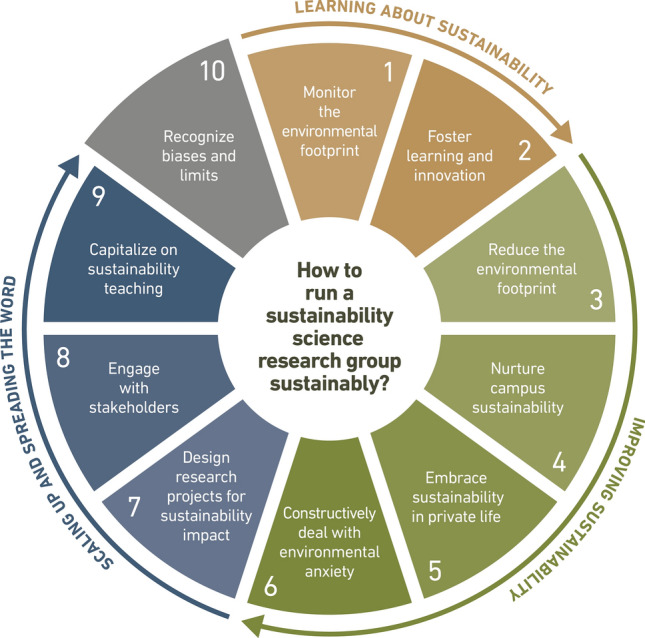
Rigorous sustainability science includes addressing pressing real-world problems, weaving multiple knowledge systems, and striving for transformative change. However, these key attributes of sustainability science often conflict with university structures and established academic work practices, for instance with regard to frequent long-distance travel. Such contradictions between key principles of sustainability and everyday practices are experienced by many researchers not only at university level, but also in their individual behaviors. To help resolve this widespread divergence, we present ten principles to foster the sustainability of a research group working in sustainability science, based on our personal experiences and experiments as research group leaders. These principles comprise: (1) monitor the environmental footprint, (2) foster learning and innovation, (3) reduce the environmental footprint, (4) nurture campus sustainability, (5) embrace sustainability in private life, (6) constructively deal with environmental anxiety, (7) design research projects for sustainability impact, (8) engage with stakeholders, (9) capitalize on sustainability teaching, and (10) recognize biases and limits. Applying sustainability principles in everyday research practices can provide important social tipping points that may trigger the spreading of new social norms and behaviors.
严谨的可持续性科学包括解决紧迫的现实世界问题、融合多种知识体系以及追求变革性变化。然而,可持续性科学的这些关键属性往往与大学结构和既定的学术工作实践相冲突,例如在频繁的长途旅行方面。许多研究人员不仅在大学层面,而且在他们的个人行为中,都经历了可持续性的关键原则与日常实践之间的这种矛盾。为了帮助解决这种普遍存在的分歧,我们根据作为研究小组负责人的个人经验和试验,提出了十条原则,以促进从事可持续性科学研究的小组的可持续性。这些原则包括:(1)监测环境足迹,(2)促进学习和创新,(3)减少环境足迹,(4)培育校园可持续性,(5)在私人生活中践行可持续性,(6)建设性地应对环境焦虑,(7)为可持续性影响设计研究项目,(8)与利益相关者互动,(9)利用可持续性教学,以及(10)认识到偏见和局限性。在日常研究实践中应用可持续性原则可以提供重要的社会转折点,可能引发新的社会规范和行为的传播。