Hefka Blahnova Veronika, Dankova Jana, Rampichova Michala, Filova Eva
Institute of Experimental Medicine, Czech Academy of Sciences, Prague, Czech Republic.
Second Faculty of Medicine, Charles University, Prague, Czech Republic.
Bone Joint Res. 2020 Aug 19;9(7):412-420. doi: 10.1302/2046-3758.97.BJR-2019-0183.R2. eCollection 2020 Jul.
Here we introduce a wide and complex study comparing effects of growth factors used alone and in combinations on human mesenchymal stem cell (hMSC) proliferation and osteogenic differentiation. Certain ways of cell behaviour can be triggered by specific peptides - growth factors, influencing cell fate through surface cellular receptors.
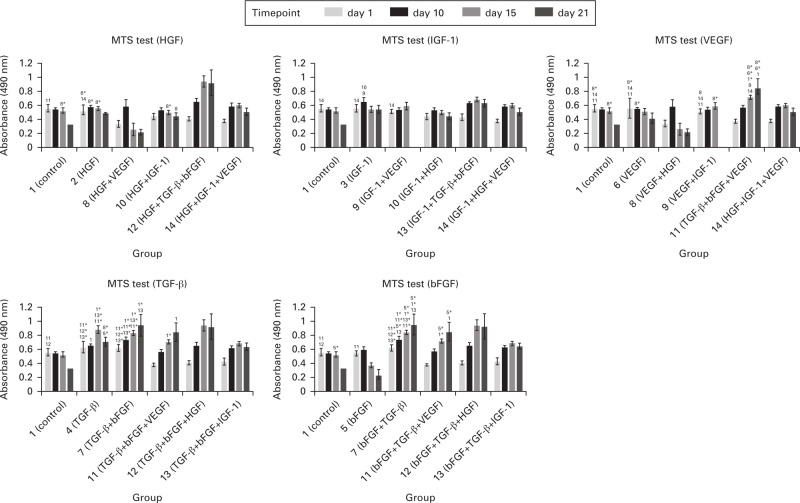
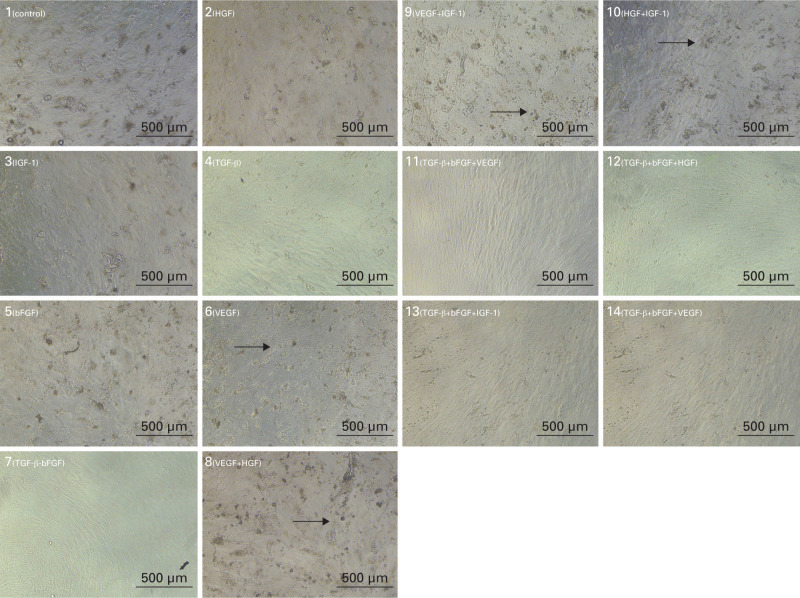
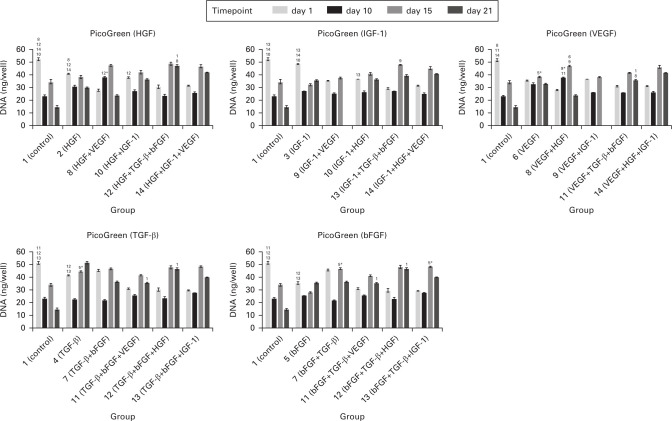
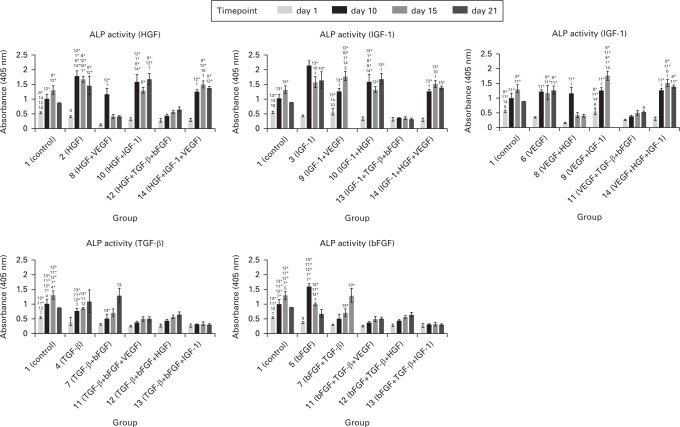
In our study transforming growth factor β (TGF-β), basic fibroblast growth factor (bFGF), hepatocyte growth factor (HGF), insulin-like growth factor 1 (IGF-1), and vascular endothelial growth factor (VEGF) were used in order to induce osteogenesis and proliferation of hMSCs from bone marrow. These cells are naturally able to differentiate into various mesodermal cell lines. Effect of each factor itself is pretty well known. We designed experimental groups where two and more growth factors were combined. We supposed cumulative effect would appear when more growth factors with the same effect were combined. The cellular metabolism was evaluated using MTS assay and double-stranded DNA (dsDNA) amount using PicoGreen assay. Alkaline phosphatase (ALP) activity, as early osteogenesis marker, was observed. Phase contrast microscopy was used for cell morphology evaluation.
TGF-β and bFGF were shown to significantly enhance cell proliferation. VEGF and IGF-1 supported ALP activity. Light microscopy showed initial extracellular matrix mineralization after VEGF/IGF-1 supply.
A combination of more than two growth factors did not support the cellular metabolism level and ALP activity even though the growth factor itself had a positive effect. This is probably caused by interplay of various messengers shared by more growth factor signalling cascades.Cite this article: 2020;9(7):412-420.
在此,我们开展了一项广泛而复杂的研究,比较单独使用和联合使用生长因子对人间充质干细胞(hMSC)增殖和成骨分化的影响。特定的肽——生长因子可触发细胞行为的某些方式,通过细胞表面受体影响细胞命运。
在我们的研究中,使用转化生长因子β(TGF-β)、碱性成纤维细胞生长因子(bFGF)、肝细胞生长因子(HGF)、胰岛素样生长因子1(IGF-1)和血管内皮生长因子(VEGF)来诱导骨髓来源的hMSC成骨和增殖。这些细胞天然能够分化为各种中胚层细胞系。每种因子本身的作用已为人熟知。我们设计了实验组,将两种及以上生长因子联合使用。我们推测,当联合使用更多具有相同作用的生长因子时会出现累积效应。使用MTS法评估细胞代谢,使用PicoGreen法评估双链DNA(dsDNA)含量。观察碱性磷酸酶(ALP)活性,作为早期成骨标志物。使用相差显微镜评估细胞形态。
结果显示,TGF-β和bFGF显著增强细胞增殖。VEGF和IGF-1支持ALP活性。光学显微镜显示,在供应VEGF/IGF-1后出现初始细胞外基质矿化。
即使生长因子本身具有积极作用,但联合使用两种以上生长因子并不能支持细胞代谢水平和ALP活性。这可能是由更多生长因子信号级联共享的各种信使之间的相互作用所致。引用本文:2020;9(7):412-420。