
即使未对运动的肌肉群进行照射,光生物调节疗法联合静磁场(PBMT-sMF)是否能促进提高运动能力的效果?一项随机、三盲、安慰剂对照试验。
Does photobiomodulation therapy combined to static magnetic field (PBMT-sMF) promote ergogenic effects even when the exercised muscle group is not irradiated? A randomized, triple-blind, placebo-controlled trial.
作者信息
Machado Caroline Dos Santos Monteiro, Casalechi Heliodora Leão, Vanin Adriane Aver, de Azevedo Jônatas Bezerra, de Carvalho Paulo de Tarso Camillo, Leal-Junior Ernesto Cesar Pinto
机构信息
Laboratory of Phototherapy and Innovative Technologies in Health (LaPIT), Nove de Julho University, Rua Vergueiro, 235/249, São Paulo, SP 01504-001 Brazil.
Postgraduate Program in Rehabilitation Sciences, Nove de Julho University, São Paulo, SP Brazil.
出版信息
BMC Sports Sci Med Rehabil. 2020 Aug 26;12:49. doi: 10.1186/s13102-020-00197-6. eCollection 2020.
BACKGROUND
The direct application of photobiomodulation therapy (PBMT) using low-level laser therapy (LLLT) and light emitting diodes (LEDs) combined with a static magnetic field (sMF) (PBMT-sMF) to target tissues is shown to improve muscle performance and recovery. Studies have reported possible PBMT effects when a local distant to the target tissue is irradiated. Notably, the extent of these effects on musculoskeletal performance and the optimal site of irradiation remain unclear, although this information is clinically important since these aspects could directly affect the magnitude of the effect. Therefore, we investigated the effects of local and non-local PBMT-sMF irradiations on musculoskeletal performance and post-exercise recovery before an eccentric exercise protocol.
METHODS
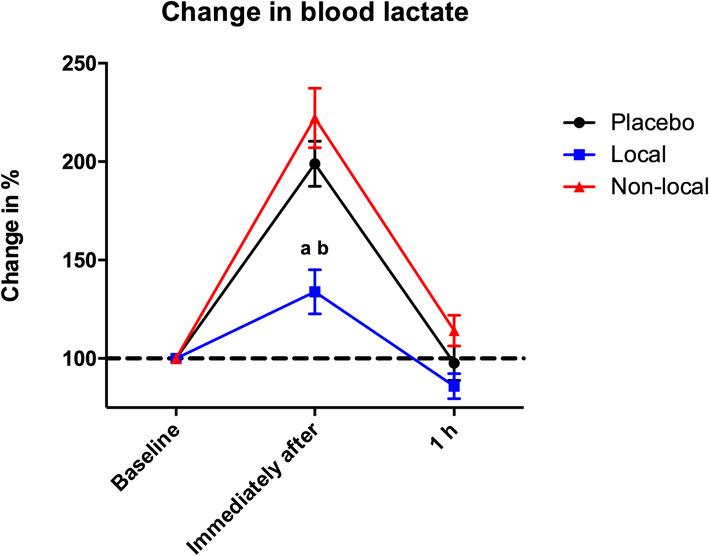
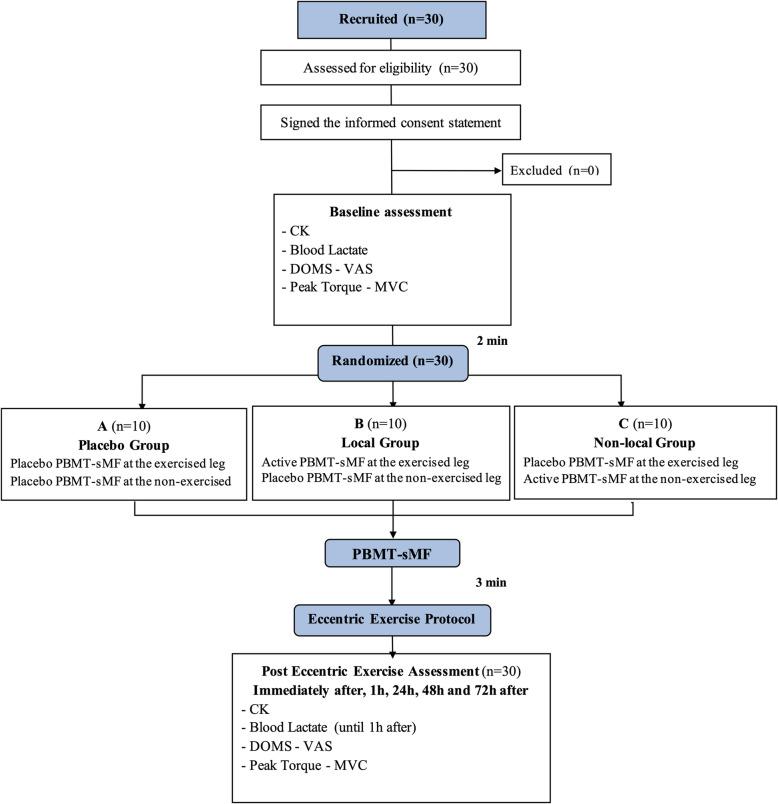
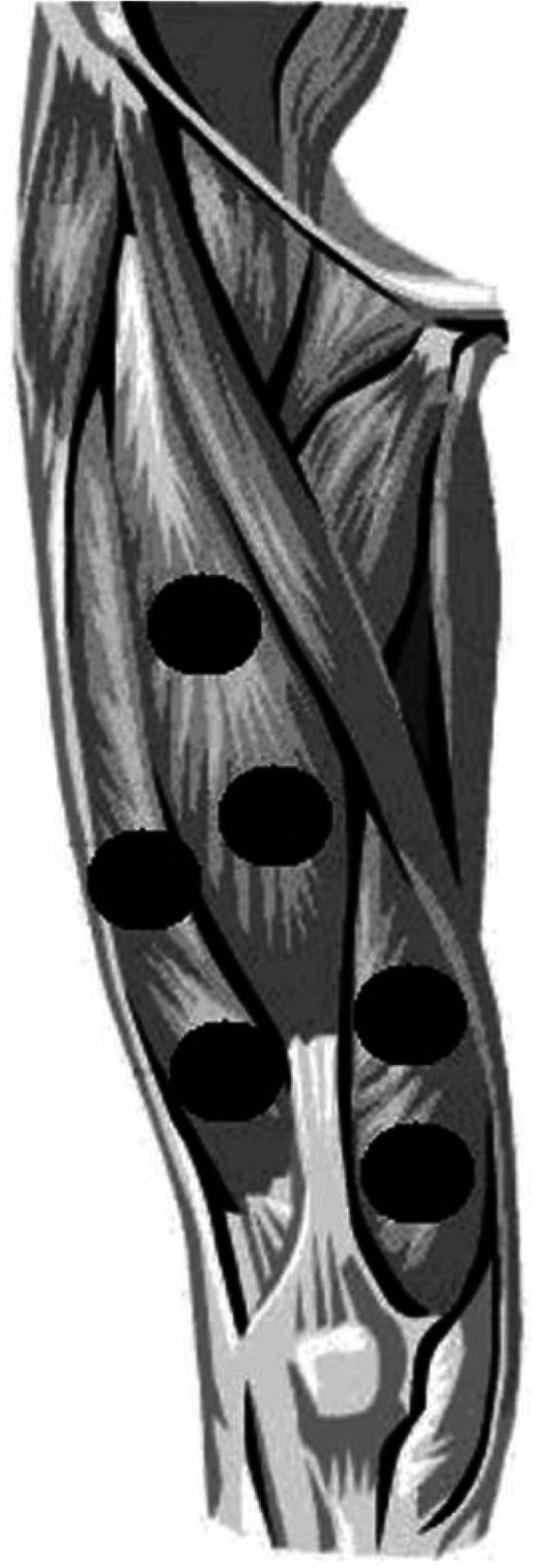
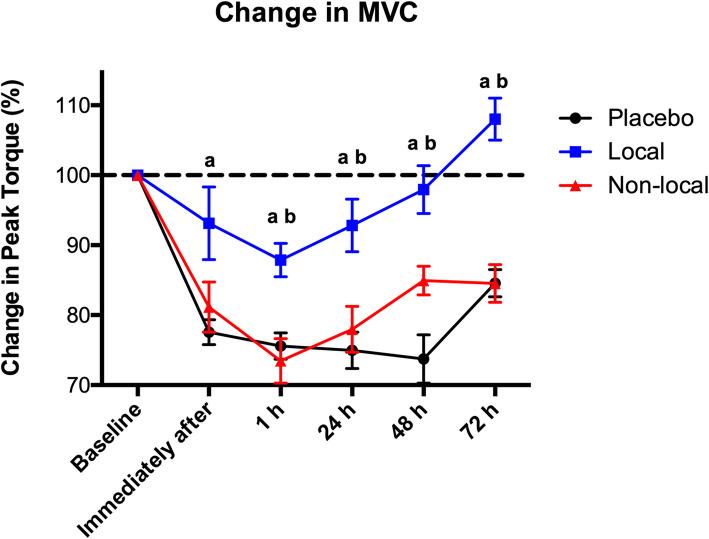
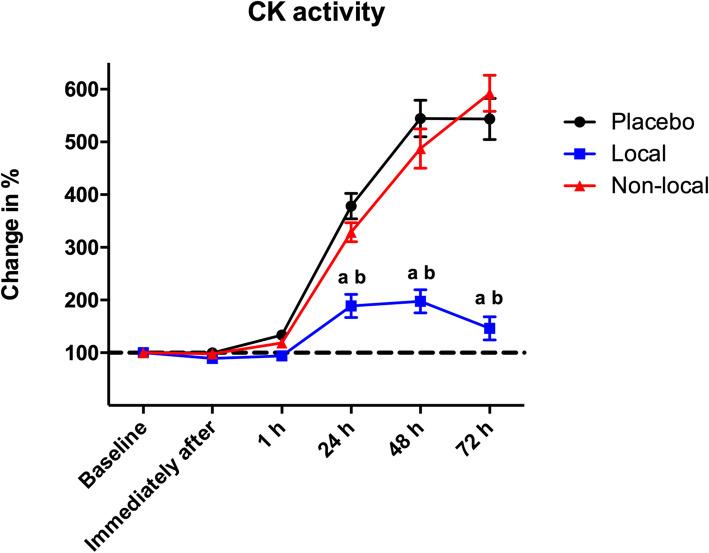
This randomized, triple-blind (participants, therapists and assessors), placebo-controlled trial included 30 healthy male volunteers randomly assigned to the placebo, local, and non-local groups. Active or placebo PBMT-sMF was applied to 6 sites of the quadriceps muscle of both legs. An eccentric exercise protocol was used to induce fatigue. The primary outcome was peak torque assessed by maximal voluntary contraction (MVC). The secondary outcomes were delayed onset muscle soreness (DOMS) measured by visual analogue scale (VAS), muscle injury assessed by serum creatine kinase activity (CK), and blood lactate levels. Evaluations were performed before the eccentric exercise protocol (baseline), as well as immediately after and 1, 24, 48, and 72 h upon protocol completion.
RESULTS
Ten volunteers were randomized per group and analysed for all outcomes. Compared to the placebo and non-local groups, irradiation with PBMT-SMF led to statistically significant improvement ( < 0.05) with regard to all variables in the local group. The outcomes observed in the non-local group were similar to those in the placebo group with regard to all variables.The volunteers did not report any adverse effects.
CONCLUSION
Our results support the current evidence that local irradiation of all exercised muscles promotes ergogenic effects. PBMT-sMF improved performance and reduced muscle fatigue only when applied locally to muscles involved in physical activity.
TRIAL REGISTRATION
NCT03695458. Registered October 04th 2018.
背景
使用低强度激光疗法(LLLT)和发光二极管(LED)结合静磁场(sMF)的光生物调节疗法(PBMT)直接作用于靶组织,已被证明可改善肌肉性能和恢复情况。研究报告称,当对远离靶组织的局部区域进行照射时,可能会产生PBMT效应。值得注意的是,尽管这些信息在临床上很重要,因为这些方面可能直接影响效应的大小,但这些效应在肌肉骨骼性能方面的程度以及最佳照射部位仍不清楚。因此,我们在进行离心运动方案之前,研究了局部和非局部PBMT-sMF照射对肌肉骨骼性能和运动后恢复的影响。
方法
这项随机、三盲(参与者、治疗师和评估者)、安慰剂对照试验纳入了30名健康男性志愿者,他们被随机分配到安慰剂组、局部组和非局部组。对双腿股四头肌的6个部位进行主动或安慰剂PBMT-sMF治疗。采用离心运动方案诱导疲劳。主要结局是通过最大自主收缩(MVC)评估的峰值扭矩。次要结局包括通过视觉模拟量表(VAS)测量的延迟性肌肉酸痛(DOMS)、通过血清肌酸激酶活性(CK)评估的肌肉损伤以及血乳酸水平。在离心运动方案之前(基线)、方案完成后立即以及完成后1、24、48和72小时进行评估。
结果
每组随机分配10名志愿者,并对所有结局进行分析。与安慰剂组和非局部组相比,局部组中PBMT-SMF照射在所有变量方面均导致具有统计学意义的改善(<0.05)。在所有变量方面,非局部组观察到的结局与安慰剂组相似。志愿者未报告任何不良反应。
结论
我们的结果支持当前的证据,即对所有运动肌肉进行局部照射可产生促力效应。PBMT-sMF仅在局部应用于参与体育活动的肌肉时,才能改善性能并减轻肌肉疲劳。
试验注册
NCT03695458。于2018年10月4日注册。
 Zotero 插件