Beijing Key Laboratory of Learning and Cognition, School of Psychology, Capital Normal University, Beijing, China.
CAS Key Laboratory of Mental Health, Institute of Psychology, Chinese Academy of Sciences, Beijing, China; Department of Psychology, University of Chinese Academy of Sciences, Beijing, China.
J Affect Disord. 2020 Dec 1;277:436-442. doi: 10.1016/j.jad.2020.08.035. Epub 2020 Aug 23.
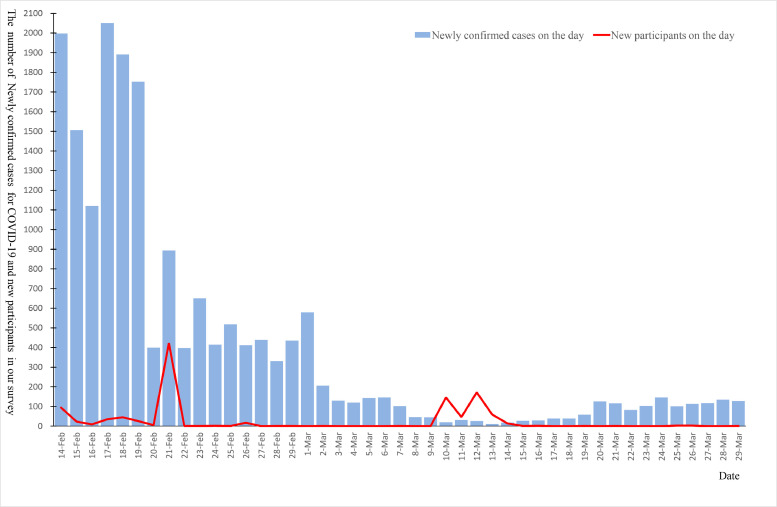
Somatization is a common comorbidity in anxious people. From January 31 to February 2, 2020, a high prevalence of moderate to severe anxiety was detected due to COVID-19 outbreak. The purpose of this study was to investigate the prevalence and correlates of somatization among Chinese participants with anxiety receiving online crisis interventions from Feb 14 to Mar 29 during the COVID-19 epidemic.
A total of 1134 participants who participated in online crisis interventions completed the Generalized Anxiety Disorder-7 (GAD-7) scale and the Symptom Checklist-90 (SCL-90) and demographic questions online. Somatization was defined as the average score of each item ≥ 2 in SCL-90 somatization subscale. Moderate to severe anxiety was defined as a score ≥ 10 in the GAD-7 scale.
Among all participants, 8.0% reported moderate to severe anxiety and 7.4% reported somatization. After March 1, the prevalence of anxiety with or without somatization did not significantly change (both p > 0.05), while the prevalence of somatization increased significantly (p < 0.01). Logistic regression analysis indicated that somatization was associated with chronic disease history (with an odds ratio of 4.80) and female gender (with an odds ratio of 0.33).
Our findings suggest that the history of chronic diseases is associated with somatization in individuals with anxiety, indicating some stress-related mechanisms. Chinese men in crisis intervention need more attention because they are more likely to report anxiety comorbid somatization.
躯体化是焦虑人群中常见的共病。2020 年 1 月 31 日至 2 月 2 日,由于 COVID-19 爆发,中度至重度焦虑的患病率很高。本研究的目的是调查在 COVID-19 流行期间,2 月 14 日至 3 月 29 日期间接受在线危机干预的焦虑症中国参与者中躯体化的患病率及其相关因素。
共有 1134 名参与者参加了在线危机干预,他们在线完成了广泛性焦虑症 7 项量表(GAD-7)和症状清单 90 项(SCL-90)以及人口统计学问题。躯体化被定义为 SCL-90 躯体化子量表中每个项目的平均得分≥2。中度至重度焦虑被定义为 GAD-7 量表得分≥10。
在所有参与者中,8.0%报告中度至重度焦虑,7.4%报告躯体化。3 月 1 日后,无论是否伴有躯体化,焦虑症的患病率均无显著变化(均 p>0.05),而躯体化的患病率显著增加(p<0.01)。逻辑回归分析表明,躯体化与慢性病病史(优势比为 4.80)和女性性别(优势比为 0.33)有关。
我们的研究结果表明,慢性病史与焦虑个体的躯体化有关,表明存在一些与压力相关的机制。接受危机干预的中国男性需要更多关注,因为他们更有可能报告焦虑症伴躯体化。