Yunnan Key Laboratory for Wild Plant Resources, Kunming Institute of Botany, Chinese Academy of Sciences, Kunming, China.
Key Laboratory of Economic Plants and Biotechnology, Kunming Institute of Botany, Chinese Academy of Sciences, Kunming, China.
J Ethnobiol Ethnomed. 2020 Aug 31;16(1):50. doi: 10.1186/s13002-020-00395-z.
Home garden is identified as a kind of small-scale land-use system which is used to manage and cultivate useful plants by local people, and home gardens can provide various plant products and services. Investigating home gardens was regarded as an effective way to understand the biodiversity-related local knowledge and culture of native people in Ethnobiology and Ethnoecology. Home garden is important in less developed and remote areas. The grand canyon of Yarlung Tsangpo is designed as one of the biodiversity hotspots of China, and it is one of the most remote regions of China, because of the rough traffic conditions. The aim of the present study is to collect, record, and document the plants and their local knowledge and functions in the local home gardens, then attempt to answer the question: "why local people selected these plants?"
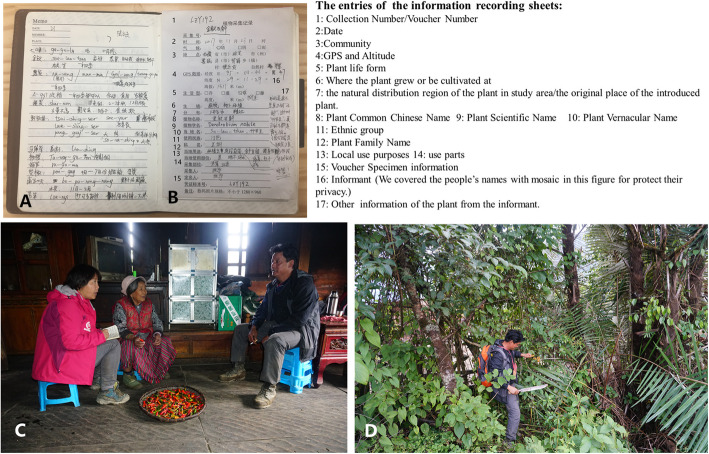
The study area was in Beibeng Township of Motuo County in the grand canyon of Yarlung Tsangpo. Observation and semi-structure interviews with informed consent were used to collect data in field study. All information was collected and organized, then documented based on "ethno-species" as a fundamental unit. All of the information of local use and knowledge were organized as the list of "use-report" for quantitative analysis, and the local uses of plants were merged into 14 use categories. Frequency of citation (FC), relative frequency of citation (RFC), cultural importance index (CI), and cultural value index (CV) were used in quantitative analysis. Besides, the Jaccard Index was used to compare the similarity in plant species selection among different communities.
A total of 78 home gardens in the 9 communities of Beibeng Township were visited, and 196 ethno-species were collected. These ethno-species were identified into 188 Botanical taxa. A total of 87 home garden owners as informants were interviewed in the present study, and they provided 625 use-reports to us. The top 5 important plants were Su-lan-tsao (Dendrobium nobile), Sa-ga (Zingiber officinale), Soe-lu (Capsicum annuum), Snying-pa (Citrus medica), and Kham-pu (Prunus persica), according to the quantitative analysis. The most citied use-category was "vegetable," followed by "ornamental plant," "medicine," and "fruit." The altitude might be the most important impact factor of the plant diversity and composition of home gardens, and the traffic conditions, local terrain, also impact the plant diversity and composition of home gardens.
In remote areas such as the Yarlung Tsangpo Grand Canyon, the plants in home gardens are important sources of plant products such as foods, herbal medicines, and fibers to support daily lives. The local home gardens in Tsang-la communities had high diversity of plants, and these plants provided many functions and services to support daily lives of local people. Local plant knowledge, including the features, life forms, habits, habitats, and use values of plants, were the summary of the understanding of local people to their surrounding plant worlds. Local people selected appropriate plants to cultivate and manage in their home gardens under the guidance of the local plant knowledge. That is the answer to the question "why local people selected these plants?"

家庭园艺被认为是一种小规模的土地利用系统,当地人用它来管理和种植有用的植物,家庭园艺可以提供各种植物产品和服务。调查家庭园艺被认为是了解民族生物学和民族生态学中本地人民与生物多样性相关的本地知识和文化的有效途径。家庭园艺在欠发达和偏远地区很重要。雅鲁藏布大峡谷被设计为中国的生物多样性热点地区之一,也是中国最偏远的地区之一,因为交通条件恶劣。本研究的目的是收集、记录和记录当地家庭花园中的植物及其本地知识和功能,并尝试回答以下问题:“为什么当地人选择这些植物?”
研究区域位于雅鲁藏布大峡谷的墨脱县背崩乡。在实地研究中,使用观察和经知情同意的半结构式访谈来收集数据。所有信息均收集并组织,然后根据“民族物种”作为基本单位进行记录。所有关于当地用途和知识的信息都被组织成“用途报告”列表,进行定量分析,植物的当地用途被合并为 14 个用途类别。使用出现频率(FC)、相对出现频率(RFC)、文化重要性指数(CI)和文化价值指数(CV)进行定量分析。此外,还使用雅卡尔指数比较不同社区中植物选择的相似性。
共访问了背崩乡 9 个社区的 78 个家庭花园,共收集到 196 种民族物种。这些民族物种被鉴定为 188 种植物分类群。本研究共访谈了 87 位作为信息提供者的家庭花园主,他们为我们提供了 625 条用途报告。根据定量分析,最重要的 5 种植物是苏兰草(Dendrobium nobile)、莎草(Zingiber officinale)、索鲁(Capsicum annuum)、思雅帕(Citrus medica)和卡姆普(Prunus persica)。引用最多的用途类别是“蔬菜”,其次是“观赏植物”、“药用植物”和“水果”。海拔高度可能是家庭花园植物多样性和组成的最重要影响因素,交通条件和当地地形也会影响家庭花园的植物多样性和组成。
在雅鲁藏布大峡谷等偏远地区,家庭花园中的植物是食物、草药和纤维等植物产品的重要来源,为日常生活提供支持。藏拉社区的当地家庭花园植物多样性很高,这些植物为当地人民的日常生活提供了许多功能和服务。当地植物知识,包括植物的特征、生活形态、习性、栖息地和使用价值,是当地人对周围植物世界的理解的总结。当地人在当地植物知识的指导下,选择在家庭花园中种植和管理合适的植物。这就是“为什么当地人选择这些植物?”这个问题的答案。