Centre for Interdisciplinary Research Education and Innovation in Health Systems (IRIS), School of Nursing, Midwifery and Health Systems, University College Dublin, Dublin, Ireland.
School of Allied Health, Faculty of Education and Health Sciences, University of Limerick, Limerick, Ireland.
Health Expect. 2020 Dec;23(6):1388-1411. doi: 10.1111/hex.13122. Epub 2020 Sep 1.
As chronic illnesses, such as rheumatoid arthritis (RA), place an increased burden on health-care systems, the ability of individuals to self-manage these diseases is crucial.
To identify and synthesize the lived experience of self-management described by adults living with RA.
A systematic search of five electronic databases (MEDLINE, CINAHL, EMBASE, PsycINFO and ASSIA) was undertaken to identify relevant studies. Data were extracted and quality-assessed using CASP guidelines. A meta-synthesis was conducted based on Thomas and Harden's thematic synthesis approach.
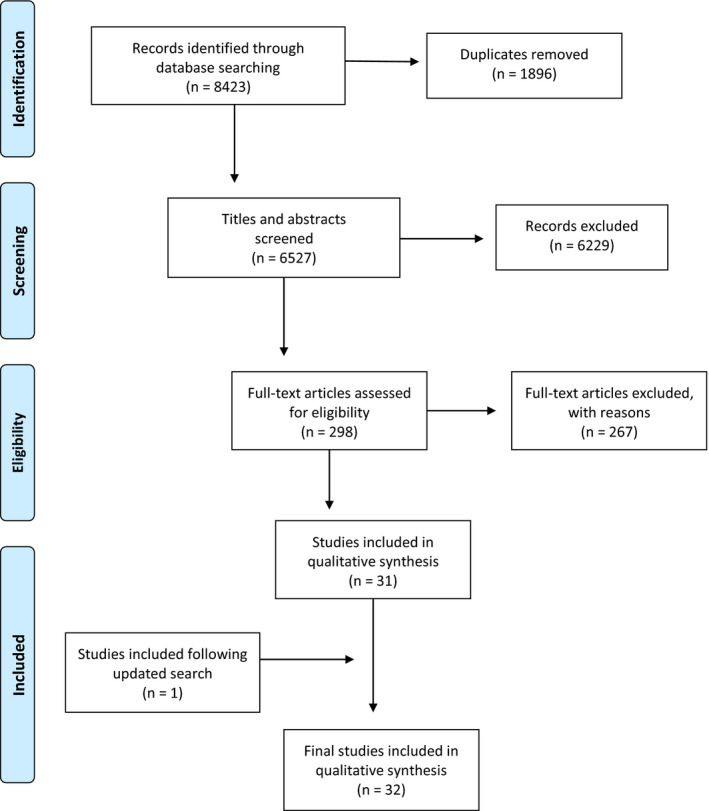
The search identified 8423 publications. After removing duplicates, 6527 records remained of which 32 studies met the inclusion criteria. Quality of studies was moderate to high, yet a considerable lack of reflection on researcher bias was evident. Our analysis identified 28 dimensions of self-management RA across six domains: (a) cognitive-emotional, (b) behavioural, (c) social, (d) environmental, (e) physical and (f) technological. Cognitive-emotional experiences dominated the analysis. Renegotiating 'the self' (self-concept, self-esteem, self-efficacy) was a key focus of self-management among individuals with RA.
Our findings highlight the focus of 'the self' as a central concern in the self-management of RA. Standardized self-management programmes may primarily focus on disease management and daily functioning. However, we suggest that personal biographies and circumstances should move to the fore of self-management support.
PROSPERO International Prospective Register of Systematic Reviews 2018: CRD42018100450.
Patient and public involvement was not explicit in this review. However, three authors provided a patient perspective on the self-management of arthritis and autoimmune disease.
随着类风湿关节炎(RA)等慢性病给医疗保健系统带来的负担不断增加,个人自我管理这些疾病的能力至关重要。
确定并综合描述成年人 RA 自我管理的真实体验。
对五个电子数据库(MEDLINE、CINAHL、EMBASE、PsycINFO 和 ASSIA)进行系统检索,以确定相关研究。使用 CASP 指南提取和评估数据。基于托马斯和哈顿的主题综合方法进行元综合。
搜索确定了 8423 篇出版物。去除重复项后,剩余 6527 条记录,其中 32 项研究符合纳入标准。研究质量为中等至较高,但明显缺乏对研究人员偏见的反思。我们的分析确定了六个领域中 RA 自我管理的 28 个维度:(a)认知情感,(b)行为,(c)社会,(d)环境,(e)身体和(f)技术。认知情感体验在分析中占主导地位。RA 患者自我管理的一个关键焦点是重新协商“自我”(自我概念、自尊、自我效能感)。
我们的研究结果强调了“自我”作为 RA 自我管理的核心关注点。标准化的自我管理计划可能主要侧重于疾病管理和日常功能。然而,我们建议个人传记和情况应该成为自我管理支持的重点。
PROSPERO 国际前瞻性系统评价注册中心 2018 年:CRD42018100450。
本综述未明确患者和公众参与。然而,三位作者从关节炎和自身免疫性疾病的自我管理角度提供了患者观点。