Neurosciences Graduate Program, Stanford University, Stanford, CA 94305.
Department of Educational Psychology, Neag School of Education, University of Connecticut, Storrs, CT 06269.
CBE Life Sci Educ. 2020 Sep;19(3):fe5. doi: 10.1187/cbe.20-05-0106.
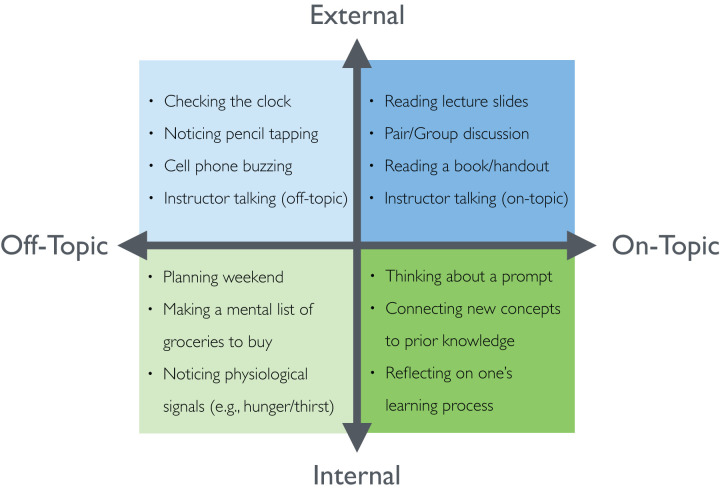
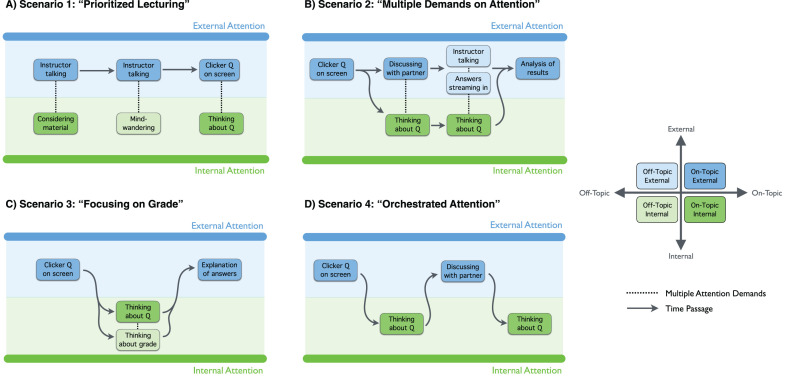
Attention is thought to be the gateway between information and learning, yet there is much we do not understand about how students pay attention in the classroom. Leveraging ideas from cognitive neuroscience and psychology, we explore a framework for understanding attention in the classroom, organized along two key dimensions: internal/external attention and on-topic/off-topic attention. This framework helps us to build new theories for why active-learning strategies are effective teaching tools and how synchronized brain activity across students in a classroom may support learning. These ideas suggest new ways of thinking about how attention functions in the classroom and how different approaches to the same active-learning strategy may vary in how effectively they direct students' attention. We hypothesize that some teaching approaches are more effective than others because they leverage natural fluctuations in students' attention. We conclude by discussing implications for teaching and opportunities for future research.
注意被认为是信息和学习之间的门户,但我们对学生在课堂上如何集中注意力知之甚少。本研究借鉴认知神经科学和心理学的观点,探讨了理解课堂注意力的框架,该框架沿两个关键维度组织:内部/外部注意和主题内/主题外注意。该框架帮助我们构建新的理论,解释为什么主动学习策略是有效的教学工具,以及课堂上学生的大脑活动如何同步支持学习。这些想法为我们思考注意力在课堂中的作用以及同一主动学习策略的不同方法在引导学生注意力方面的有效性提供了新的思路。我们假设,一些教学方法比其他方法更有效,因为它们利用了学生注意力的自然波动。最后,我们讨论了对教学的启示和未来研究的机会。