Melbourne School of Psychological Sciences, University of Melbourne, Parkville, Victoria, Australia.
Queensland Brain Institute, University of Queensland, St Lucia, Queensland, Australia.
Hum Brain Mapp. 2020 Dec 15;41(18):5151-5163. doi: 10.1002/hbm.25181. Epub 2020 Sep 1.
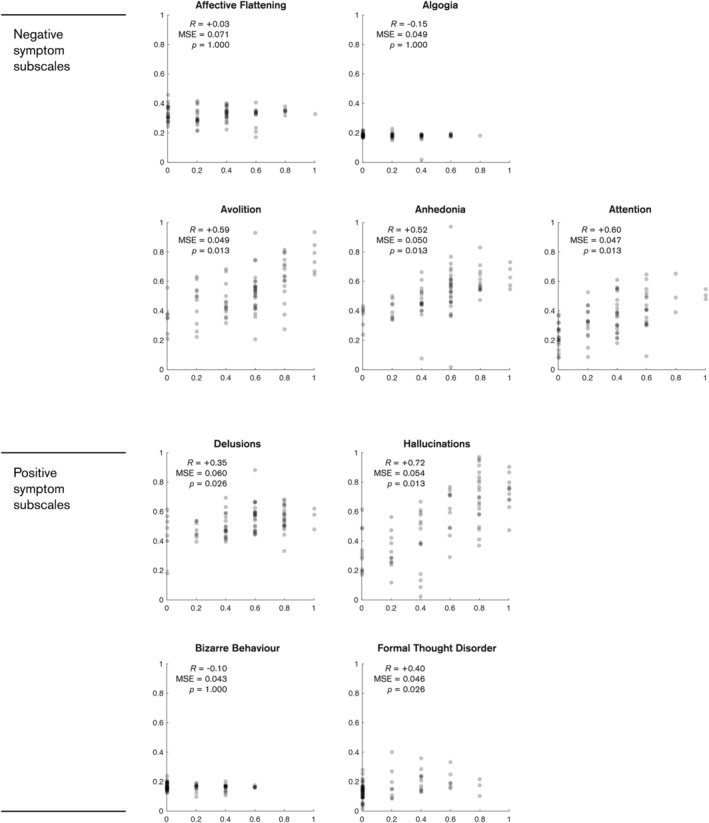
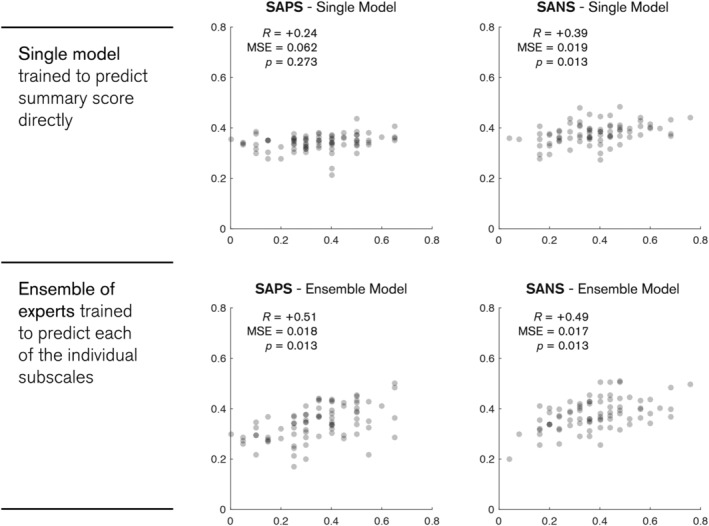
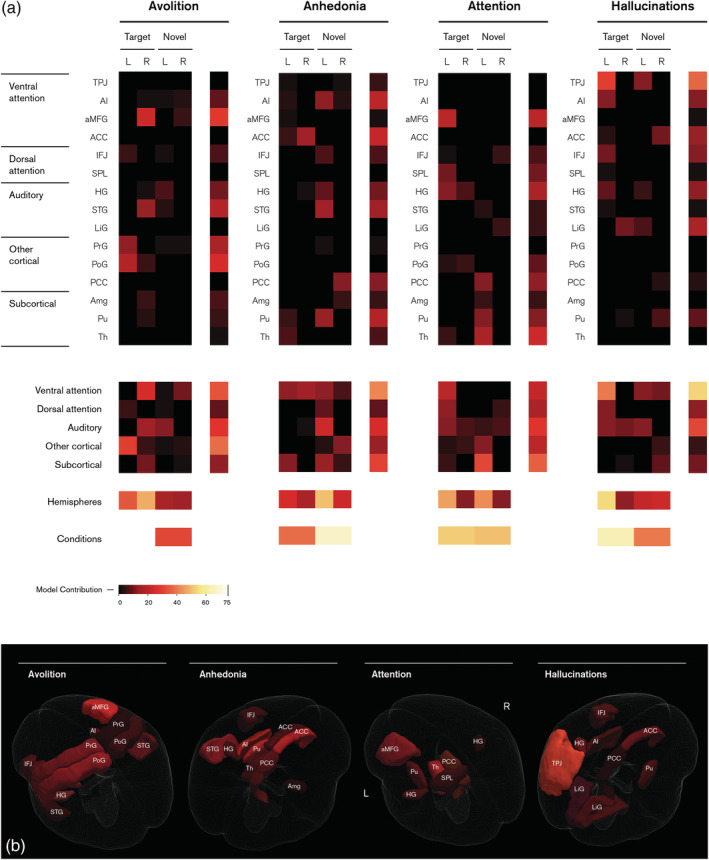
The diagnostic criteria for schizophrenia comprise a diverse range of heterogeneous symptoms. As a result, individuals each present a distinct set of symptoms despite having the same overall diagnosis. Whilst previous machine learning studies have primarily focused on dichotomous patient-control classification, we predict the severity of each individual symptom on a continuum. We applied machine learning regression within a multi-modal fusion framework to fMRI and behavioural data acquired during an auditory oddball task in 80 schizophrenia patients. Brain activity was highly predictive of some, but not all symptoms, namely hallucinations, avolition, anhedonia and attention. Critically, each of these symptoms was associated with specific functional alterations across different brain regions. We also found that modelling symptoms as an ensemble of subscales was more accurate, specific and informative than models which predict compound scores directly. In principle, this approach is transferrable to any psychiatric condition or multi-dimensional diagnosis.
精神分裂症的诊断标准包含了多种多样的异质症状。因此,尽管具有相同的总体诊断,每个人呈现的症状也各不相同。虽然之前的机器学习研究主要集中在二分类的患者-对照分类上,但我们预测每个个体症状在连续体上的严重程度。我们在 fMRI 和行为数据的多模态融合框架内应用机器学习回归,这些数据是在 80 名精神分裂症患者进行听觉Oddball 任务期间获得的。大脑活动对某些但不是所有症状(即幻觉、意志缺乏、快感缺失和注意力)具有高度预测性。至关重要的是,这些症状中的每一个都与不同大脑区域的特定功能改变有关。我们还发现,将症状建模为子量表的集合比直接预测复合分数的模型更准确、更具体、更具信息量。原则上,这种方法可以转移到任何精神疾病或多维诊断。