Centre for Medical Image Computing and Artificial Intelligence, University College London, London, United Kingdom; Institute of Cognitive Neuroscience, University College London, London, United Kingdom; Max Planck-UCL Centre for Computational Psychiatry and Ageing Research, London, United Kingdom; Department of Psychiatry, Yale University School of Medicine, New Haven, Connecticut.
Centre for Mathematical Neuroscience and Psychology and Department of Psychology, City University of London, London, United Kingdom; Picower Institute for Learning & Memory and Department of Brain and Cognitive Sciences, Massachusetts Institute of Technology, Cambridge, Massachusetts.
Biol Psychiatry. 2022 Jan 15;91(2):202-215. doi: 10.1016/j.biopsych.2021.07.024. Epub 2021 Aug 10.
Diminished synaptic gain-the sensitivity of postsynaptic responses to neural inputs-may be a fundamental synaptic pathology in schizophrenia. Evidence for this is indirect, however. Furthermore, it is unclear whether pyramidal cells or interneurons (or both) are affected, or how these deficits relate to symptoms.
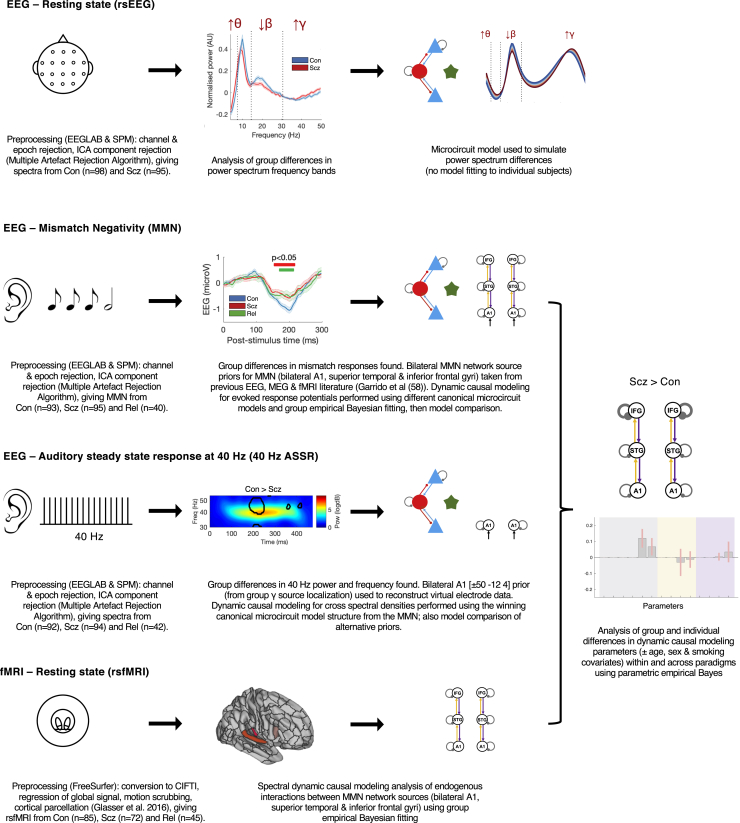
People with schizophrenia diagnoses (PScz) (n = 108), their relatives (n = 57), and control subjects (n = 107) underwent 3 electroencephalography (EEG) paradigms-resting, mismatch negativity, and 40-Hz auditory steady-state response-and resting functional magnetic resonance imaging. Dynamic causal modeling was used to quantify synaptic connectivity in cortical microcircuits.
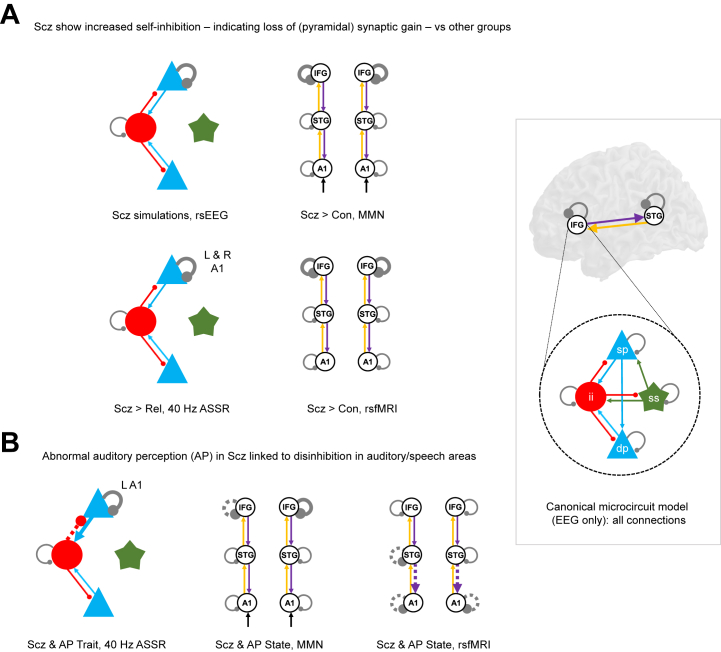
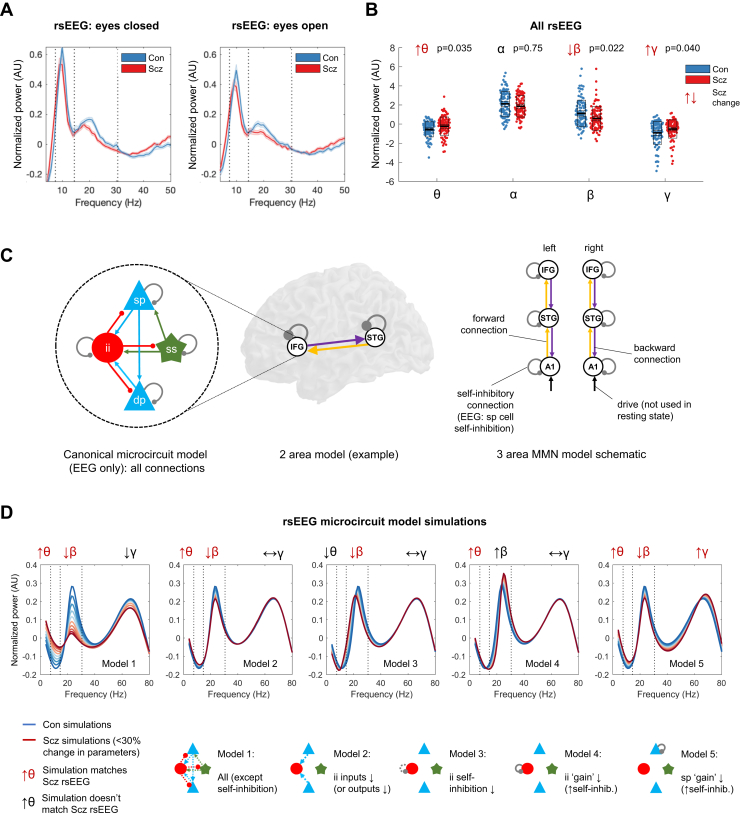
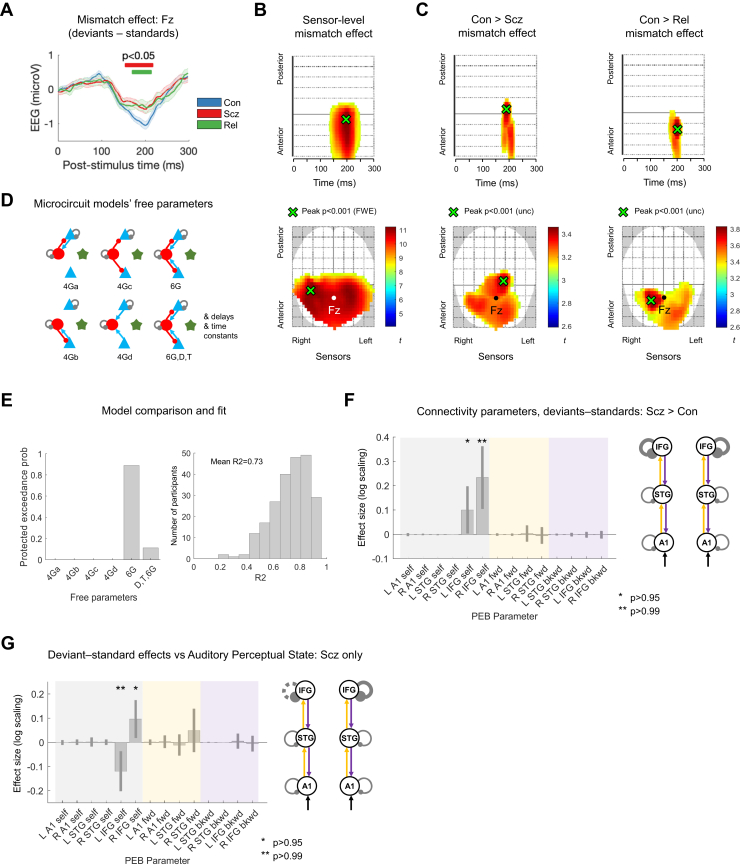
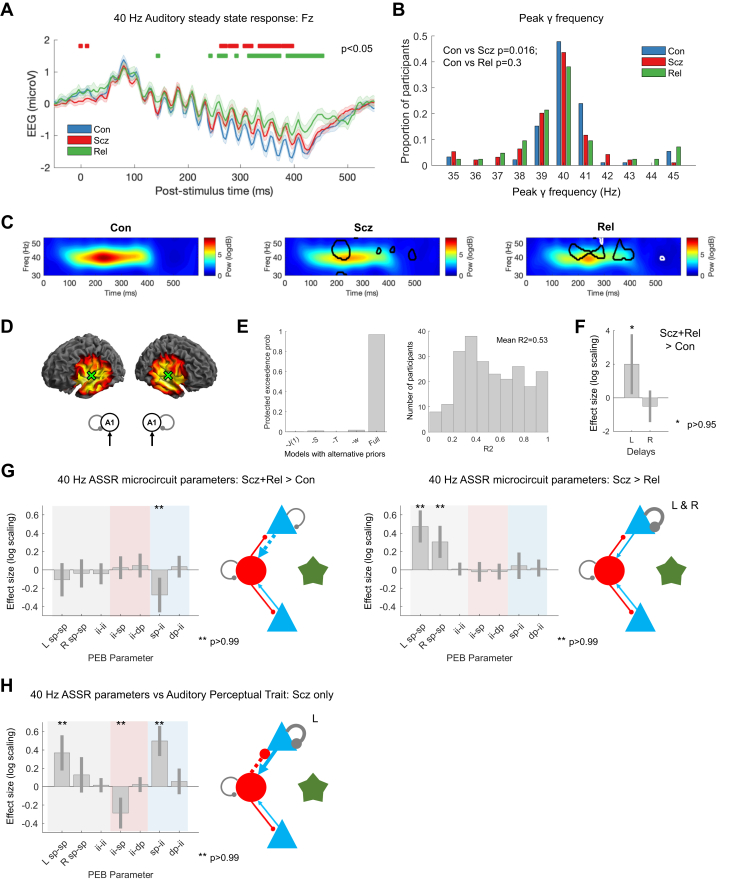
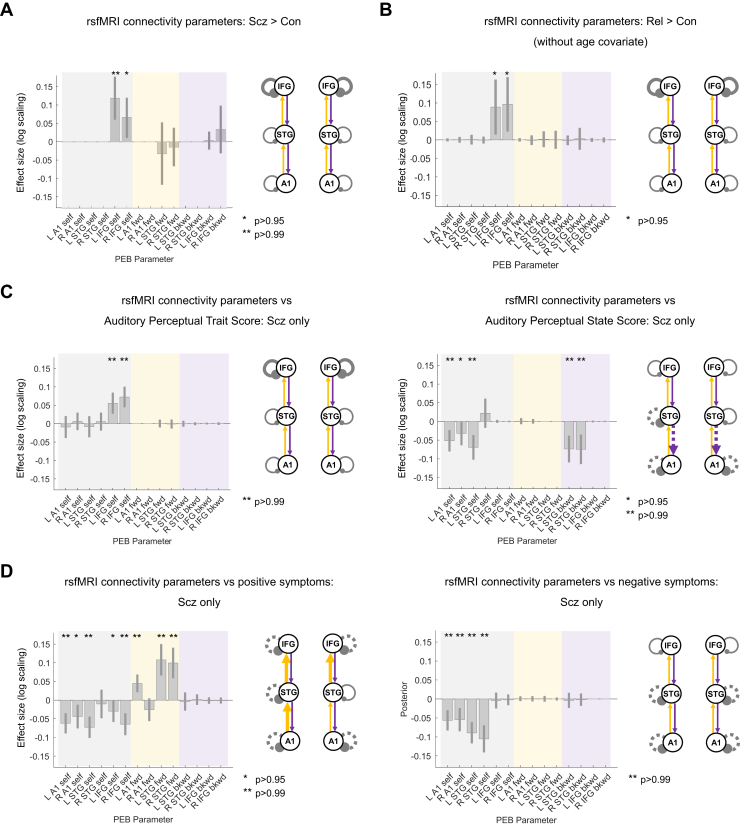
Classic group differences in EEG features between PScz and control subjects were replicated, including increased theta and other spectral changes (resting EEG), reduced mismatch negativity, and reduced 40-Hz power. Across all 4 paradigms, characteristic PScz data features were all best explained by models with greater self-inhibition (decreased synaptic gain) in pyramidal cells. Furthermore, disinhibition in auditory areas predicted abnormal auditory perception (and positive symptoms) in PScz in 3 paradigms.
First, characteristic EEG changes in PScz in 3 classic paradigms are all attributable to the same underlying parameter change: greater self-inhibition in pyramidal cells. Second, psychotic symptoms in PScz relate to disinhibition in neural circuits. These findings are more commensurate with the hypothesis that in PScz, a primary loss of synaptic gain on pyramidal cells is then compensated by interneuron downregulation (rather than the converse). They further suggest that psychotic symptoms relate to this secondary downregulation.
突触传递效能降低——即突触后反应对神经输入的敏感性降低——可能是精神分裂症的基本突触病理学。然而,目前这方面的证据仍不充分。此外,尚不清楚是锥体神经元还是中间神经元(或两者都有)受到了影响,以及这些缺陷与症状之间的关系如何。
精神分裂症患者(PScz)(n=108)、他们的亲属(n=57)和对照组受试者(n=107)接受了 3 项脑电图(EEG)范式——静息、失匹配负波和 40-Hz 听觉稳态反应——以及静息功能磁共振成像。动态因果建模用于量化皮质微电路中的突触连接。
PScz 与对照组受试者之间在 EEG 特征上的经典组间差异得到了复制,包括θ波和其他频谱变化增加(静息 EEG)、失匹配负波减少和 40-Hz 功率减少。在所有 4 个范式中,PScz 数据的特征均最好由锥体神经元中自抑制(突触传递效能降低)增加的模型来解释。此外,听觉区域的去抑制可预测 PScz 在 3 个范式中的异常听觉感知(和阳性症状)。
首先,PScz 在 3 个经典范式中的特征性 EEG 变化均可归因于相同的潜在参数变化:锥体神经元中的自抑制增加。其次,PScz 的精神病症状与神经回路的去抑制有关。这些发现与以下假设更为一致,即 PScz 中,锥体神经元上的突触传递效能首先降低,然后通过中间神经元下调来补偿(而不是相反)。它们进一步表明,精神病症状与这种二级下调有关。