Meinig School of Biomedical Engineering, Cornell University, Ithaca, NY, USA.
Department of Internal Medicine, Weill Cornell Medicine, New York, NY, USA.
Nat Commun. 2020 Sep 1;11(1):4379. doi: 10.1038/s41467-020-18164-7.
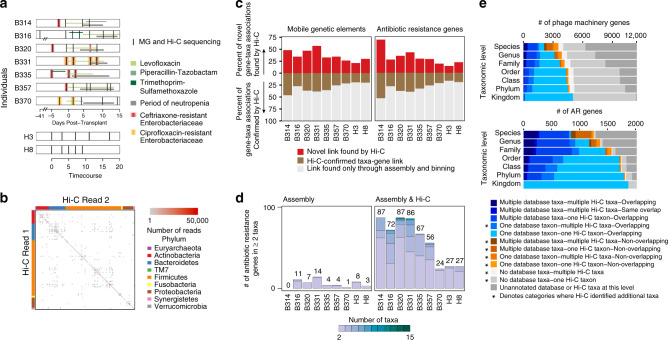
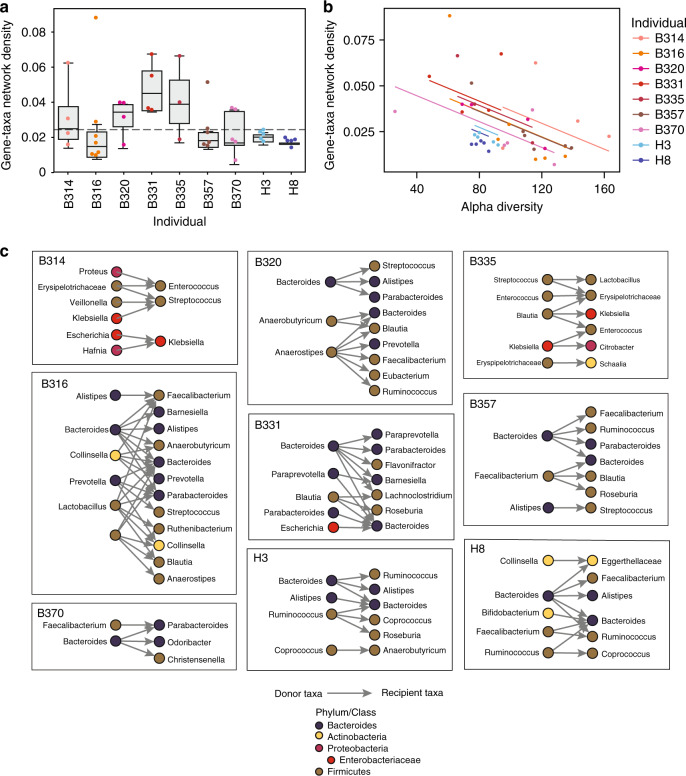
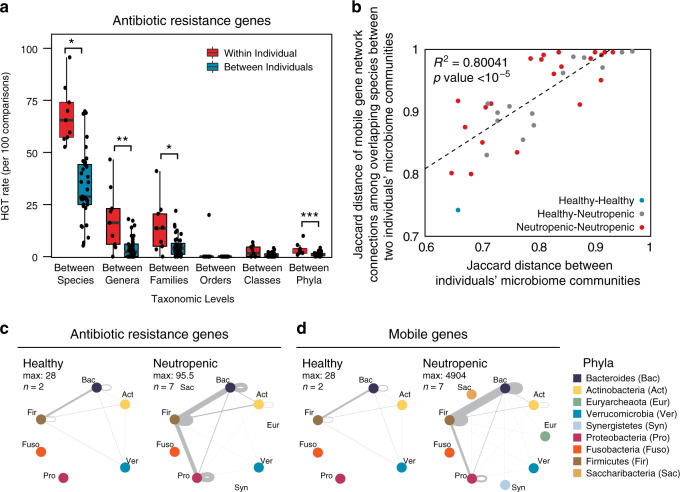
The gut microbiome harbors a 'silent reservoir' of antibiotic resistance (AR) genes that is thought to contribute to the emergence of multidrug-resistant pathogens through horizontal gene transfer (HGT). To counteract the spread of AR, it is paramount to know which organisms harbor mobile AR genes and which organisms engage in HGT. Despite methods that characterize the overall abundance of AR genes in the gut, technological limitations of short-read sequencing have precluded linking bacterial taxa to specific mobile genetic elements (MGEs) encoding AR genes. Here, we apply Hi-C, a high-throughput, culture-independent method, to surveil the bacterial carriage of MGEs. We compare two healthy individuals with seven neutropenic patients undergoing hematopoietic stem cell transplantation, who receive multiple courses of antibiotics, and are acutely vulnerable to the threat of multidrug-resistant infections. We find distinct networks of HGT across individuals, though AR and mobile genes are associated with more diverse taxa within the neutropenic patients than the healthy subjects. Our data further suggest that HGT occurs frequently over a several-week period in both cohorts. Whereas most efforts to understand the spread of AR genes have focused on pathogenic species, our findings shed light on the role of the human gut microbiome in this process.
肠道微生物组蕴藏着一个“沉默的抗生素耐药(AR)基因库”,这些基因被认为通过水平基因转移(HGT)促进了多药耐药病原体的出现。为了遏制 AR 的传播,了解哪些生物体携带可移动的 AR 基因以及哪些生物体参与 HGT 至关重要。尽管有方法可以描述肠道中 AR 基因的总体丰度,但短读测序的技术限制使得无法将细菌分类群与编码 AR 基因的特定移动遗传元件(MGE)联系起来。在这里,我们应用 Hi-C 这一高通量、非培养依赖的方法来监测 MGE 在细菌中的携带情况。我们比较了两名健康个体和七名接受造血干细胞移植的中性粒细胞减少症患者,这些患者接受了多次抗生素治疗,并且极易受到多药耐药感染的威胁。我们发现个体之间存在不同的 HGT 网络,尽管 AR 和可移动基因与中性粒细胞减少症患者中的更多多样化的分类群相关,而不是与健康个体相关。我们的数据进一步表明,在两个队列中,HGT 都经常发生在数周的时间内。虽然大多数理解 AR 基因传播的努力都集中在致病物种上,但我们的发现揭示了人类肠道微生物组在这一过程中的作用。