Kaushal Navin, Keith NiCole, Aguiñaga Susan, Hagger Martin S
School of Health & Human Sciences, Department of Health Sciences, Indiana University, Indianapolis, IN 47405, USA.
School of Health & Human Sciences, Department of Kinesiology, Indiana University, Indianapolis, IN 47405, USA.
Behav Sci (Basel). 2020 Aug 31;10(9):133. doi: 10.3390/bs10090133.
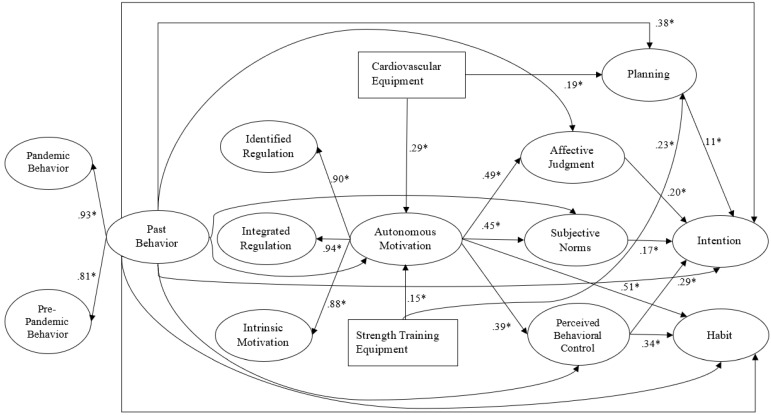
'Shelter in place' and 'lockdown' orders implemented to minimize the spread of COVID-19 have reduced opportunities to be physically active. For many, the home environment emerged as the only viable option to participate in physical activity. Previous research suggests that availability of exercise equipment functions as a determinant of home-based physical activity participation among the general adult population. The purpose of this study was to use a socioecological framework to investigate how the availability of exercise equipment at home predicts behavioral decisions, namely, intention, planning, and habits with respect to participation in physical activity. Participants ( = 429) were adults recruited in U.S. states subject to lockdown orders during the pandemic who completed measures online. A structural equation model indicated that availability of cardiovascular and strength training equipment predicted physical activity planning. Social cognition constructs mediated the relationship between each type of exercise equipment and intentions. Autonomous motivation and perceived behavioral control were found to mediate the relationship between each type of exercise equipment and habit. The availability of large cardiovascular and strength training equipment demonstrated significant predictive effects with intention, planning, habit, and autonomous motivation. Facilitating these constructs for home-based physical activity interventions could be efficacious for promoting physical activity.
为尽量减少新冠病毒传播而实施的“就地避难”和“封锁”命令减少了人们进行体育活动的机会。对许多人来说,家庭环境成为参与体育活动的唯一可行选择。先前的研究表明,健身器材的可获得性是普通成年人群参与家庭体育活动的一个决定因素。本研究的目的是使用社会生态框架来调查家中健身器材的可获得性如何预测行为决策,即参与体育活动的意图、计划和习惯。参与者(n = 429)是在疫情期间受封锁命令影响的美国各州招募的成年人,他们通过在线方式完成各项测量。结构方程模型表明,心血管和力量训练器材的可获得性预测了体育活动计划。社会认知结构介导了每种类型健身器材与意图之间的关系。发现自主动机和感知行为控制介导了每种类型健身器材与习惯之间的关系。大型心血管和力量训练器材的可获得性对意图、计划、习惯和自主动机具有显著的预测作用。为家庭体育活动干预促进这些结构可能对促进体育活动有效。