Department of Mathematics and Mathematical Statistics, Umeå University, Linneaus väg 49, Umeå, SE-901 87, Sweden.
Department of Forest Ecology and Management, Swedish University of Agricultural Sciences, Skogsmarksgränd 17, SE-901 83 Umeå, Sweden.
Tree Physiol. 2021 Jan 9;41(1):1-11. doi: 10.1093/treephys/tpaa110.
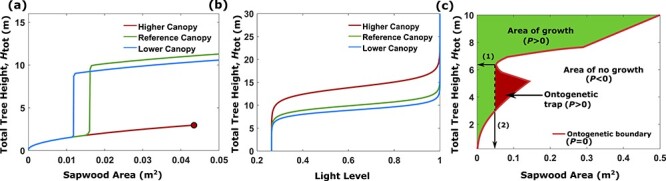
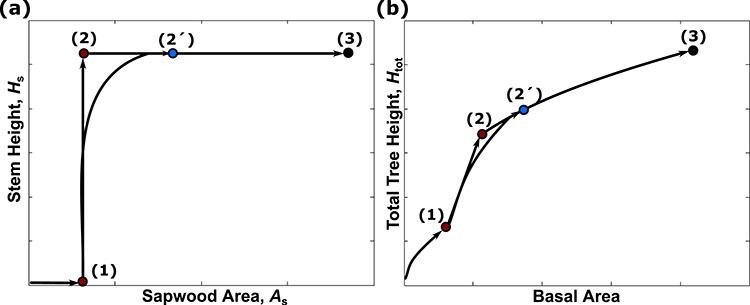
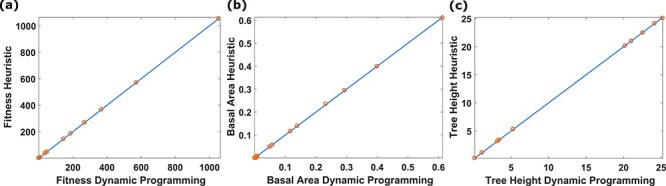
For trees in forests, striving for light is matter of life and death, either by growing taller toward brighter conditions or by expanding the crown to capture more of the available light. Here, we present a mechanistic model for the development path of stem height and crown size, accounting for light capture and growth, as well as mortality risk. We determine the optimal growth path among all possible trajectories using dynamic programming. The optimal growth path follows a sequence of distinct phases: (i) initial crown size expansion, (ii) stem height growth toward the canopy, (iii) final expansion of the crown in the canopy and (iv) seed production without further increase in size. The transition points between these phases can be optimized by maximizing fitness, defined as expected lifetime reproductive production. The results imply that to reach the canopy in an optimal way, trees must consider the full profile of expected increasing light levels toward the canopy. A shortsighted maximization of growth based on initial light conditions can result in arrested height growth, preventing the tree from reaching the canopy. The previous result can explain canopy stratification, and why canopy species often get stuck at a certain size under a shading canopy. The model explains why trees with lower wood density have a larger diameter at a given tree height and grow taller than trees with higher wood density. The model can be used to implement plasticity in height versus diameter growth in individual-based vegetation and forestry models.
对于森林中的树木来说,争取更多的阳光是生死攸关的事情,要么通过向更明亮的条件生长更高,要么通过扩大树冠来捕捉更多可用的光线。在这里,我们提出了一个用于解释茎高和树冠大小发育路径的机械模型,该模型考虑了光捕获和生长以及死亡率风险。我们使用动态规划来确定所有可能轨迹中的最佳生长路径。最优生长路径遵循一系列不同的阶段:(i)初始树冠大小扩展,(ii)向树冠生长的茎高,(iii)树冠在树冠中的最终扩展,以及(iv)无需进一步增大尺寸即可进行种子生产。通过最大化适应度(定义为预期寿命生殖产量)可以优化这些阶段之间的过渡点。结果表明,为了以最佳方式到达树冠,树木必须考虑到树冠中预期光照水平的完整分布。基于初始光照条件的短视生长最大化可能导致生长停止,从而阻止树木到达树冠。先前的结果可以解释树冠分层,以及为什么在遮荫树冠下,冠层物种通常会被困在一定的大小。该模型解释了为什么木材密度较低的树木在给定的树高上具有更大的直径,并且比木材密度较高的树木长得更高。该模型可用于在个体植被和林业模型中实现高度与直径生长之间的可塑性。