Department of Ecology and Evolutionary Biology, Princeton University, Princeton, New Jersey, United States of America.
PLoS One. 2007 Sep 12;2(9):e870. doi: 10.1371/journal.pone.0000870.
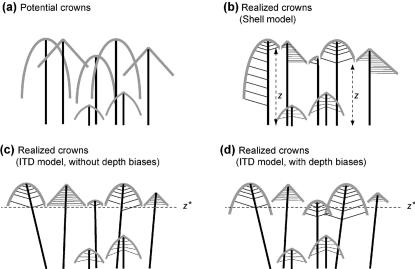
Canopy structure, which can be defined as the sum of the sizes, shapes and relative placements of the tree crowns in a forest stand, is central to all aspects of forest ecology. But there is no accepted method for deriving canopy structure from the sizes, species and biomechanical properties of the individual trees in a stand. Any such method must capture the fact that trees are highly plastic in their growth, forming tessellating crown shapes that fill all or most of the canopy space.
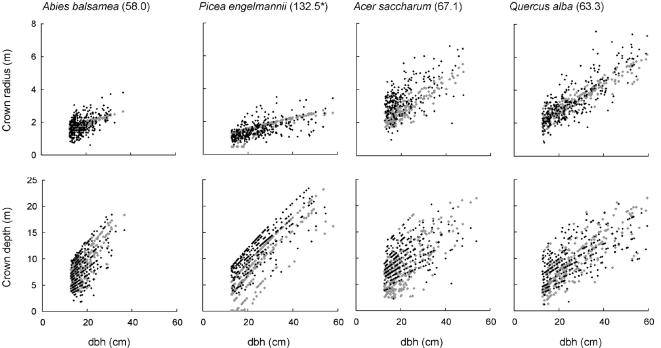
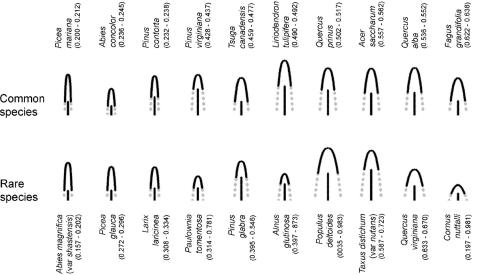
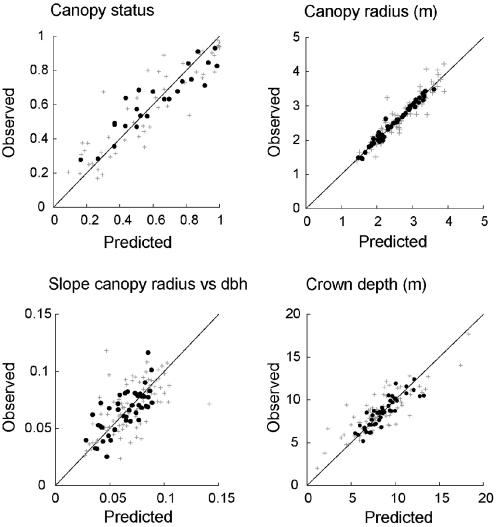
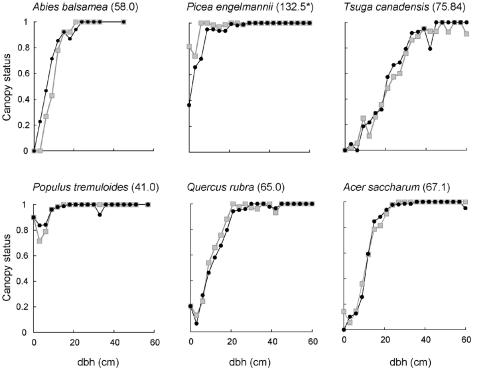
METHODOLOGY/PRINCIPAL FINDINGS: We introduce a new, simple and rapidly-implemented model--the Ideal Tree Distribution, ITD--with tree form (height allometry and crown shape), growth plasticity, and space-filling, at its core. The ITD predicts the canopy status (in or out of canopy), crown depth, and total and exposed crown area of the trees in a stand, given their species, sizes and potential crown shapes. We use maximum likelihood methods, in conjunction with data from over 100,000 trees taken from forests across the coterminous US, to estimate ITD model parameters for 250 North American tree species. With only two free parameters per species--one aggregate parameter to describe crown shape, and one parameter to set the so-called depth bias--the model captures between-species patterns in average canopy status, crown radius, and crown depth, and within-species means of these metrics vs stem diameter. The model also predicts much of the variation in these metrics for a tree of a given species and size, resulting solely from deterministic responses to variation in stand structure.
CONCLUSIONS/SIGNIFICANCE: This new model, with parameters for US tree species, opens up new possibilities for understanding and modeling forest dynamics at local and regional scales, and may provide a new way to interpret remote sensing data of forest canopies, including LIDAR and aerial photography.
林冠结构可以定义为林分中树冠的大小、形状和相对位置的总和,是森林生态学的各个方面的核心。但是,目前还没有一种方法可以从林分中树木的大小、物种和生物力学特性中推导出林冠结构。任何这样的方法都必须考虑到树木在生长过程中具有高度的可塑性,形成镶嵌的树冠形状,从而填满或大部分填满树冠空间。
方法/主要发现:我们引入了一种新的、简单且快速实现的模型——理想树木分布(Ideal Tree Distribution,ITD),其核心是树木形态(高度异速生长和树冠形状)、生长可塑性和空间填充。ITD 可以预测林分中树木的树冠状态(在树冠内或树冠外)、树冠深度以及总树冠面积和暴露树冠面积,前提是已知其物种、大小和潜在树冠形状。我们使用最大似然法,结合来自美国大陆各地森林的超过 100,000 棵树木的数据,来估计 250 种北美树种的 ITD 模型参数。每个物种有两个自由参数——一个聚合参数用于描述树冠形状,另一个参数用于设置所谓的深度偏差——该模型可以捕捉到平均树冠状态、树冠半径和树冠深度的种间模式,以及这些指标的种内平均值与茎直径的关系。该模型还可以预测给定物种和大小的树木的这些指标的大部分变异,而这些变异完全是由对林分结构变化的确定性反应引起的。
结论/意义:这种具有美国树种参数的新模型为在局部和区域尺度上理解和模拟森林动态开辟了新的可能性,并且可能为解释森林树冠的遥感数据提供一种新方法,包括激光雷达和航空摄影。