Yeh Ching-Hua, Menozzi Davide, Török Áron
Institute for Food and Resource Economics, University of Bonn, 53115 Bonn, Germany.
Department of Food and Drug, University of Parma, 43124 Parma, Italy.
Foods. 2020 Sep 1;9(9):1212. doi: 10.3390/foods9091212.
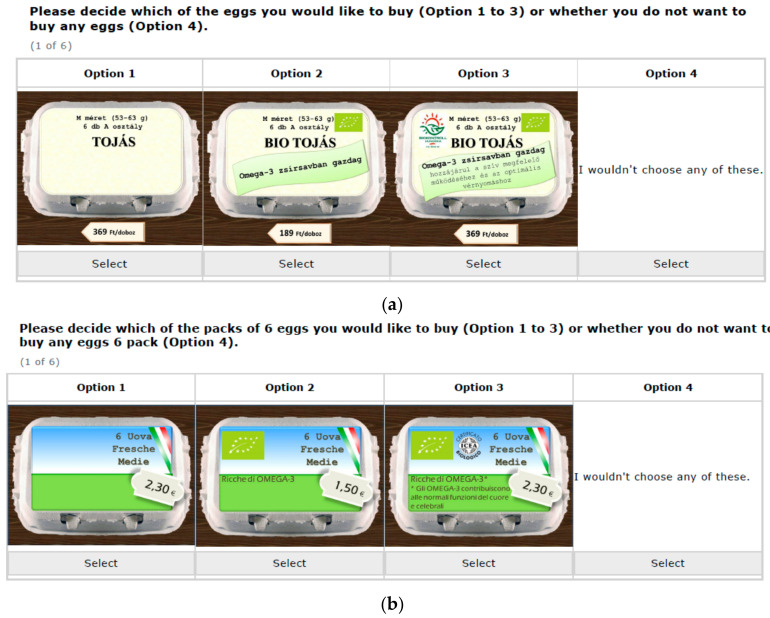
This paper investigates consumers' preferences for egg purchase in two European countries, Hungary and Italy. We utilize random parameter logit models to interpret the results of discrete choice experiments (DCE) for the elicitation of preference of the egg consumers. A sample of 403 in the Hungarian survey and 404 in the Italian survey were recruited in summer 2018. The DCE questionnaire includes the following product and process characteristics: organic labels, nutrition and health claims, and price. Our results show that for Hungarian and Italian consumers, the price is the most important attribute, followed by the nutrition and health claim and the organic production labelling. Three egg consumer segments can be identified via latent class models for each country. In both countries, we found similar consumer groups, the Price Sensitive and Quality Optimizing Opportunist Consumers and Health Conscious Buyers, respectively. Particularly, compared to the other segments the Health Conscious Buyers (46% in Hungary and 49% in Italy) exhibited stronger preference for and are willing to pay a higher price premium for eggs with organic label and nutrition claims. In Italy, we identified a third segment with consumers preferring simpler labelling approach, whilst in Hungary we found a consumer segment distrusting the EU organic logo.
本文研究了匈牙利和意大利这两个欧洲国家消费者对鸡蛋购买的偏好。我们使用随机参数logit模型来解释离散选择实验(DCE)的结果,以引出鸡蛋消费者的偏好。2018年夏季,匈牙利调查招募了403个样本,意大利调查招募了404个样本。DCE问卷包括以下产品和过程特征:有机标签、营养与健康声明以及价格。我们的结果表明,对于匈牙利和意大利消费者而言,价格是最重要的属性,其次是营养与健康声明以及有机生产标签。通过每个国家的潜在类别模型可以识别出三个鸡蛋消费者细分群体。在这两个国家,我们发现了类似的消费者群体,分别是价格敏感型和质量优化机会主义消费者以及健康意识型购买者。特别是,与其他细分群体相比,健康意识型购买者(匈牙利为46%,意大利为49%)对带有有机标签和营养声明的鸡蛋表现出更强的偏好,并且愿意支付更高的价格溢价。在意大利,我们识别出了第三个细分群体,其消费者更喜欢更简单的标签方式,而在匈牙利,我们发现了一个不信任欧盟有机标志的消费者细分群体。