Department of Sport and Health Sciences, College of Life and Environmental Sciences, University ofExeter, Exeter EX1 2LU, UK.
Living Systems Institute, University of Exeter, Stocker Road, Exeter EX4 4QD, UK.
Nutrients. 2020 Sep 1;12(9):2670. doi: 10.3390/nu12092670.
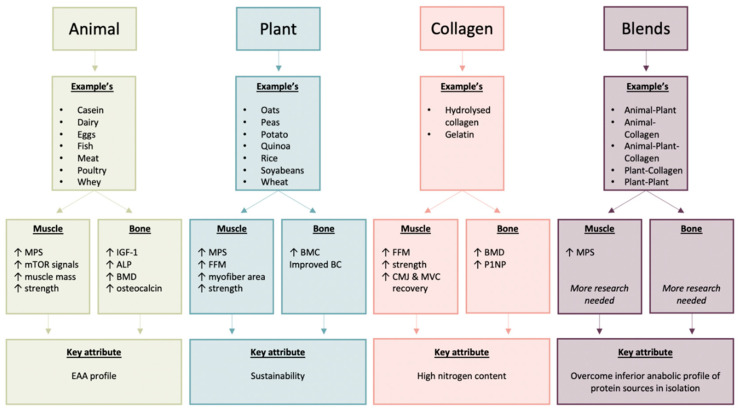
Dietary protein is critical for the maintenance of musculoskeletal health, whereappropriate intake (i.e., source, dose, timing) can mitigate declines in muscle and bone mass and/orfunction. Animal-derived protein is a potent anabolic source due to rapid digestion and absorptionkinetics stimulating robust increases in muscle protein synthesis and promoting bone accretion andmaintenance. However, global concerns surrounding environmental sustainability has led to anincreasing interest in plant- and collagen-derived protein as alternative or adjunct dietary sources.This is despite the lower anabolic profile of plant and collagen protein due to the inferior essentialamino acid profile (e.g., lower leucine content) and subordinate digestibility (versus animal). Thisreview evaluates the efficacy of animal-, plant- and collagen-derived proteins in isolation, and asprotein blends, for augmenting muscle and bone metabolism and health in the context of ageing,exercise and energy restriction.
饮食蛋白质对于维持肌肉骨骼健康至关重要,适量摄入(即来源、剂量、时间)可以减轻肌肉和骨量以及/或功能的下降。由于动物源性蛋白质具有快速消化和吸收的特点,能刺激肌肉蛋白质合成的显著增加,促进骨生成和维持,因此它是一种有效的合成代谢来源。然而,全球对环境可持续性的关注导致人们对植物源性和胶原蛋白源性蛋白质越来越感兴趣,将其作为替代或辅助的饮食来源。尽管植物和胶原蛋白蛋白质的合成代谢特性较低,因为其必需氨基酸谱较差(例如,亮氨酸含量较低)且消化率较低(与动物相比),但仍存在这种情况。本综述评估了动物源性、植物源性和胶原蛋白源性蛋白质在单独使用以及作为蛋白质混合物时,对增龄、运动和能量限制背景下肌肉和骨骼代谢和健康的功效。