Collaborative Innovation Center for the Diagnosis and Treatment of Infectious Diseases, State Key Laboratory for the Diagnosis and Treatment of Infectious Diseases, |The First Affiliated Hospital, School of Medicine, Zhejiang University, Hangzhou, People's Republic of China.
National Clinical Research Center for Infectious Diseases, The First Affiliated Hospital, School of Medicine, Zhejiang University, Hangzhou, Zhejiang, People's Republic of China.
Stem Cell Res Ther. 2020 Sep 3;11(1):377. doi: 10.1186/s13287-020-01895-1.
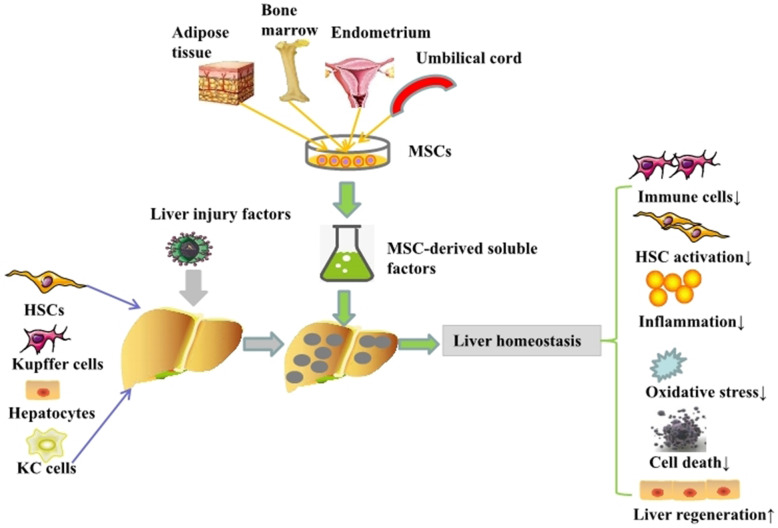
Various hepatoxic factors, such as viruses, drugs, lipid deposition, and autoimmune responses, induce acute or chronic liver injury, and 3.5% of all worldwide deaths result from liver cirrhosis, liver failure, or hepatocellular carcinoma. Liver transplantation is currently limited by few liver donors, expensive surgical costs, and severe immune rejection. Cell therapy, including hepatocyte transplantation and stem cell transplantation, has recently become an attractive option to reduce the overall need for liver transplantation and reduce the wait time for patients. Recent studies showed that mesenchymal stem cell (MSC) administration was a promising therapeutic approach for promoting liver regeneration and repairing liver injury by the migration of cells into liver sites, hepatogenic differentiation, immunoregulation, and paracrine mechanisms. MSCs secrete a large number of molecules into the extracellular space, and soluble proteins, free nucleic acids, lipids, and extracellular vesicles (EVs) effectively repair tissue injury in response to fluctuations in physiological states or pathological conditions. Cell-free-based therapies avoid the potential tumorigenicity, rejection of cells, emboli formation, undesired differentiation, and infection transmission of MSC transplantation. In this review, we focus on the potential mechanisms of MSC-based cell-free strategies for attenuating liver injury in various liver diseases. Secretome-mediated paracrine effects participate in the regulation of the hepatic immune microenvironment and promotion of hepatic epithelial repair. We look forward to completely reversing liver injury through an MSC-based cell-free strategy in regenerative medicine in the near future.
各种肝毒性因素,如病毒、药物、脂质沉积和自身免疫反应,可导致急性或慢性肝损伤,全球 3.5%的死亡归因于肝硬化、肝功能衰竭或肝细胞癌。肝移植目前受到肝供体数量少、手术费用昂贵和严重免疫排斥等因素的限制。细胞疗法,包括肝细胞移植和干细胞移植,最近成为一种有吸引力的选择,可以减少对肝移植的总体需求,并减少患者的等待时间。最近的研究表明,间充质干细胞(MSC)的给药是一种很有前途的治疗方法,可以通过细胞迁移到肝脏部位、肝向分化、免疫调节和旁分泌机制来促进肝脏再生和修复肝损伤。MSC 会将大量分子分泌到细胞外空间,而可溶性蛋白、游离核酸、脂质和细胞外囊泡(EV)可有效修复组织损伤,以应对生理状态或病理条件的波动。无细胞的基于细胞的疗法可避免 MSC 移植的潜在致瘤性、细胞排斥、栓塞形成、意外分化和感染传播。在这篇综述中,我们重点讨论了基于 MSC 的无细胞策略在各种肝脏疾病中减轻肝损伤的潜在机制。分泌组介导的旁分泌作用参与调节肝脏免疫微环境和促进肝上皮修复。我们期待在不久的将来,通过基于 MSC 的无细胞策略在再生医学中彻底逆转肝损伤。