Cho Hoyoun, Kwon Youngjoo
Department of Food Science and Engineering Ewha Womans University Seoul Korea.
Food Sci Nutr. 2020 Jul 16;8(8):4611-4624. doi: 10.1002/fsn3.1785. eCollection 2020 Aug.
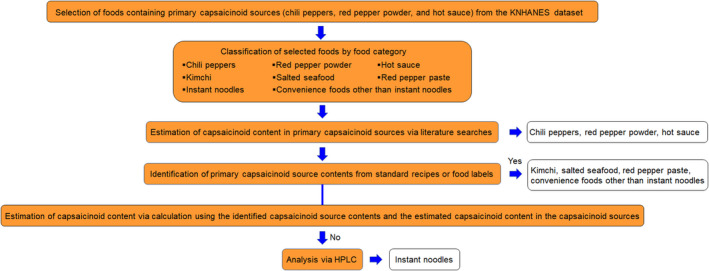
Chili peppers ( L.) are widely consumed worldwide, and the health benefits of capsaicinoids (the active compounds in chili peppers) have been suggested. However, the link between capsaicinoid consumption and the risk of certain cancers remains controversial. Capsaicinoid consumption level is an important determinant of its potential health effects. This study sought to construct a database of capsaicinoid contents in foods commonly consumed in Korea (CAPKO) to enable a more reliable estimation of capsaicinoid intake. Capsaicinoid-containing foods were identified from the Korea National Health and Nutrition Examination Survey datasets and divided into eight categories: chili peppers, red pepper powder, hot sauce, kimchi, salted seafood, red pepper paste, instant noodles, and convenience foods other than instant noodles. The capsaicinoid contents of primary capsaicinoid sources (chili peppers, red pepper powder, and hot sauce) were estimated from the literature. For the remaining food categories, the contents of primary capsaicinoid sources were identified from standardized recipes (kimchi) or food labels (salted seafood, red pepper paste, and convenience foods other than instant noodles). Then, capsaicinoid contents were estimated by calculation using the identified capsaicinoid source contents and the estimated capsaicinoid content in these sources. This information was unavailable for instant noodles, and capsaicinoid content was measured by HPLC analyses. This study developed the CAPKO database, which includes a variety of foods with varying levels of spiciness, which can be used in combination with dietary surveys to estimate capsaicinoid intakes. Therefore, this study established a framework for future database development for other compounds with potential health effects.
辣椒(L.)在全球范围内广泛食用,辣椒素类物质(辣椒中的活性成分)对健康有益已得到证实。然而,食用辣椒素类物质与某些癌症风险之间的联系仍存在争议。辣椒素类物质的食用水平是其潜在健康影响的重要决定因素。本研究旨在构建一个韩国常见食用食品中辣椒素类物质含量的数据库(CAPKO),以便更可靠地估计辣椒素类物质的摄入量。从韩国国家健康与营养检查调查数据集里识别出含辣椒素类物质的食品,并将其分为八类:辣椒、红辣椒粉、辣酱、泡菜、腌制海产品、辣椒酱、方便面以及非方便面的方便食品。从文献中估算主要辣椒素类物质来源(辣椒、红辣椒粉和辣酱)的辣椒素类物质含量。对于其余食品类别,从标准化食谱(泡菜)或食品标签(腌制海产品、辣椒酱和非方便面的方便食品)中识别主要辣椒素类物质来源的含量。然后,利用识别出的辣椒素类物质来源含量以及这些来源中估算的辣椒素类物质含量,通过计算来估算辣椒素类物质含量。方便面的此类信息无法获取,其辣椒素类物质含量通过高效液相色谱分析进行测定。本研究开发了CAPKO数据库,该数据库包含各种辣度不同的食品,可与饮食调查结合使用以估算辣椒素类物质的摄入量。因此,本研究为未来开发其他具有潜在健康影响的化合物的数据库建立了框架。