Xiong Wei, Liao Yong, Qin Ji-Yong, Li Wen-Hui, Tang Zhao-You
The Department of Radiation Oncology, Yunnan Cancer Hospital, The Third Affiliated Hospital of Kunming Medical University, Kunming, China.
Institute for Viral Hepatitis, The Second Affiliated Hospital of Chongqing Medical University, Chongqing, China.
Genes Dis. 2020 Apr 9;7(3):351-358. doi: 10.1016/j.gendis.2020.04.004. eCollection 2020 Sep.
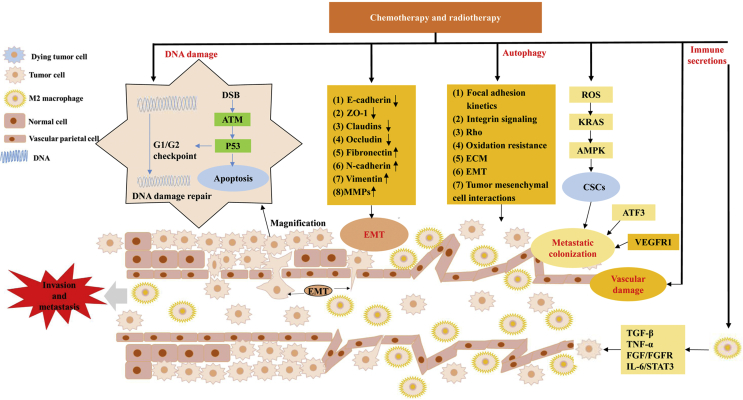
The phenomenon of enhanced invasion and metastasis of residual tumor cells has been observed in an increasing number of patients receiving chemoradiotherapy recently, and tumor metastasis will undoubtedly limit patient prognosis. However, the key mechanism by which chemoradiotherapy affects the invasion and metastasis of tumor cells remains unclear. Studies have shown that chemoradiotherapy may directly act on tumor cells and alter the tumor microenvironment, or induce cell apoptosis and autophagy to promote tumor cell survival and metastasis. In this review, we summarize the potential mechanisms by which chemoradiotherapy may affect the biological behavior of tumor cells and open up new avenues for reducing tumor recurrence and metastasis after treatment. These insights will improve the efficacy of chemoradiotherapy.
近年来,在越来越多接受放化疗的患者中观察到残留肿瘤细胞侵袭和转移增强的现象,而肿瘤转移无疑会限制患者的预后。然而,放化疗影响肿瘤细胞侵袭和转移的关键机制仍不清楚。研究表明,放化疗可能直接作用于肿瘤细胞并改变肿瘤微环境,或诱导细胞凋亡和自噬以促进肿瘤细胞的存活和转移。在这篇综述中,我们总结了放化疗可能影响肿瘤细胞生物学行为的潜在机制,并为减少治疗后肿瘤复发和转移开辟新途径。这些见解将提高放化疗的疗效。