Bretl Kathrine N, Clark Torin K
University of Colorado Boulder, 3775 Discovery Drive, Boulder, CO 80309 USA.
NPJ Microgravity. 2020 Aug 26;6:22. doi: 10.1038/s41526-020-00112-w. eCollection 2020.
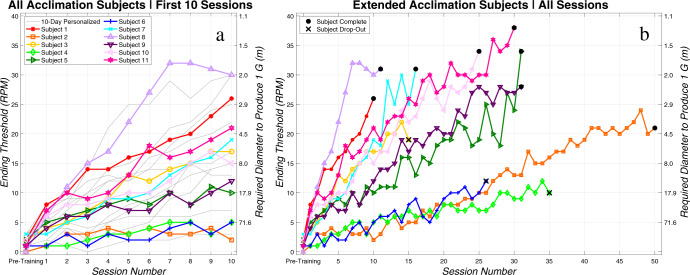
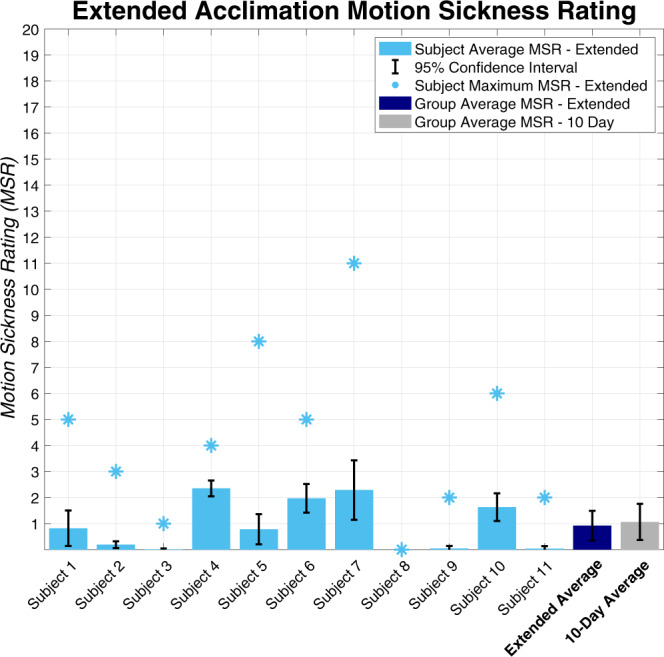
The "Coriolis" cross-coupled (CC) illusion has historically limited the tolerability of utilizing fast-spin rate, short-radius centrifugation for in-flight artificial gravity. Previous research confirms that humans acclimate to the CC illusion over 10 daily sessions, though the efficacy of additional training is unknown. We investigated human acclimation to the CC illusion over up to 50 daily sessions of personalized, incremental training. During each 25-min session, subjects spun in yaw and performed roll head tilts approximately every 30 s, reporting the presence or absence of the illusion while rating motion sickness every 5 min. Illusion intensity was modulated by altering spin rate based upon subject response, such that the administered stimulus remained near each individual's instantaneous illusion threshold. Every subject ( = 11) continued to acclimate linearly to the CC illusion during the investigation. Subjects acclimated at an average rate of 1.17 RPM per session (95% CI: 0.63-1.71 RPM per session), with the average tolerable spin rate increasing from 1.4 to 26.2 RPM, corresponding to a reduction in required centrifuge radius from 456.6 to 1.3 m (to produce loading of 1 g at the feet). Subjects reported no more than slight motion sickness throughout their training (mean: 0.92/20, 95% CI: 0.35-1.49/20). We applied survival analysis to determine the probability of individuals reaching various spin rates over a number of training days, providing a tolerability trade parameter for centrifuge design. Results indicate that acclimation to a given, operationally relevant spin rate may be feasible for all subjects if given a sufficient training duration.
“科里奥利”交叉耦合(CC)错觉在历史上一直限制着利用快速旋转速率、短半径离心来产生飞行中人工重力的耐受性。先前的研究证实,人类在10天的日常训练中会适应CC错觉,不过额外训练的效果尚不清楚。我们研究了人类在长达50天的个性化渐进训练中对CC错觉的适应情况。在每次25分钟的训练过程中,受试者进行偏航旋转,并每隔约30秒进行一次侧倾头部倾斜,每5分钟报告一次错觉的有无并对晕动病进行评分。根据受试者的反应改变旋转速率来调节错觉强度,以使施加的刺激保持在每个个体的瞬时错觉阈值附近。在研究过程中,每个受试者(n = 11)继续线性地适应CC错觉。受试者平均每次训练适应速率为1.17转/分钟(95%置信区间:每次训练0.63 - 1.71转/分钟),平均可耐受旋转速率从1.4转/分钟增加到26.2转/分钟,这对应着所需离心机半径从456.6米减小到1.3米(以在脚部产生1g的负荷)。受试者在整个训练过程中报告的晕动病不超过轻微程度(平均值:0.92/20,95%置信区间:0.35 - 1.49/20)。我们应用生存分析来确定个体在多个训练日达到各种旋转速率的概率,为离心机设计提供了一个耐受性权衡参数。结果表明,如果给予足够的训练时长,所有受试者适应给定的、与操作相关的旋转速率可能是可行的。