Iwelunmor Juliet, Nwaozuru Ucheoma, Obiezu-Umeh Chisom, Uzoaru Florida, Ehiri John, Curley Jami, Ezechi Oliver, Airhihenbuwa Collins, Ssewamala Fred
College for Public Health and Social Justice, Saint Louis University, Salus Center, 3545 Lafayette Avenue, Saint Louis, MO 63104 USA.
Mel and Enid Zuckerman College of Public Health, University of Arizona, 1295 N Martin Avenue, Tucson, AZ 85724 USA.
Implement Sci Commun. 2020 Jun 10;1:53. doi: 10.1186/s43058-020-00042-4. eCollection 2020.
Economic empowerment (EE) HIV prevention programs for adolescent girls and young women (AGYW) in sub-Saharan Africa are gaining traction as effective strategies to reduce HIV risk and vulnerabilities among this population. While intervention effectiveness is critical, there are numerous factors beyond effectiveness that shape an intervention's impact. The objective of this systematic review was to assess the reporting of implementation outcomes of EE HIV prevention programs for AGYW in SSA, as conceptualized in the RE-AIM (reach, efficacy/effectiveness, adoption, implementation, and maintenance) framework.
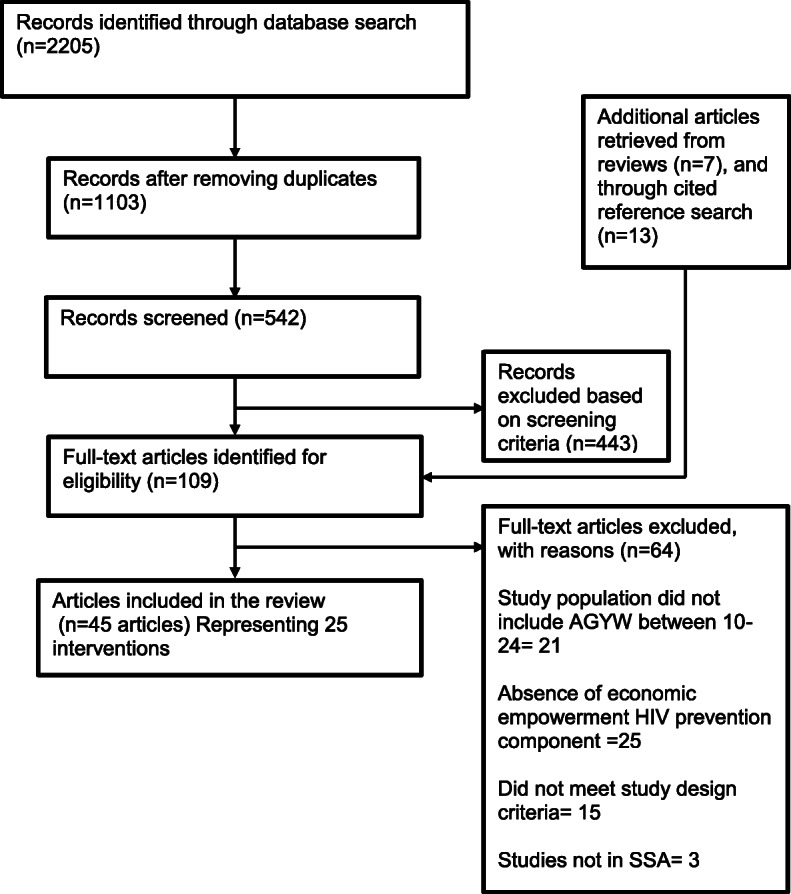
We searched PubMed, Ovid/MEDLINE, Science Direct, Ebscohost, PsycINFO, Scopus, and Web of Science for EE HIV interventions for AGYW in SSA. Study selection and data extraction were conducted according to the PRISMA (Preferred Reporting Items for Systematic Reviews and Meta-analyses) guidelines. Two researchers coded each article using a validated RE-AIM data extraction tool and independently extracted information from each article. The reporting of RE-AIM dimensions were summarized and synthesized across included interventions.
A total of 25 unique interventions (reported in 45 articles) met the predefined eligibility criteria. Efficacy/effectiveness 19(74.4%) was the highest reported RE-AIM dimension, followed by adoption 17(67.2%), reach 16(64.0%), implementation 9(38.0%), and maintenance 7(26.4%). Most interventions reported on RE-AIM components such as sample size 25(100.0%), intervention location 24(96.0%), and measures and results for at least one follow-up 24(96.0%). Few reported on RE-AIM components such as characteristics of non-participants 8(32.0%), implementation costs 3(12.0%), and intervention fidelity 0(0.0%).
Results of the review emphasize the need for future economic empowerment HIV prevention interventions for AGYW in SSA to report multiple implementation strategies and highlight considerations for translating such programs into real-world settings. Researchers should pay close attention to reporting setting-level adoption, implementation cost, and intervention maintenance. These measures are needed for policy decisions related to the full merit and worth of EE HIV interventions and their long-term sustainability for AGYW.
撒哈拉以南非洲针对少女和年轻女性(AGYW)的经济赋权(EE)艾滋病毒预防项目正逐渐成为降低该人群艾滋病毒风险和脆弱性的有效策略。虽然干预效果至关重要,但影响干预效果的因素众多。本系统评价的目的是评估撒哈拉以南非洲针对AGYW的EE艾滋病毒预防项目实施结果的报告情况,这是根据RE-AIM(覆盖范围、效果/有效性、采用情况、实施情况和维持情况)框架进行概念化的。
我们在PubMed、Ovid/MEDLINE、Science Direct、Ebscohost、PsycINFO、Scopus和Web of Science中搜索了撒哈拉以南非洲针对AGYW的EE艾滋病毒干预措施。根据PRISMA(系统评价和荟萃分析的首选报告项目)指南进行研究选择和数据提取。两名研究人员使用经过验证的RE-AIM数据提取工具对每篇文章进行编码,并独立从每篇文章中提取信息。对纳入干预措施的RE-AIM维度报告进行总结和综合。
共有25项独特干预措施(在45篇文章中报告)符合预先确定的纳入标准。效果/有效性19项(74.4%)是报告最多的RE-AIM维度,其次是采用情况17项(67.2%)、覆盖范围16项(64.0%)、实施情况9项(38.0%)和维持情况7项(26.4%)。大多数干预措施报告了RE-AIM组成部分,如样本量25项(100.0%)、干预地点24项(96.0%)以及至少一次随访的测量和结果24项(96.0%)。很少有报告涉及RE-AIM组成部分,如未参与者的特征8项(32.0%)、实施成本3项(12.0%)和干预保真度0项(0.0%)。
评价结果强调,未来针对撒哈拉以南非洲AGYW的经济赋权艾滋病毒预防干预措施需要报告多种实施策略,并突出将此类项目转化为实际应用的考虑因素。研究人员应密切关注报告实施层面的采用情况、实施成本和干预维持情况。这些措施对于与EE艾滋病毒干预措施的全部优点和价值及其对AGYW的长期可持续性相关的政策决策是必要的。