Bhana Arvin, Abas Melanie Amna, Kelly Jane, van Pinxteren Myrna, Mudekunye Lynette Alice, Pantelic Marija
Health Systems Research Unit, South African Medical Research Council, South Africa; and Centre for Rural Health, School of Nursing and Public Health, College of Health Sciences, University of KwaZulu-Natal, South Africa.
Institute of Psychiatry, Psychology and Neuroscience, King's College London, UK.
BJPsych Open. 2020 Sep 4;6(5):e104. doi: 10.1192/bjo.2020.67.
Mental health difficulties and mental disorders are common in adolescents living with HIV or who are affected by HIV because of living in HIV-affected households in low- and middle-income (LMICs) countries, but little is known about the interventions that target these individuals and whether they are effective.
This systematic review aims to address these gaps by examining what has worked and what has not worked to support the mental health of adolescents living with HIV or affected by HIV in low- and middle-income contexts (PROSPERO Number: CRD42018103269).
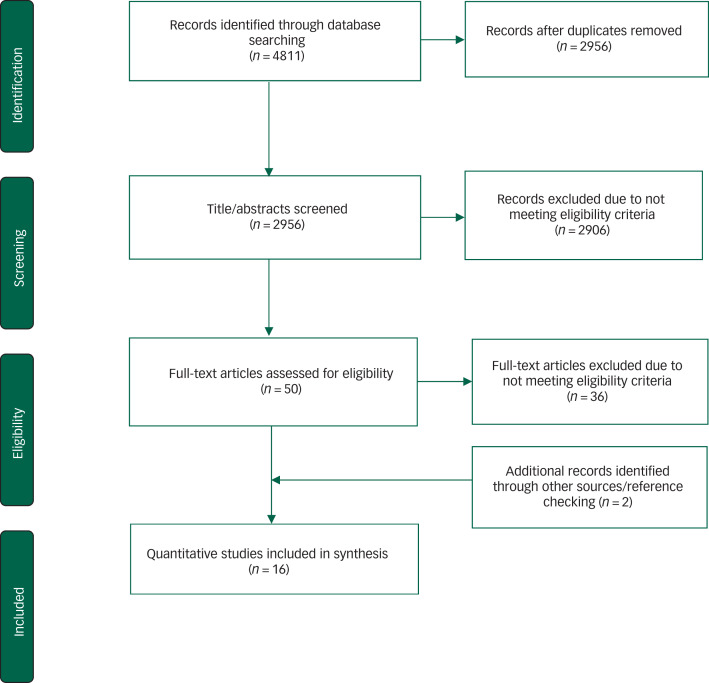
A systematic literature review of online databases from the year 2000 to 2018, using Preferred Reporting Items for Systematic Reviews and Meta-Analyses guidelines, included English-language publications of quantitative evaluations of psychosocial interventions aiming to improve mental health among adolescents living with HIV and adolescents from HIV-affected households (aged 10-24 years) in LMICs.
Out of 2956 articles, 16 studies from 8 LMICs met the inclusion criteria. Thirteen studies focused on adolescents affected by HIV and only three studies on adolescents living with HIV. Only five studies included were from Sub-Saharan Africa. Interventions most often used a family-strengthening approach strengthening caregiver-adolescent relationships and communication and some problem-solving in groups or individually. Five studies reported statistically significant changes in adolescent and caregiver mental health or mental well-being, five among adolescents only and two among caregivers only.
Research on what works to improve mental health in adolescents living with HIV in LMIC is in its nascent stages. Family-based interventions and economic strengthening show promise.
在低收入和中等收入国家(LMICs),心理健康问题和精神障碍在感染艾滋病毒的青少年或因生活在受艾滋病毒影响的家庭中而受艾滋病毒影响的青少年中很常见,但针对这些个体的干预措施及其有效性却鲜为人知。
本系统评价旨在通过研究哪些措施有效、哪些无效,以支持低收入和中等收入环境下感染艾滋病毒或受艾滋病毒影响的青少年的心理健康,从而填补这些空白(国际前瞻性系统评价注册编号:CRD42018103269)。
根据系统评价和Meta分析的首选报告项目指南,对2000年至2018年在线数据库进行系统文献综述,纳入旨在改善低收入和中等收入国家感染艾滋病毒的青少年以及来自受艾滋病毒影响家庭的青少年(10至24岁)心理健康的社会心理干预定量评估的英文出版物。
在2956篇文章中,来自8个低收入和中等收入国家的16项研究符合纳入标准。13项研究关注受艾滋病毒影响的青少年,只有3项研究关注感染艾滋病毒的青少年。纳入的研究中只有5项来自撒哈拉以南非洲。干预措施最常采用加强家庭的方法,加强照顾者与青少年的关系和沟通,并在小组或个体中进行一些问题解决。5项研究报告了青少年和照顾者心理健康或幸福感有统计学意义的变化,其中5项仅在青少年中出现,2项仅在照顾者中出现。
在低收入和中等收入国家,关于如何改善感染艾滋病毒青少年心理健康的研究尚处于起步阶段。基于家庭的干预措施和经济扶持显示出前景。