Global Obesity Centre (GLOBE), Faculty of Health, Deakin University, Geelong Australia, Geelong, Victoria, Australia.
Health Improvement Directorate, Risk Factors Intelligence, Public Health England, London, UK.
Obesity (Silver Spring). 2020 Oct;28(10):1951-1963. doi: 10.1002/oby.22970. Epub 2020 Sep 4.
This study examined the prevalence and risk of overweight/obesity among expanded ethnicity categories within boys and girls in England and the differential influence of socioeconomic position using the 2015/2016 and the 2016/2017 cycles of the National Child Measurement Programme.
This cross-sectional and descriptive study examined surveillance data of weight status among primary school children in England. Data were pooled across data collection years, representing 1.25 million children in Reception (aged 4-5 years) and 1.1 million children in Year 6 (aged 10-11 years). Ethnicity was classified according to National Health Service definitions, and child residence was used to calculate quintiles of Income Deprivation Affecting Children Index. Measured weight status was classified using the International Obesity Task Force's definition. Logistic regression models were run for each sex and year group.
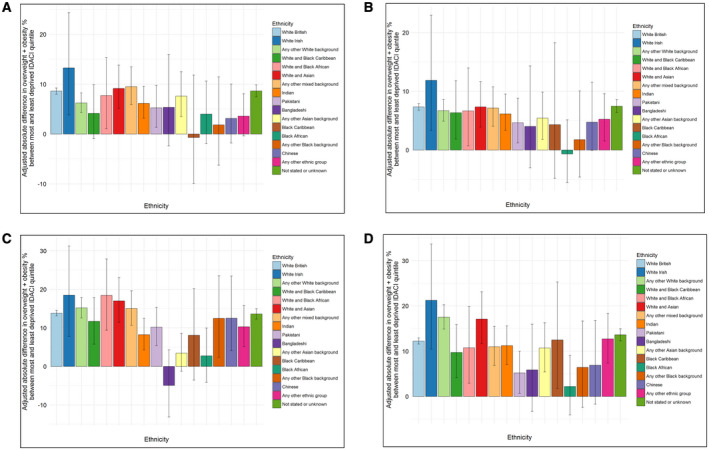
Within each sex, ethnicity- and socioeconomic-specific differentials in overweight/obesity prevalence were evident. For example, among the five most populous ethnic groups in the most deprived quintile, 26.8% of White British girls in Reception had overweight/obesity compared with 20.7% of girls with Pakistani, 31.2% with Black African, 17.1% with Indian, and 22.2% with any Any Other White (e.g., White European) background.
Ethnicity had an independent influence on overweight/obesity risk after adjustment for socioeconomic position.
本研究利用 2015/2016 年和 2016/2017 年全国儿童测量计划的两轮数据,调查了英国不同种族群体中男孩和女孩超重/肥胖的流行率和风险,以及社会经济地位的差异影响。
本横断面和描述性研究调查了英国小学生体重状况的监测数据。将各年的数据汇总,代表了 4-5 岁的幼儿园(接收组)和 10-11 岁的六年级(六年级)的 125 万名儿童和 110 万名儿童。种族按国民保健服务定义进行分类,儿童居住地用于计算儿童收入剥夺影响指数的五分位数。使用国际肥胖工作组的定义来分类测量的体重状况。为每个性别和年龄组运行逻辑回归模型。
在每个性别中,不同种族和社会经济地位的超重/肥胖流行率存在差异。例如,在最贫困五分位数的五个人口最多的族裔群体中,接收组中 26.8%的英国白人女孩超重/肥胖,而巴基斯坦裔女孩为 20.7%,黑人非洲裔女孩为 31.2%,印度裔女孩为 17.1%,任何其他白人(如欧洲白人)背景的女孩为 22.2%。
在调整社会经济地位后,种族对超重/肥胖风险有独立影响。