Centre for Primary Care, Wolfson Institute of Population Health, Queen Mary University of London, London, UK
Centre for Primary Care, Wolfson Institute of Population Health, Queen Mary University of London, London, UK.
BMJ Paediatr Open. 2022 Aug;6(1). doi: 10.1136/bmjpo-2022-001528. Epub 2022 Aug 4.
Children with obesity at school entry are at increased risk of persistent obesity throughout childhood and adulthood. Little is known about associations with adverse health outcomes with onset during childhood including those affecting the musculoskeletal system. We examined the association between obesity present at school entry and adverse musculoskeletal diagnoses with onset during childhood.
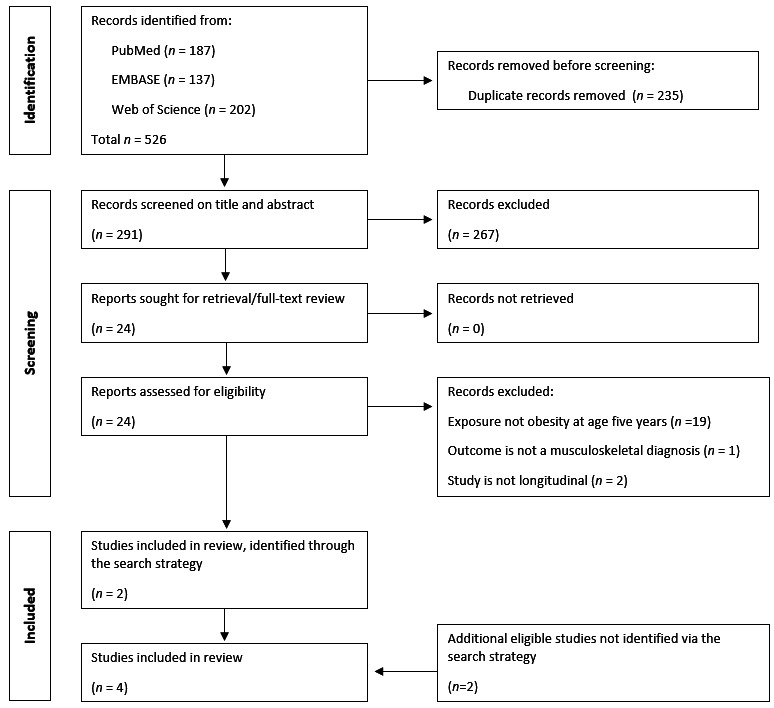
We searched three electronic databases to identify longitudinal studies published in English between January 2000 and June 2022 assessing associations between obesity measured at school entry (around age 5 years) and musculoskeletal diagnoses made before age 20 years. Two reviewers screened titles, abstracts and full-text using EPPI-Reviewer software. Bias and quality of eligible studies were appraised using The Quality Assessment tool for Observational Cohort and Cross-sectional studies and findings synthesised.
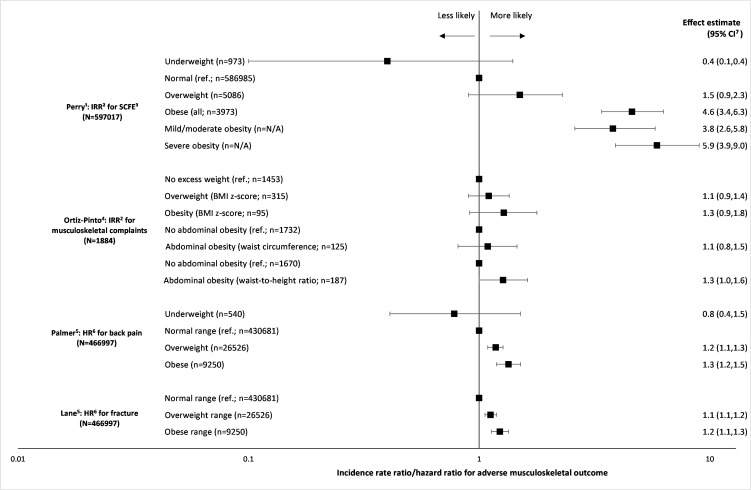
We identified four eligible studies from 291 unique records, three conducted in Spain and one in Scotland. These studies reported on 1 232 895 children (available data: 51.4% boys; none reported ethnic distribution) with study sample sizes ranging from <2000 to 600 000 and length of follow-up from 2 to 13 years. Quantitative synthesis of findings across these four studies was not possible due to differences in outcomes and effect sizes reported. Children with obesity at school entry were more likely to receive diagnoses of slipped capital femoral epiphysis, back pain, fractures and musculoskeletal complaints made in primary care settings. Included studies were assessed as of 'fair' to 'good' quality.
There is good to fair evidence to suggest children with obesity at school entry are more likely to receive a diagnosis of a musculoskeletal condition during childhood. Further research is needed to replicate these findings in ethnically diverse populations and to investigate whether these are causal associations. The implications of this for children's mobility and quality of life and future musculoskeletal health warrants further assessment.
入学时肥胖的儿童在整个儿童期和成年期持续肥胖的风险增加。对于与儿童期开始出现的不良健康结果的关联,包括影响肌肉骨骼系统的结果,我们知之甚少。我们研究了入学时肥胖与儿童期开始出现的不良肌肉骨骼诊断之间的关联。
我们在三个电子数据库中进行了搜索,以确定 2000 年 1 月至 2022 年 6 月期间发表的评估入学时(约 5 岁)肥胖与 20 岁前做出的肌肉骨骼诊断之间关联的英文纵向研究。两位评审员使用 EPPI-Reviewer 软件筛选标题、摘要和全文。使用观察性队列和横断面研究的质量评估工具评估合格研究的偏倚和质量,并综合研究结果。
我们从 291 份独特记录中确定了 4 项合格研究,其中 3 项在西班牙进行,1 项在苏格兰进行。这些研究报告了 1232895 名儿童(可获得的数据:51.4%为男孩;均未报告种族分布),研究样本量从<2000 到 600000 不等,随访时间从 2 到 13 年不等。由于报告的结果和效应量存在差异,因此无法对这四项研究的结果进行定量综合。入学时肥胖的儿童更有可能被诊断为股骨头骨骺滑脱、背痛、骨折和在初级保健环境中出现的肌肉骨骼投诉。纳入的研究被评估为“良好”到“良好”质量。
有充分到良好的证据表明,入学时肥胖的儿童更有可能在儿童期被诊断出肌肉骨骼疾病。需要在种族多样化的人群中进一步研究这些发现,并调查这些是否为因果关联。这对儿童的活动能力和生活质量以及未来的肌肉骨骼健康的影响值得进一步评估。