Department of Medical Social Sciences, Northwestern University Feinberg School of Medicine, Chicago, IL, United States of America.
Department of Haematological Medicine, King's College Hospital, NIHR/Wellcome King's Clinical Research Facility, and King's College London, London, United Kingdom.
PLoS One. 2020 Sep 4;15(9):e0237497. doi: 10.1371/journal.pone.0237497. eCollection 2020.
Eculizumab has transformed management of paroxysmal nocturnal hemoglobinuria (PNH) since its approval. However, its biweekly dosing regimen remains a high treatment burden. Ravulizumab administered every 8 weeks demonstrated noninferiority to eculizumab in two phase 3 trials. In regions where two PNH treatment options are available, it is important to consider patient preference.
The aim of this study was to assess patient preference for ravulizumab or eculizumab.
Study 302s (ALXN1210-PNH-302s) enrolled PNH patients who participated in the extension period of phase 3 study ALXN1210-PNH-302. In the parent study, eculizumab-experienced adult PNH patients received ravulizumab or eculizumab during a 26-week primary evaluation period. All patients in the extension period received ravulizumab. In study 302s, patient treatment preference was evaluated using an 11-item PNH-specific Patient Preference Questionnaire (PNH-PPQ©). Of 98 patients, 95 completed PNH-PPQ© per protocol for analysis.
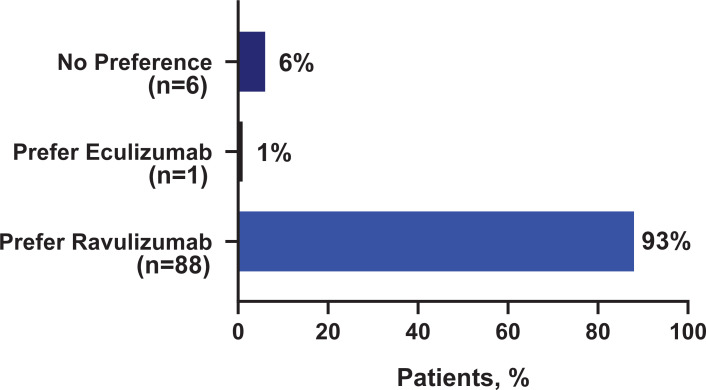
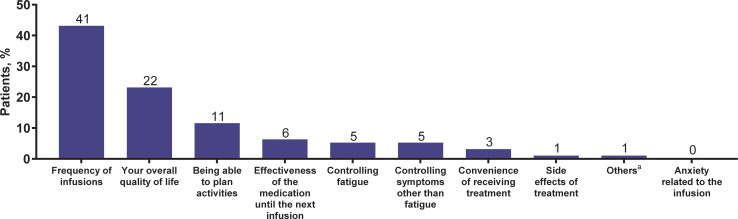
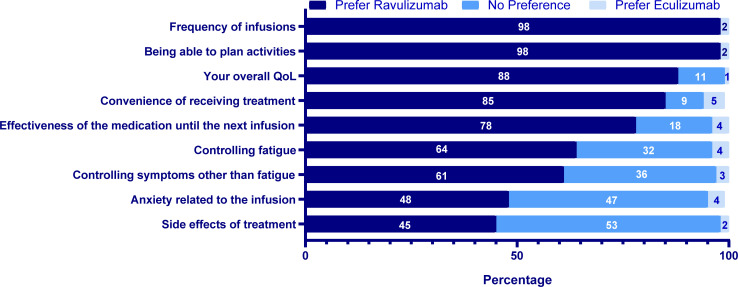
Overall, 93% of patients preferred ravulizumab whereas 7% of patients either had no preference (6%) or preferred eculizumab (1%) (P < 0.001). For specific aspects of treatment, ravulizumab was preferred (in comparison to no preference or eculizumab) on infusion frequency (98% vs. 0% vs. 2%), ability to plan activities (98% vs. 0% vs. 2%), and overall quality of life (88% vs. 11% vs. 1%), among other aspects. Most participants selected frequency of infusions as the most important factor determining preference (43%), followed by overall quality of life (23%).
This study shows that a substantial proportion of patients preferred ravulizumab over eculizumab and provides an important patient perspective on PNH treatment when there is more than one treatment option.
依库珠单抗(Eculizumab)自获得批准以来改变了阵发性睡眠性血红蛋白尿症(PNH)的治疗模式。然而,其每两周的给药方案仍然是一个较高的治疗负担。在两项 3 期临床试验中,每 8 周给药的拉维珠单抗(Ravulizumab)显示出非劣效性优于依库珠单抗。在有两种 PNH 治疗选择的地区,考虑患者的偏好很重要。
本研究旨在评估患者对拉维珠单抗或依库珠单抗的偏好。
研究 302s(ALXN1210-PNH-302s)纳入了参加 3 期研究 ALXN1210-PNH-302 的扩展期的 PNH 患者。在主要研究中,依库珠单抗治疗的成年 PNH 患者在 26 周的主要评估期内接受拉维珠单抗或依库珠单抗治疗。扩展期的所有患者均接受拉维珠单抗治疗。在研究 302s 中,使用 11 项 PNH 特异性患者偏好问卷(PNH-PPQ©)评估患者的治疗偏好。在 98 名患者中,95 名患者按方案完成了 PNH-PPQ©分析。
总体而言,93%的患者更喜欢拉维珠单抗,而 7%的患者要么没有偏好(6%),要么更喜欢依库珠单抗(1%)(P<0.001)。在治疗的具体方面,与无偏好或依库珠单抗相比,拉维珠单抗在输注频率(98%对 0%对 2%)、计划活动的能力(98%对 0%对 2%)和总体生活质量(88%对 11%对 1%)等方面更受欢迎。大多数参与者选择输注频率作为决定偏好的最重要因素(43%),其次是总体生活质量(23%)。
本研究表明,相当一部分患者更喜欢拉维珠单抗而不是依库珠单抗,这为 PNH 治疗提供了一个重要的患者视角,当有不止一种治疗选择时。