Aging Research Center, Department of Neurobiology, Care Sciences and Society, Karolinska Institutet and Stockholm University, Sweden.
Gösta Ekman Laboratory, Department of Psychology, Stockholm University, Sweden.
J Gerontol A Biol Sci Med Sci. 2020 Nov 13;75(12):2441-2449. doi: 10.1093/gerona/glaa221.
Olfactory dysfunction is common in aging and associated with dementia and mortality. However, longitudinal studies tracking change in olfactory ability are scarce. We sought to identify predictors of interindividual differences in rate of olfactory identification change in aging.
Participants were 1780 individuals, without dementia at baseline and with at least 2 olfactory assessments over 12 years of follow-up (mean age = 70.5 years; 61.9% female), from the Swedish National Study on Aging and Care in Kungsholmen (SNAC-K). Odor identification was assessed with the Sniffin' Sticks. We estimated the impact of demographic, health, and genetic factors on rate of olfactory change with linear mixed effect models.
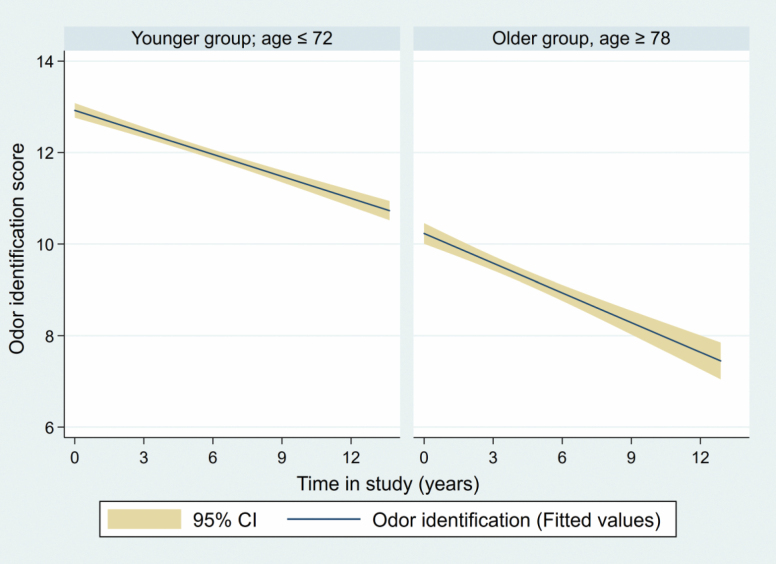
Advancing age, manufacturing profession, history of cerebrovascular disease, higher cardiovascular disease burden, diabetes, slower walking speed, higher number of medications, and the APOE ε4 allele were associated with accelerated odor identification decline (ps < .014). Multi-adjusted analyses showed unique associations of age, diabetes, and ε4 to olfactory decline (ps < .017). In 1531 participants who remained free of dementia (DSM IV criteria) during follow-up, age, cardiovascular disease burden, and diabetes were associated with accelerated decline (ps < .011). Of these, age and diabetes remained statistically significant in the multi-adjusted model (ps < .001).
Demographic, vascular, and genetic factors are linked to rate of decline in odor identification in aging. Although some olfactory loss may be an inevitable part of aging, our results highlight the importance of vascular factors for the integrity of the olfactory system, even in the absence of dementia.
嗅觉功能障碍在衰老中很常见,并且与痴呆和死亡率有关。然而,跟踪嗅觉能力变化的纵向研究很少。我们试图确定个体间嗅觉识别能力变化率差异的预测因素。
参与者是 1780 名个体,在基线时没有痴呆症,并且在 12 年的随访中有至少 2 次嗅觉评估(平均年龄=70.5 岁;61.9%为女性),来自瑞典 Kungsholmen 老龄化和护理全国研究(SNAC-K)。嗅觉识别能力使用 Sniffin' Sticks 进行评估。我们使用线性混合效应模型估计人口统计学、健康和遗传因素对嗅觉变化率的影响。
年龄增长、制造业职业、脑血管病史、心血管疾病负担较高、糖尿病、步行速度较慢、服用药物种类较多以及 APOE ε4 等位基因与嗅觉识别能力下降加速有关(p<.014)。多调整分析显示,年龄、糖尿病和 ε4 与嗅觉下降有独特的关联(p<.017)。在 1531 名随访期间未发生痴呆症(DSM-IV 标准)的参与者中,年龄、心血管疾病负担和糖尿病与嗅觉下降加速有关(p<.011)。在多调整模型中,年龄和糖尿病仍然具有统计学意义(p<.001)。
人口统计学、血管和遗传因素与衰老过程中嗅觉识别能力下降的速度有关。尽管一些嗅觉丧失可能是衰老不可避免的一部分,但我们的研究结果强调了血管因素对嗅觉系统完整性的重要性,即使在没有痴呆症的情况下也是如此。