Sorokowski Piotr, Karwowski Maciej, Misiak Michał, Marczak Michalina Konstancja, Dziekan Martyna, Hummel Thomas, Sorokowska Agnieszka
Institute of Psychology, University of Wroclaw, Wroclaw, Poland.
Institute of Psychology, Adam Mickiewicz University in Poznan, Poznan, Poland.
Front Psychol. 2019 Feb 13;10:242. doi: 10.3389/fpsyg.2019.00242. eCollection 2019.
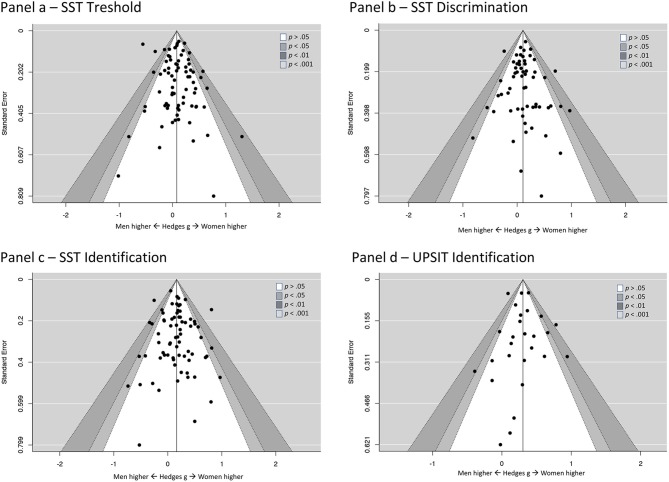
Although the view that women's olfactory abilities outperform men's is taken for granted, some studies involving large samples suggested that male and female olfactory abilities are actually similar. To address this discrepancy, we conducted a meta-analysis of existing studies on olfaction, targeting possible sex differences. The analyzed sample comprised = 8 848 (5 065 women and 3 783 men) for olfactory threshold (as measured with the Sniffin Sticks Test; SST), = 8 067 (4 496 women and 3 571 men) for discrimination (SST), = 13 670 (7 501 women and 6 169 men) for identification (SST), and a total sample of = 7 154 (3 866 women and 3 288 men) for works using University of Pennsylvania Smell Identification Test (UPSIT). We conducted separate meta-analyses for each aspect of olfaction: identification, discrimination and threshold. The results of our meta-analysis indicate that women generally outperform men in olfactory abilities. What is more, they do so in every aspect of olfaction analyzed in the current study. However, the effect sizes were weak and ranged between = 0.08 and = 0.30. We discuss our findings in the context of factors that potentially shape sex differences in olfaction. Nevertheless, although our findings seem to confirm the "common knowledge" on female olfactory superiority, it needs to be emphasized that the effect sizes we observed were notably small.
尽管女性嗅觉能力优于男性的观点被视为理所当然,但一些涉及大样本的研究表明,男性和女性的嗅觉能力实际上是相似的。为了解决这一差异,我们针对可能存在的性别差异,对现有的嗅觉研究进行了荟萃分析。分析样本包括用于嗅觉阈值(通过嗅棒测试;SST测量)的8848人(5065名女性和3783名男性)、用于辨别(SST)的8067人(4496名女性和3571名男性)、用于识别(SST)的13670人(7501名女性和6169名男性),以及使用宾夕法尼亚大学嗅觉识别测试(UPSIT)的研究中的7154人(3866名女性和3288名男性)的总样本。我们对嗅觉的每个方面:识别、辨别和阈值进行了单独的荟萃分析。我们的荟萃分析结果表明,女性在嗅觉能力方面通常优于男性。此外,在本研究分析的嗅觉的每个方面都是如此。然而,效应大小较弱,范围在0.08至0.30之间。我们在可能影响嗅觉性别差异的因素背景下讨论了我们的发现。尽管如此,虽然我们的发现似乎证实了关于女性嗅觉优势的“常识”,但需要强调的是,我们观察到的效应大小明显较小。