Hazlewood Jessamine E, Rawle Daniel J, Tang Bing, Yan Kexin, Vet Laura J, Nakayama Eri, Hobson-Peters Jody, Hall Roy A, Suhrbier Andreas
Inflammation Biology Group, QIMR Berghofer Medical Research Institute, Brisbane, QLD 4006, Australia.
School of Chemistry and Molecular Biosciences, University of Queensland, St. Lucia, QLD 4072, Australia.
Vaccines (Basel). 2020 Sep 2;8(3):496. doi: 10.3390/vaccines8030496.
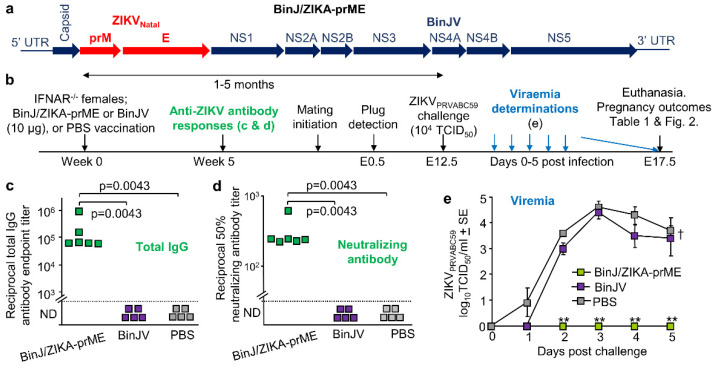
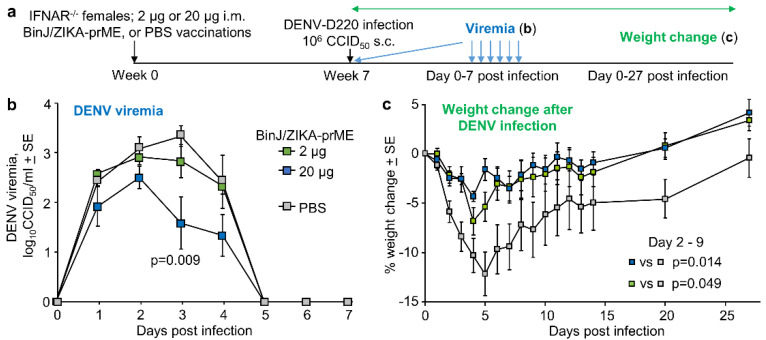
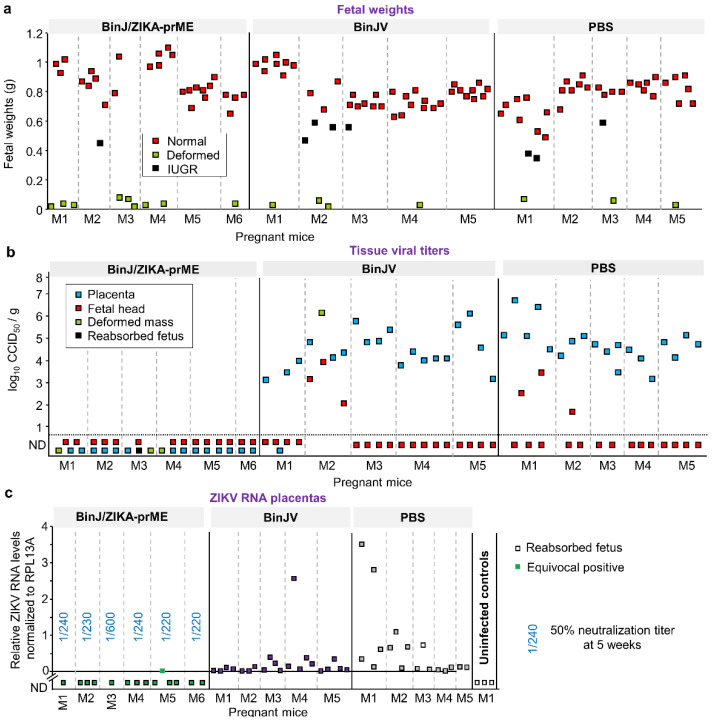
Zika virus (ZIKV) is the etiological agent of congenital Zika syndrome (CZS), a spectrum of birth defects that can lead to life-long disabilities. A range of vaccines are in development with the target population including pregnant women and women of child-bearing age. Using a recently described chimeric flavivirus vaccine technology based on the novel insect-specific Binjari virus (BinJV), we generated a ZIKV vaccine (BinJ/ZIKA-prME) and illustrate herein its ability to protect against fetal brain infection. Female IFNAR mice were vaccinated once with unadjuvanted BinJ/ZIKA-prME, were mated, and at embryonic day 12.5 were challenged with ZIKV. No infectious ZIKV was detected in maternal blood, placenta, or fetal heads in BinJ/ZIKA-prME-vaccinated mice. A similar result was obtained when the more sensitive qRT PCR methodology was used to measure the viral RNA. BinJ/ZIKA-prME vaccination also did not result in antibody-dependent enhancement of dengue virus infection or disease. BinJ/ZIKA-prME thus emerges as a potential vaccine candidate for the prevention of CSZ.
寨卡病毒(ZIKV)是先天性寨卡综合征(CZS)的病原体,CZS是一系列可导致终身残疾的出生缺陷。一系列疫苗正在研发中,目标人群包括孕妇和育龄妇女。利用最近描述的基于新型昆虫特异性宾贾里病毒(BinJV)的嵌合黄病毒疫苗技术,我们研发了一种寨卡病毒疫苗(BinJ/ZIKA-prME),并在此展示其预防胎儿脑部感染的能力。雌性IFNAR小鼠单次接种无佐剂的BinJ/ZIKA-prME,然后交配,在胚胎第12.5天用寨卡病毒进行攻击。在接种BinJ/ZIKA-prME的小鼠的母血、胎盘或胎儿头部未检测到传染性寨卡病毒。当使用更灵敏的qRT PCR方法测量病毒RNA时,也得到了类似的结果。BinJ/ZIKA-prME疫苗接种也未导致登革病毒感染或疾病的抗体依赖性增强。因此,BinJ/ZIKA-prME成为预防先天性寨卡综合征的潜在候选疫苗。