School of Mechatronical Engineering, Beijing Institute of Technology, Beijing 100081, China.
Shenzhen Institutes of Advanced Technology, Chinese Academy of Sciences, Shenzhen 518000, China.
Sensors (Basel). 2020 Sep 2;20(17):4966. doi: 10.3390/s20174966.
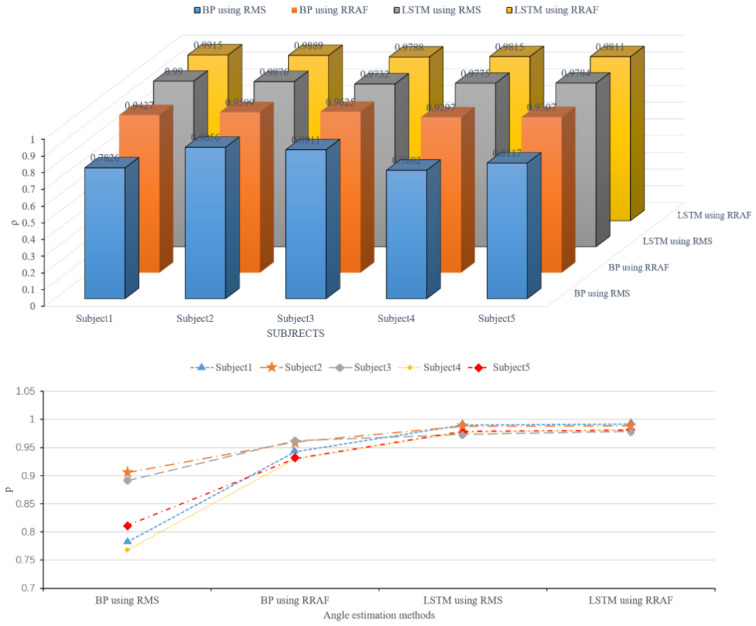
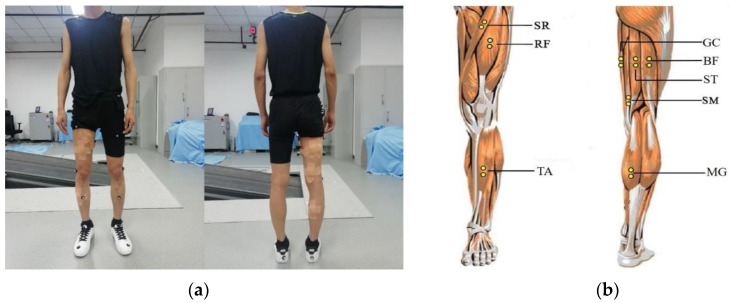
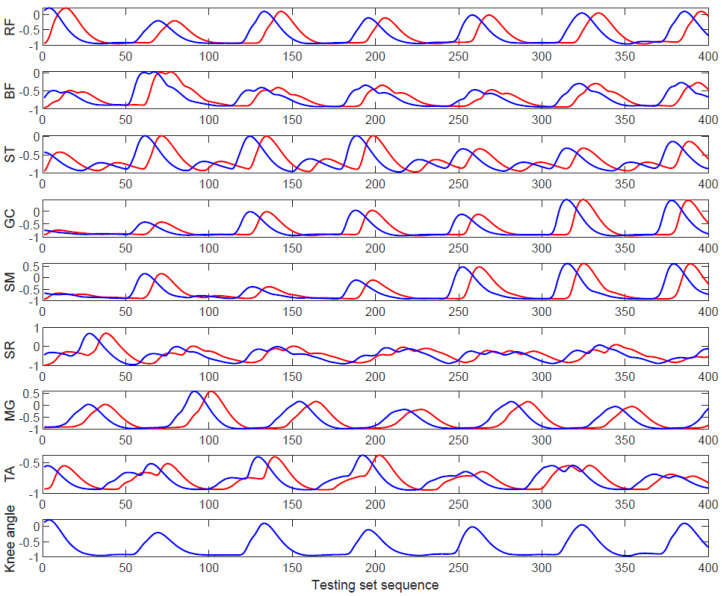
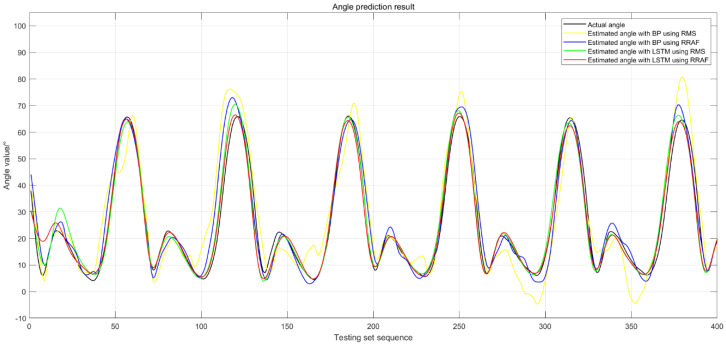
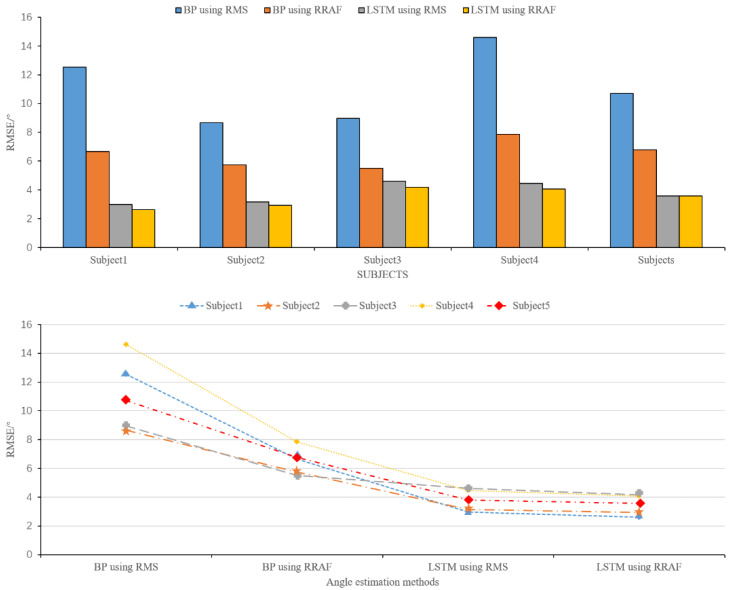
Continuous joint angle estimation based on a surface electromyography (sEMG) signal can be used to improve the man-machine coordination performance of the exoskeleton. In this study, we proposed a time-advanced feature and utilized long short-term memory (LSTM) with a root mean square (RMS) feature and its time-advanced feature (RMSTAF; collectively referred to as RRTAF) of sEMG to estimate the knee joint angle. To evaluate the effect of joint angle estimation, we used root mean square error (RMSE) and cross-correlation coefficient between the estimated angle and actual angle. We also compared three methods (i.e., LSTM using RMS, BPNN (back propagation neural network) using RRTAF, and BPNN using RMS) with LSTM using RRTAF to highlight its good performance. Five healthy subjects participated in the experiment and their eight muscle (i.e., rectus femoris (RF), biceps femoris (BF), semitendinosus (ST), gracilis (GC), semimembranosus (SM), sartorius (SR), medial gastrocnemius (MG), and tibialis anterior (TA)) sEMG signals were taken as algorithm inputs. Moreover, the knee joint angles were used as target values. The experimental results showed that, compared with LSTM using RMS, BPNN using RRTAF, and BPNN using RMS, the average RMSE values of LSTM using RRTAF were respectively reduced by 8.57%, 46.62%, and 68.69%, whereas the average values were respectively increased by 0.31%, 4.15%, and 18.35%. The results demonstrated that LSTM using RRTAF, which contained the time-advanced feature, had better performance for estimating the knee joint motion.
基于表面肌电信号(sEMG)的连续关节角度估计可用于提高外骨骼的人机协调性能。在这项研究中,我们提出了一个时间超前特征,并利用长短期记忆(LSTM)和其均方根(RMS)特征及其时间超前特征(RMSTAF;统称为 RRTAF)的 sEMG 来估计膝关节角度。为了评估关节角度估计的效果,我们使用均方根误差(RMSE)和估计角度与实际角度之间的互相关系数。我们还比较了三种方法(即使用 RMS 的 LSTM、使用 RRTAF 的 BPNN(反向传播神经网络)和使用 RMS 的 BPNN)与使用 RRTAF 的 LSTM,以突出其良好的性能。五名健康受试者参与了实验,他们的八块肌肉(即股直肌(RF)、股二头肌(BF)、半腱肌(ST)、股薄肌(GC)、半膜肌(SM)、缝匠肌(SR)、内侧腓肠肌(MG)和胫骨前肌(TA))的 sEMG 信号被用作算法输入。此外,膝关节角度被用作目标值。实验结果表明,与使用 RMS 的 LSTM、使用 RRTAF 的 BPNN 和使用 RMS 的 BPNN 相比,使用 RRTAF 的 LSTM 的平均 RMSE 值分别降低了 8.57%、46.62%和 68.69%,而平均 值分别增加了 0.31%、4.15%和 18.35%。结果表明,包含时间超前特征的使用 RRTAF 的 LSTM 具有更好的膝关节运动估计性能。