Department of Animal Science, University College of Agriculture and Natural Resources, University of Tehran, Karaj, 31587-11167, Iran.
Department of Animal Breeding and Genetics, Swedish University of Agricultural Sciences, SE-75007, Uppsala, Sweden.
Genet Sel Evol. 2020 Sep 4;52(1):52. doi: 10.1186/s12711-020-00571-5.
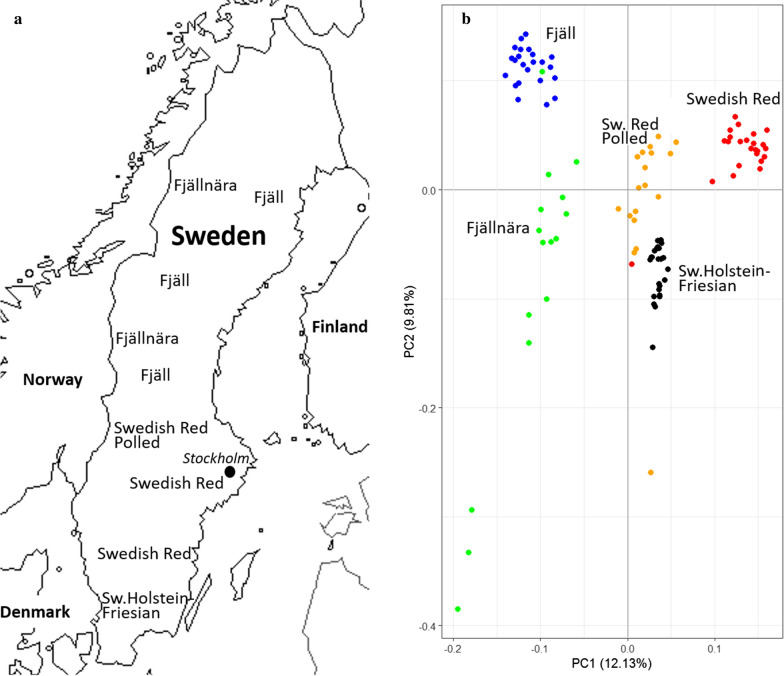
Thousands of years of natural and artificial selection have resulted in indigenous cattle breeds that are well-adapted to the environmental challenges of their local habitat and thereby are considered as valuable genetic resources. Understanding the genetic background of such adaptation processes can help us design effective breeding objectives to preserve local breeds and improve commercial cattle. To identify regions under putative selection, GGP HD 150 K single nucleotide polymorphism (SNP) arrays were used to genotype 106 individuals representing five Swedish breeds i.e. native to different regions and covering areas with a subarctic cold climate in the north and mountainous west, to those with a continental climate in the more densely populated south regions.
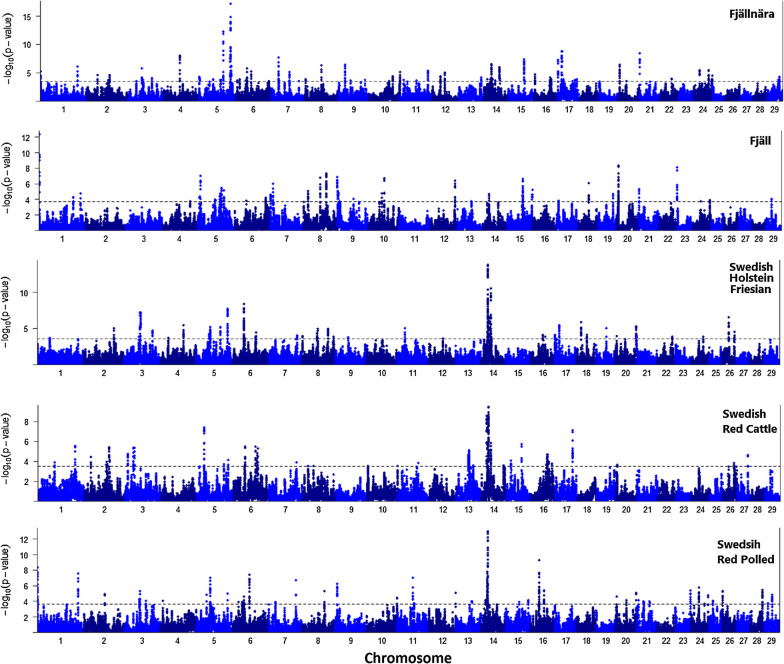
Five statistics were incorporated within a framework, known as de-correlated composite of multiple signals (DCMS) to detect signatures of selection. The obtained p-values were adjusted for multiple testing (FDR < 5%), and significant genomic regions were identified. Annotation of genes in these regions revealed various verified and novel candidate genes that are associated with a diverse range of traits, including e.g. high altitude adaptation and response to hypoxia (DCAF8, PPP1R12A, SLC16A3, UCP2, UCP3, TIGAR), cold acclimation (AQP3, AQP7, HSPB8), body size and stature (PLAG1, KCNA6, NDUFA9, AKAP3, C5H12orf4, RAD51AP1, FGF6, TIGAR, CCND2, CSMD3), resistance to disease and bacterial infection (CHI3L2, GBP6, PPFIBP1, REP15, CYP4F2, TIGD2, PYURF, SLC10A2, FCHSD2, ARHGEF17, RELT, PRDM2, KDM5B), reproduction (PPP1R12A, ZFP36L2, CSPP1), milk yield and components (NPC1L1, NUDCD3, ACSS1, FCHSD2), growth and feed efficiency (TMEM68, TGS1, LYN, XKR4, FOXA2, GBP2, GBP5, FGD6), and polled phenotype (URB1, EVA1C).
We identified genomic regions that may provide background knowledge to understand the mechanisms that are involved in economic traits and adaptation to cold climate in cattle. Incorporating p-values of different statistics in a single DCMS framework may help select and prioritize candidate genes for further analyses.
几千年的自然和人工选择造就了适应当地环境挑战的本土牛品种,因此被认为是有价值的遗传资源。了解这种适应过程的遗传背景可以帮助我们设计有效的育种目标,以保护本地品种和提高商业牛的产量。为了鉴定可能存在选择的区域,我们使用 GGP HD 150K 单核苷酸多态性 (SNP) 阵列对代表五个瑞典品种的 106 个个体进行了基因分型,这些品种分别来自不同的地区,涵盖了北部和西部的亚北极寒冷气候地区、山区,以及南部人口密集地区的大陆性气候地区。
我们将五种统计数据纳入一个称为去相关复合多信号 (DCMS) 的框架中,以检测选择的特征。获得的 P 值经过多重测试(FDR<5%)调整,并鉴定了显著的基因组区域。对这些区域中的基因注释揭示了各种已验证和新的候选基因,这些基因与各种性状相关,例如高海拔适应和对缺氧的反应(DCAF8、PPP1R12A、SLC16A3、UCP2、UCP3、TIGAR)、冷适应(AQP3、AQP7、HSPB8)、体型和身材(PLAG1、KCNA6、NDUFA9、AKAP3、C5H12orf4、RAD51AP1、FGF6、TIGAR、CCND2、CSMD3)、对疾病和细菌感染的抵抗力(CHI3L2、GBP6、PPFIBP1、REP15、CYP4F2、TIGD2、PYURF、SLC10A2、FCHSD2、ARHGEF17、RELT、PRDM2、KDM5B)、繁殖(PPP1R12A、ZFP36L2、CSPP1)、产奶量和成分(NPC1L1、NUDCD3、ACSS1、FCHSD2)、生长和饲料效率(TMEM68、TGS1、LYN、XKR4、FOXA2、GBP2、GBP5、FGD6)和无角表型(URB1、EVA1C)。
我们鉴定了可能为理解经济性状和牛对寒冷气候适应机制提供背景知识的基因组区域。在单个 DCMS 框架中合并不同统计数据的 P 值可以帮助选择和优先考虑候选基因,以便进一步分析。