Center for Evidence-Based and Translational Medicine, Zhongnan Hospital of Wuhan University, Wuhan, 430071, China.
National Clinical Research Center for Respiratory Diseases, China-Japan Friendship Hospital, Beijing, 100029, China.
Mil Med Res. 2020 Sep 4;7(1):41. doi: 10.1186/s40779-020-00270-8.
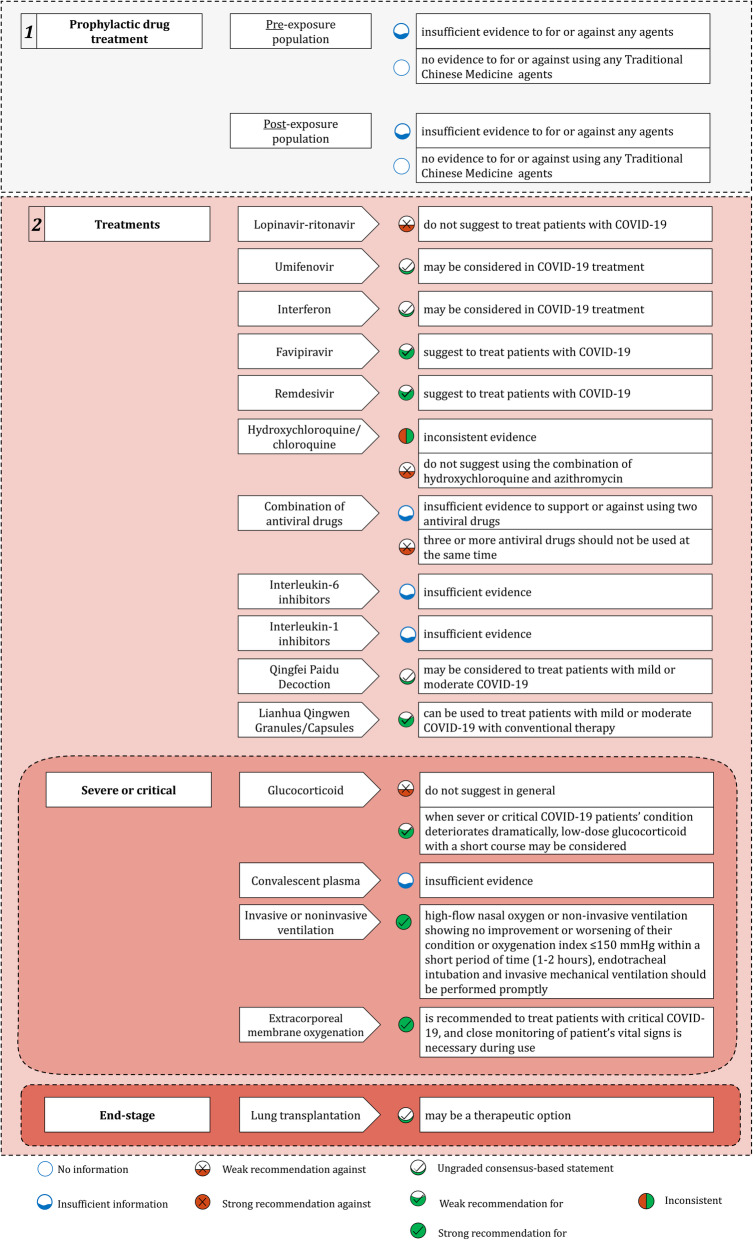
The novel severe acute respiratory syndrome coronavirus 2 (SARS-CoV-2) is the cause of a rapidly spreading illness, coronavirus disease 2019 (COVID-19), affecting more than seventeen million people around the world. Diagnosis and treatment guidelines for clinicians caring for patients are needed. In the early stage, we have issued "A rapid advice guideline for the diagnosis and treatment of 2019 novel coronavirus (2019-nCoV) infected pneumonia (standard version)"; now there are many direct evidences emerged and may change some of previous recommendations and it is ripe for develop an evidence-based guideline. We formed a working group of clinical experts and methodologists. The steering group members proposed 29 questions that are relevant to the management of COVID-19 covering the following areas: chemoprophylaxis, diagnosis, treatments, and discharge management. We searched the literature for direct evidence on the management of COVID-19, and assessed its certainty generated recommendations using the Grading of Recommendations, Assessment, Development and Evaluation (GRADE) approach. Recommendations were either strong or weak, or in the form of ungraded consensus-based statement. Finally, we issued 34 statements. Among them, 6 were strong recommendations for, 14 were weak recommendations for, 3 were weak recommendations against and 11 were ungraded consensus-based statement. They covered topics of chemoprophylaxis (including agents and Traditional Chinese Medicine (TCM) agents), diagnosis (including clinical manifestations, reverse transcription-polymerase chain reaction (RT-PCR), respiratory tract specimens, IgM and IgG antibody tests, chest computed tomography, chest x-ray, and CT features of asymptomatic infections), treatments (including lopinavir-ritonavir, umifenovir, favipiravir, interferon, remdesivir, combination of antiviral drugs, hydroxychloroquine/chloroquine, interleukin-6 inhibitors, interleukin-1 inhibitors, glucocorticoid, qingfei paidu decoction, lianhua qingwen granules/capsules, convalescent plasma, lung transplantation, invasive or noninvasive ventilation, and extracorporeal membrane oxygenation (ECMO)), and discharge management (including discharge criteria and management plan in patients whose RT-PCR retesting shows SARS-CoV-2 positive after discharge). We also created two figures of these recommendations for the implementation purpose. We hope these recommendations can help support healthcare workers caring for COVID-19 patients.
新型严重急性呼吸综合征冠状病毒 2(SARS-CoV-2)是一种迅速传播的疾病的病原体,即 2019 年冠状病毒病(COVID-19),影响了全球超过 1700 万人。需要为照顾患者的临床医生制定诊断和治疗指南。在早期,我们已经发布了“针对 2019 年新型冠状病毒(2019-nCoV)感染肺炎的快速诊断和治疗指南(标准版)”;现在出现了许多直接证据,可能会改变以前的一些建议,现在已经成熟,可以制定一个基于证据的指南。我们成立了一个由临床专家和方法学家组成的工作组。指导小组成员提出了 29 个与 COVID-19 管理相关的问题,涵盖了以下领域:化学预防、诊断、治疗和出院管理。我们搜索了 COVID-19 管理的直接证据,并使用推荐评估、制定与评价(GRADE)方法评估其确定性,生成建议。建议要么是强有力的,要么是弱的,要么是未分级的共识性陈述。最后,我们发布了 34 条声明。其中,有 6 条是针对化学预防(包括药物和中药)的强烈建议,有 14 条是针对诊断(包括临床表现、逆转录-聚合酶链反应(RT-PCR)、呼吸道标本、IgM 和 IgG 抗体检测、胸部计算机断层扫描、胸部 X 线和无症状感染的 CT 特征)的弱建议,有 3 条是针对治疗(包括洛匹那韦-利托那韦、乌米酚韦、法匹拉韦、干扰素、瑞德西韦、抗病毒药物联合、羟氯喹/氯喹、白细胞介素-6 抑制剂、白细胞介素-1 抑制剂、糖皮质激素、清肺排毒汤、连花清瘟颗粒/胶囊、恢复期血浆、肺移植、有创或无创通气以及体外膜氧合(ECMO))的弱建议,有 11 条是针对出院管理(包括出院标准和出院后 RT-PCR 复查 SARS-CoV-2 阳性患者的管理计划)的未分级共识性陈述。我们还为实施目的创建了这两个建议的两个图表。我们希望这些建议能够帮助支持照顾 COVID-19 患者的医护人员。