Department of Psychosocial Oncology and Palliative Care, Dana-Farber Cancer Institute, Boston, Massachusetts, USA.
Department of Psychosocial Oncology and Palliative Care, Dana-Farber Cancer Institute, Boston, Massachusetts, USA; Department of Pediatrics, Boston Children's Hospital, Boston, Massachusetts, USA.
J Pain Symptom Manage. 2020 Nov;60(5):e15-e20. doi: 10.1016/j.jpainsymman.2020.08.035. Epub 2020 Sep 2.
Coronavirus disease 2019 (COVID-19) has impacted most elements of daily life, including the provision of support after a child's death and the experience of parental bereavement.
This study aims to examine ways in which COVID-19 has affected the bereavement experiences of parents whose children died of cancer before the pandemic.
Parents who participated in a survey-based study examining the early grief experience were invited to complete a semistructured interview. During the interview, which focused on examining the current support for parents and other family members within the first several years after the child's death, participants were asked how COVID-19 has impacted their life and bereavement.
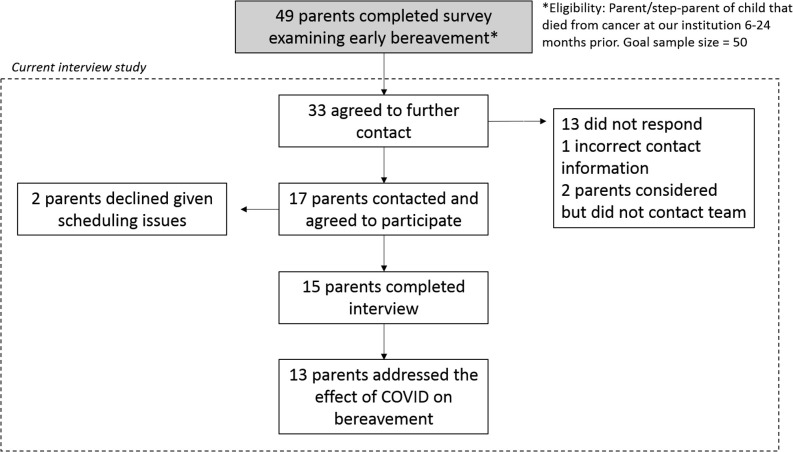
Fifteen of 33 eligible parents completed the interview; 14 were white and non-Hispanic, five were males. Parents participated an average of 19 (range 12-34) months after their child's death. COVID-19 was addressed in 13 interviews. Eleven codes were used to describe interview segments; the most commonly used codes were change in support, no effect, familiarity with uncertainty/ability to cope, and change in contact with care/research team.
Parents identified multiple and variable ways-both positive, negative, and neutral-how COVID-19 has affected their bereavement. Many parents commented on feeling more isolated because of the inability to connect with family or attend in-person support groups, whereas others acknowledged their experience has made them uniquely positioned to cope with the uncertainty of the current situation. Clinicians must find innovative ways to connect with and support bereaved parents during this unique time.
2019 年冠状病毒病(COVID-19)对日常生活的大多数方面都产生了影响,包括为孩子去世后的家庭提供支持,以及父母丧亲的经历。
本研究旨在探讨 COVID-19 如何影响大流行前因癌症而去世的孩子的父母的丧亲经历。
参加了一项基于调查的研究,该研究旨在检查大流行后几年内孩子死亡后父母和其他家庭成员的当前支持情况的父母,被邀请完成半结构化访谈。在访谈中,重点是检查父母的当前支持以及孩子去世后几年内的丧亲经历,询问参与者 COVID-19 如何影响他们的生活和丧亲。
在 33 位符合条件的父母中,有 15 位完成了访谈;14 位是白人,非西班牙裔,5 位是男性。父母在孩子去世后平均参与了 19 个月(范围 12-34)。在 13 次访谈中提到了 COVID-19。使用了 11 个代码来描述访谈片段;最常用的代码是支持的变化,没有影响,对不确定性的熟悉/应对能力,以及与护理/研究团队的接触变化。
父母确定了多种不同的方式,包括积极,消极和中立,COVID-19 如何影响他们的丧亲。许多父母表示,由于无法与家人联系或无法参加面对面的支持小组,他们感到更加孤立,而另一些父母则承认,他们的经历使他们能够更好地应对当前情况的不确定性。临床医生必须在这个特殊时期找到与丧亲父母保持联系并为其提供支持的创新方法。