Computational Medicine Center, Thomas Jefferson University, 1020 Locust Street, Philadelphia, PA 19107, USA.
Nucleic Acids Res. 2020 Sep 25;48(17):9433-9448. doi: 10.1093/nar/gkaa657.
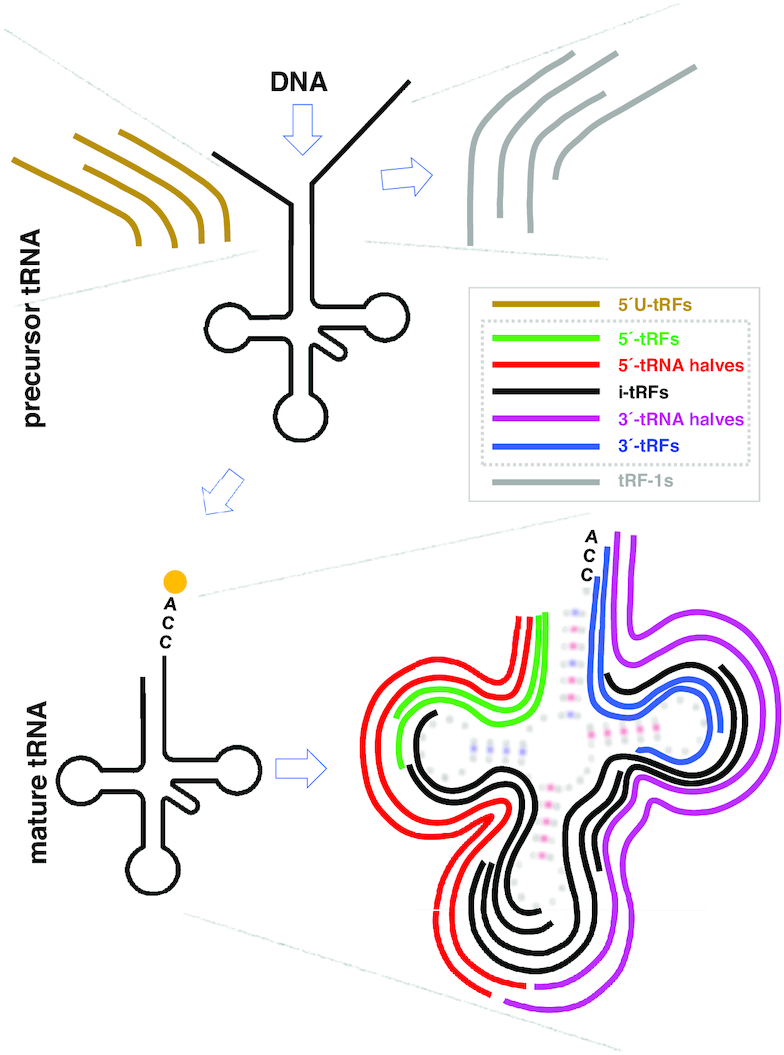
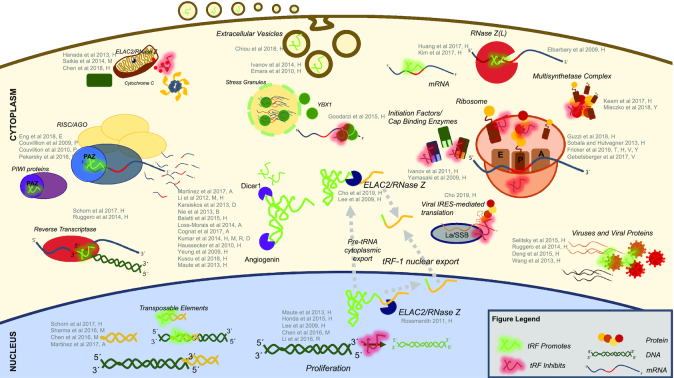
The fragments that derive from transfer RNAs (tRNAs) are an emerging category of regulatory RNAs. Known as tRFs, these fragments were reported for the first time only a decade ago, making them a relatively recent addition to the ever-expanding pantheon of non-coding RNAs. tRFs are short, 16-35 nucleotides (nts) in length, and produced through cleavage of mature and precursor tRNAs at various positions. Both cleavage positions and relative tRF abundance depend strongly on context, including the tissue type, tissue state, and disease, as well as the sex, population of origin, and race/ethnicity of an individual. These dependencies increase the urgency to understand the regulatory roles of tRFs. Such efforts are gaining momentum, and comprise experimental and computational approaches. System-level studies across many tissues and thousands of samples have produced strong evidence that tRFs have important and multi-faceted roles. Here, we review the relevant literature on tRF biology in higher organisms, single cell eukaryotes, and prokaryotes.
源自转移 RNA(tRNA)的片段是一类新兴的调控 RNA。这些片段被称为 tRFs,它们于十年前首次被报道,是不断扩展的非编码 RNA 大家族中的相对较新成员。tRFs 长度较短,为 16-35 个核苷酸(nt),通过成熟和前体 tRNA 在不同位置的切割产生。切割位置和相对 tRF 丰度强烈依赖于上下文,包括组织类型、组织状态和疾病,以及个体的性别、来源人群和种族/民族。这些依赖性增加了理解 tRF 调控作用的紧迫性。这些努力正在取得进展,包括实验和计算方法。在许多组织和数千个样本中进行的系统水平研究提供了强有力的证据,表明 tRFs 具有重要的、多方面的作用。在这里,我们综述了高等生物、单细胞真核生物和原核生物中 tRF 生物学的相关文献。