Yu Qiuhua, Huang Huanjie, Zhang Zhou, Hu Xiaoqian, Li Wenfeng, Li Le, Chen Min, Liang Zhenwen, Lo Wai Leung Ambrose, Wang Chuhuai
Department of Rehabilitation Medicine, The First Affiliated Hospital, Sun Yat-sen University, 58 Zhong Shan Er Lu, Guangzhou, 5100800, China.
School of Biomedical Sciences, Li Ka Shing Faculty of Medicine, The University of Hong Kong, Hong Kong, China.
BMC Musculoskelet Disord. 2020 Sep 5;21(1):596. doi: 10.1186/s12891-020-03617-3.
Empirical evidence that demonstrates the relationship between pelvic asymmetry and non-specific chronic low back pain (NCLBP) is currently lacking.
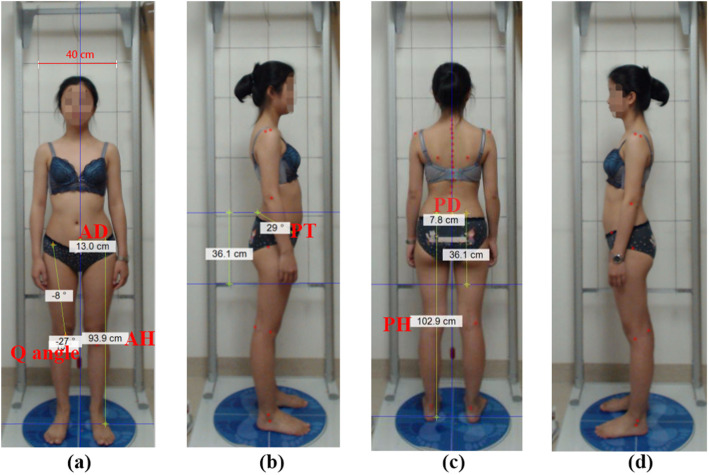
To establish the reliability of the Global Postural System (GPS) in assessing pelvic asymmetry and identify the association between pelvic asymmetry parameters and the occurrence of NCLBP in young adults.
A cross-sectional, regression study.
People who were aged between 18 and 30 and were diagnosed with NCLBP were recruited. Healthy individuals who were matched for age, sex, and education level were recruited as controls. Global Postural System (GPS) was employed to assess pelvic asymmetry. Prior to exploring the association, the reliability of GPS was assessed by the ICC (2, k) for interrater reliability, ICC (3, k) for intra-rater reliability, standard error and minimal detectable difference. Bivariate correlation analysis and logistic regression analysis were used to determine the relationship between pelvic asymmetry and the occurrence of NCLBP.
Twenty-eight healthy participants and 28 people with NCLBP were recruited. Moderate to excellent ICCs were observed for the inter-rater and intra-rater reliability of most postural parameters. The bivariate correlation analysis indicated that age, body mass index and pelvic asymmetry parameters were related to the occurrence of NCLBP. Pelvic angle asymmetry (odds ratio = 1.17), and asymmetry of the distance between the posterior superior iliac spine and the floor (odds ratio = 1.21) were associated with NCLBP.
This study did not explore the causal relationship between pelvic asymmetry in the sagittal plane/pelvic asymmetry in the transverse plane and the occurrence of NCLBP. The interpretation of the results may not be generalized beyond the sample population.
The GPS is a reliable method to assess pelvic asymmetry in a clinical setting. Two pelvic parameters were associated with the presence of NLBP. Measurement of pelvic asymmetry may assist in the early identification of potential occurrence of NCLBP but further work is required.
目前缺乏能证明骨盆不对称与非特异性慢性下腰痛(NCLBP)之间关系的实证证据。
确定全球姿势系统(GPS)在评估骨盆不对称方面的可靠性,并确定骨盆不对称参数与年轻成年人NCLBP发生之间的关联。
一项横断面回归研究。
招募年龄在18至30岁之间且被诊断为NCLBP的人群。招募年龄、性别和教育水平相匹配的健康个体作为对照。采用全球姿势系统(GPS)评估骨盆不对称。在探索关联之前,通过组间相关系数(ICC)(2,k)评估GPS的组间可靠性,通过ICC(3,k)评估组内可靠性、标准误差和最小可检测差异。采用双变量相关分析和逻辑回归分析来确定骨盆不对称与NCLBP发生之间的关系。
招募了28名健康参与者和28名患有NCLBP的人。大多数姿势参数的组间和组内可靠性观察到中等至优秀的ICC值。双变量相关分析表明,年龄、体重指数和骨盆不对称参数与NCLBP的发生有关。骨盆角度不对称(优势比 = 1.17)以及髂后上棘与地面之间距离的不对称(优势比 = 1.21)与NCLBP相关。
本研究未探讨矢状面骨盆不对称/横断面骨盆不对称与NCLBP发生之间的因果关系。结果的解释可能不适用于样本人群之外的情况。
GPS是在临床环境中评估骨盆不对称的可靠方法。两个骨盆参数与NLBP的存在相关。骨盆不对称的测量可能有助于早期识别NCLBP的潜在发生,但仍需进一步研究。