Department of Obstetrics and Gynecology, Erasmus MC, University Medical Center Rotterdam, PO Box 2040, 3000 CA, Rotterdam, the Netherlands.
Department of Epidemiology, Erasmus MC, University Medical Center Rotterdam, PO Box 2040, 3000 CA, Rotterdam, the Netherlands.
BMC Pregnancy Childbirth. 2020 Sep 7;20(1):515. doi: 10.1186/s12884-020-03180-8.
In recent years it has become clear that fetal anomalies can already be detected at the end of the first trimester of pregnancy by two-dimensional (2D) ultrasound. This is why increasingly in developed countries the first trimester anomaly scan is being offered as part of standard care. We have developed a Virtual Reality (VR) approach to improve the diagnostic abilities of 2D ultrasound. Three-dimensional (3D) ultrasound datasets are used in VR assessment, enabling real depth perception and unique interaction. The aim of this study is to investigate whether first trimester 3D VR ultrasound is of additional value in terms of diagnostic accuracy for the detection of fetal anomalies. Health-related quality of life, cost-effectiveness and also the perspective of both patient and ultrasonographer on the 3D VR modality will be studied.
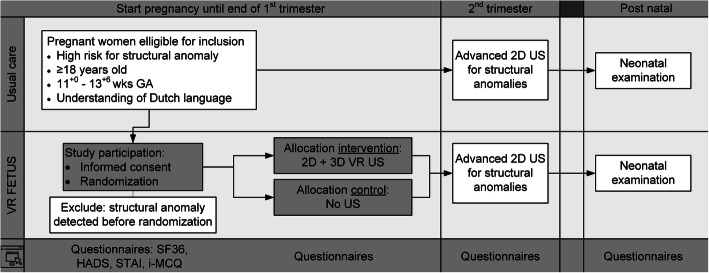
Women in the first trimester of a high risk pregnancy for a fetus with a congenital anomaly are eligible for inclusion. This is a randomized controlled trial with two intervention arms. The control group receives 'care as usual': a second trimester 2D advanced ultrasound examination. The intervention group will undergo an additional first trimester 2D and 3D VR ultrasound examination. Following each examination participants will fill in validated questionnaires evaluating their quality of life and healthcare related expenses. Participants' and ultrasonographers' perspectives on the 3D VR ultrasound will be surveyed. The primary outcome will be the detection of fetal anomalies. The additional first trimester 3D VR ultrasound examination will be compared to 'care as usual'. Neonatal or histopathological examinations are considered the gold standard for the detection of congenital anomalies. To reach statistical significance and 80% power with a detection rate of 65% for second trimester ultrasound examination and 70% for the combined detection of first trimester 3D VR and second trimester ultrasound examination, a sample size of 2800 participants is needed.
First trimester 3D VR detection of fetal anomalies may improve patients' quality of life through reassurance or earlier identification of malformations. Results of this study will provide policymakers and healthcare professionals with the highest level of evidence for cost-effectiveness of first trimester ultrasound using a 3D VR approach.
Dutch Trial Registration number NTR6309 , date of registration 26 January 2017.
近年来,二维(2D)超声技术已能够在妊娠第一期末检测到胎儿异常,因此在发达国家,第一孕期异常扫描作为标准护理的一部分被越来越多地提供。我们开发了一种虚拟现实(VR)方法来提高 2D 超声的诊断能力。在 VR 评估中使用三维(3D)超声数据集,实现真实的深度感知和独特的交互。本研究旨在探讨第一孕期 3D VR 超声在检测胎儿异常方面的诊断准确性是否具有附加价值。还将研究健康相关生活质量、成本效益以及患者和超声医师对 3D VR 模式的看法。
高危妊娠第一孕期的胎儿有先天性异常的妇女有资格入选。这是一项随机对照试验,有两个干预组。对照组接受“常规护理”:第二孕期 2D 高级超声检查。干预组将进行额外的第一孕期 2D 和 3D VR 超声检查。每次检查后,参与者将填写经过验证的问卷,评估他们的生活质量和医疗保健相关费用。还将调查参与者和超声医师对 3D VR 超声的看法。主要结局将是检测到胎儿异常。将额外的第一孕期 3D VR 超声检查与“常规护理”进行比较。新生儿或组织病理学检查被认为是检测先天性异常的金标准。为了达到统计学意义和 80%的效力,对于第二孕期超声检查的检测率为 65%,第一孕期 3D VR 和第二孕期超声联合检测的检测率为 70%,需要 2800 名参与者的样本量。
第一孕期 3D VR 检测胎儿异常可以通过保证或更早地识别畸形来提高患者的生活质量。本研究的结果将为决策者和医疗保健专业人员提供第一孕期使用 3D VR 方法进行超声检查的成本效益的最高水平证据。
荷兰试验注册编号 NTR6309,注册日期为 2017 年 1 月 26 日。