Institute of Collective Health, Universidade Federal da Bahia, Salvador, Brazil.
School of Nutrition, Universidade Federal da Bahia, Salvador, Brazil.
Public Health Nutr. 2020 Dec;23(17):3236-3240. doi: 10.1017/S1368980020003493. Epub 2020 Sep 8.
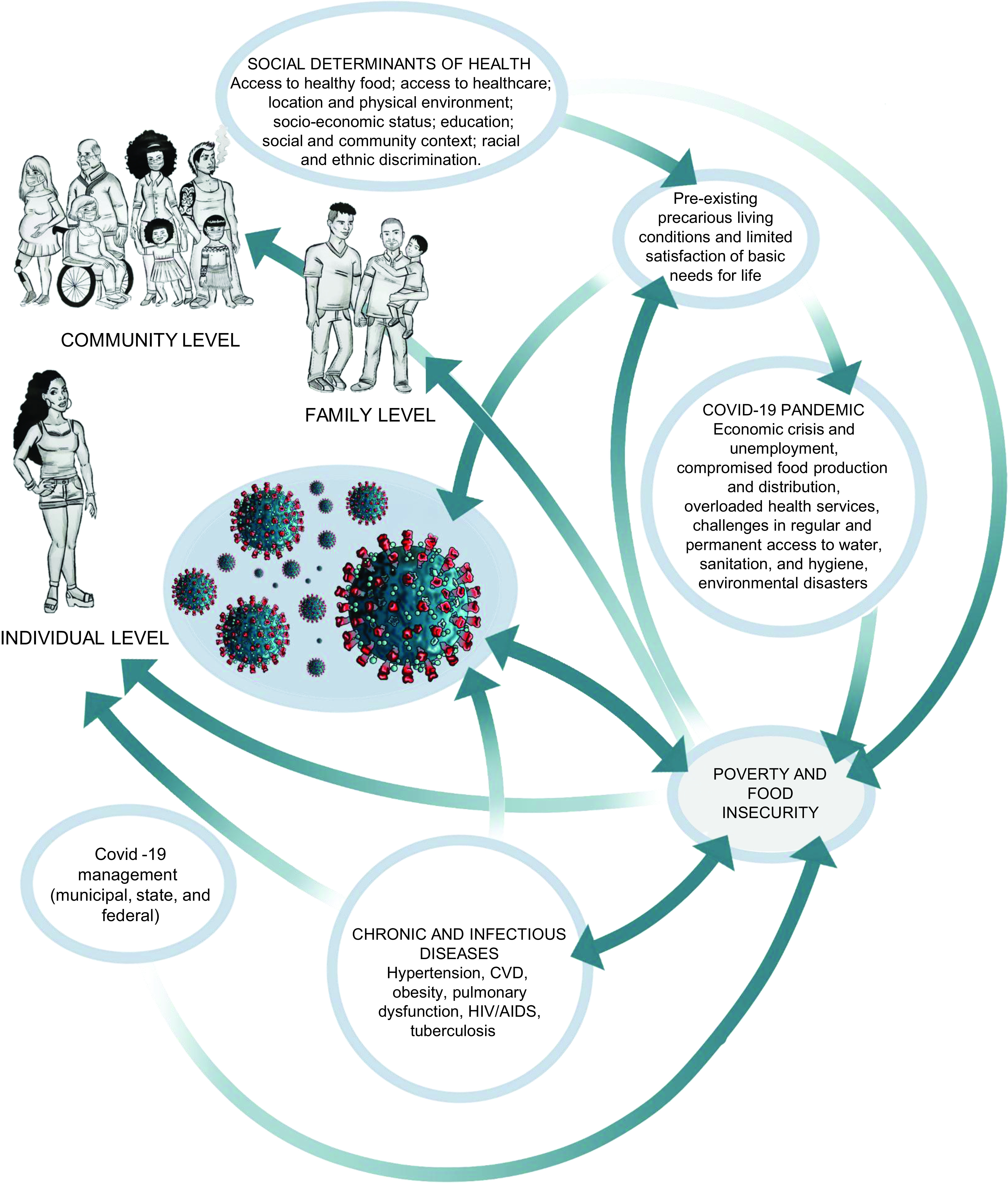
This article discusses the relationship between both poverty and food insecurity (FI) and the COVID-19 pandemic, as well as presenting possible strategies and actions for increasing social protection in the fight against these conditions in the current epidemiological context, especially for low-income countries. This is a narrative review concerning COVID-19, poverty, and food and nutritional insecurity. The COVID-19 pandemic may increase poverty and FI levels, resulting from the absence of or weak political, economic and social interventions to maintain jobs, as well as compromised food production and distribution chains and reduced access to healthy foods in different countries around the world, especially the poorest ones, where social and economic inequality was already historically high; the pandemic heightens and uncovers the vulnerability of poor populations. Public policies focused on guaranteeing the human right to adequate food must be improved and implemented for populations in contexts of poverty with the aim of providing food security.
本文讨论了贫困和粮食不安全(FI)与 COVID-19 大流行之间的关系,并提出了在当前流行病学背景下,特别是在低收入国家,增加社会保护以对抗这些情况的可能策略和行动。这是一篇关于 COVID-19、贫困和粮食及营养不安全的叙述性综述。COVID-19 大流行可能会增加贫困和 FI 水平,这是由于缺乏或薄弱的政治、经济和社会干预措施来维持就业,以及粮食生产和分配链受损,以及在全球不同国家,特别是最贫穷国家,获得健康食品的机会减少,而这些国家的社会和经济不平等在历史上已经很高;大流行加剧并揭示了贫困人口的脆弱性。必须改善和实施面向贫困人群的公共政策,以保障其获得充足食物的人权,从而实现粮食安全。