Instituto de Investigación Nutricional (IIN), Lima 15024, Peru.
Grupo de Análisis para el Desarrollo (GRADE), Lima 15063, Peru.
Nutrients. 2021 Oct 9;13(10):3546. doi: 10.3390/nu13103546.
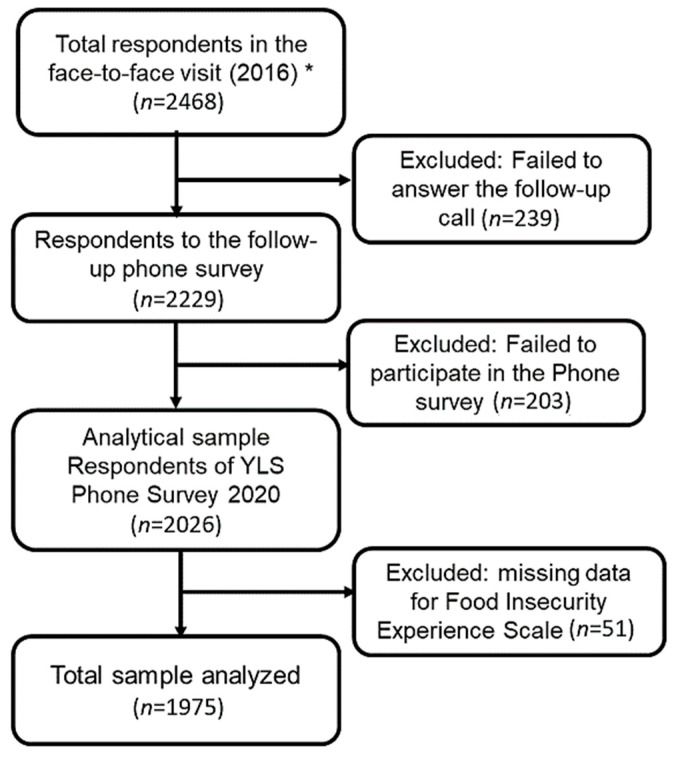
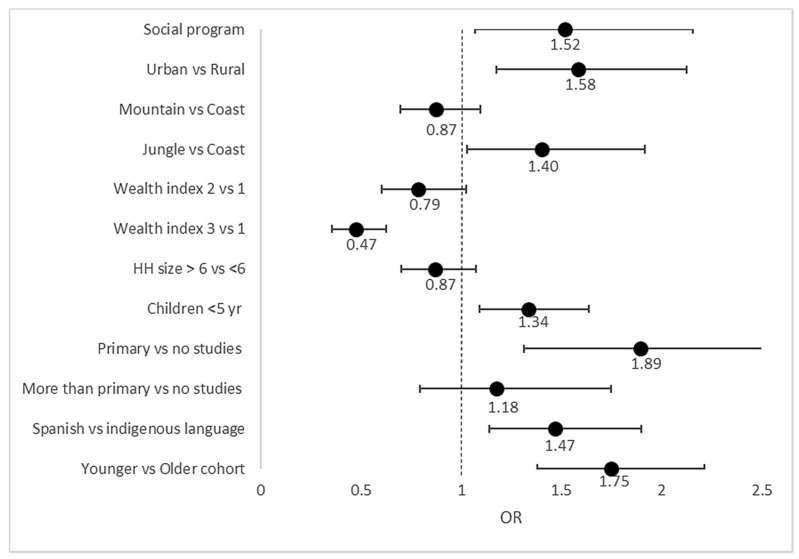
Peruvian households have experienced one of the most prevalent economic shocks due to COVID-19, significantly increasing their vulnerability to food insecurity (FI). To understand the vulnerability characteristics of these households among the Peruvian young population, including the role of the government's response through emergency cash transfer, we analysed longitudinal data from the Young Lives study ( = 2026), a study that follows the livelihoods of two birth cohorts currently aged 18 to 27 years old. FI was assessed using the Food Insecurity Experience Scale. Household characteristics were collected before and during the COVID-19 outbreak in Peru to characterise participants' vulnerability to FI. Multivariate logistic regression was used to evaluate the association between government support and participants' vulnerability characteristics to FI. During the period under study (March to December 2020), 24% (95% CI: 22.1-25.9%) of the participants experienced FI. Families in the top wealth tercile were 49% less likely to experience FI. Larger families (>5 members) and those with increased household expenses and decreased income due to COVID-19 were more likely to experience FI (by 35%, 39% and 42%, respectively). There was no significant association between government support and FI ( = 0.768). We conclude that pre-pandemic socioeconomic status, family size, and the economic disruption during COVID-19 contribute to the risk of FI among the Peruvian young population, while government support insufficiently curtailed the risk to these households.
秘鲁家庭经历了由 COVID-19 引发的最普遍的经济冲击之一,这极大地增加了他们面临粮食不安全(FI)的脆弱性。为了了解秘鲁年轻人群体中这些家庭的脆弱性特征,包括政府通过紧急现金转移做出的反应的作用,我们分析了 Young Lives 研究(n=2026)的纵向数据。该研究跟踪了目前年龄在 18 至 27 岁的两个出生队列的生计情况。使用粮食不安全经验量表评估 FI。在秘鲁 COVID-19 爆发之前和期间收集了家庭特征,以描述参与者面临 FI 的脆弱性。使用多变量逻辑回归评估政府支持与参与者面临 FI 的脆弱性特征之间的关联。在所研究的期间(2020 年 3 月至 12 月),24%(95%CI:22.1-25.9%)的参与者经历了 FI。处于最富有三分之一的家庭经历 FI 的可能性降低了 49%。家庭规模较大(>5 人),以及由于 COVID-19 导致家庭开支增加和收入减少的家庭更有可能经历 FI(分别增加了 35%、39%和 42%)。政府支持与 FI 之间没有显著关联( = 0.768)。我们得出结论,大流行前的社会经济地位、家庭规模以及 COVID-19 期间的经济混乱导致秘鲁年轻人群体面临 FI 的风险增加,而政府支持不足以减少这些家庭面临的风险。