Zhang Yong, Pan Yang, Zhao Xiang, Shi Weifeng, Chen Zhixiao, Zhang Sheng, Liu Peipei, Xiao Jinbo, Tan Wenjie, Wang Dayan, Liu William J, Xu Wenbo, Wang Quanyi, Wu Guizhen
NHC Key Laboratory of Biosafety, National Institute for Viral Disease Control and Prevention, Chinese Center for Disease Control and Prevention, Beijing 102206, China.
Beijing Center for Disease Control and Prevention, Beijing 100013, China.
Biosaf Health. 2020 Dec;2(4):202-205. doi: 10.1016/j.bsheal.2020.08.006. Epub 2020 Sep 2.
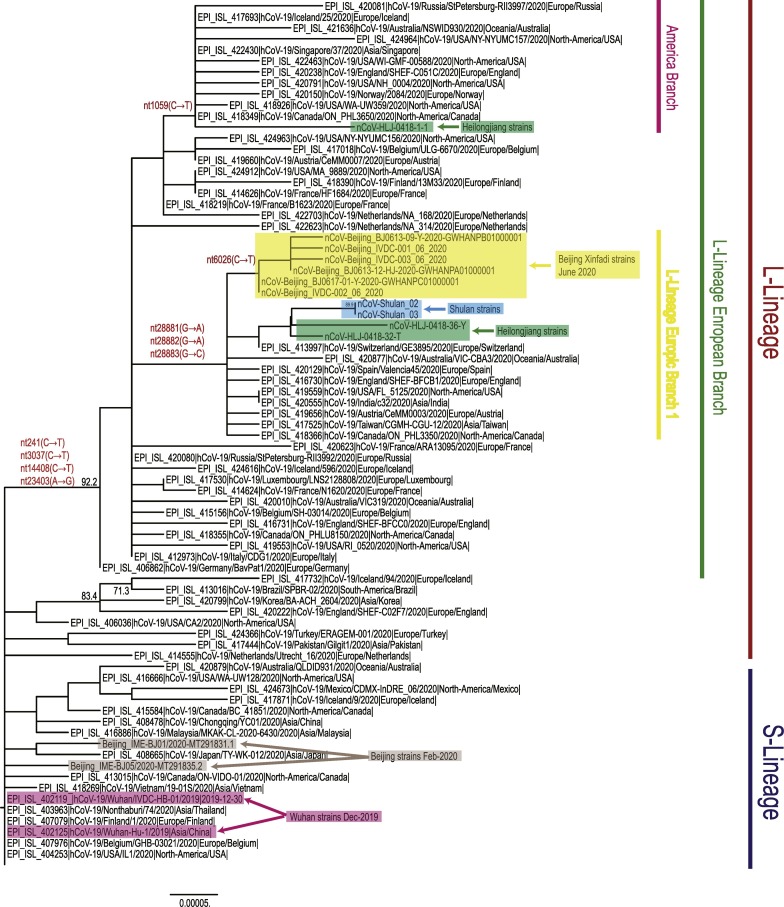
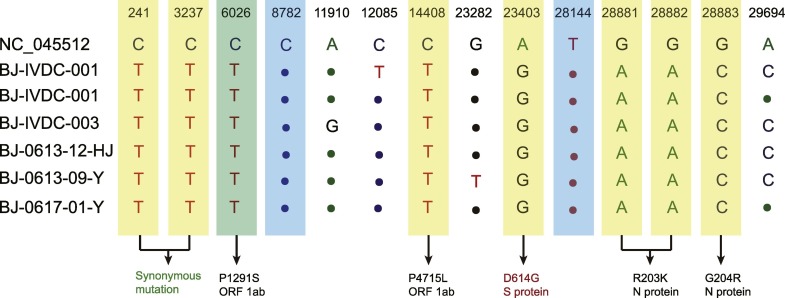
After 56 days without coronavirus disease 2019 (COVID-19) cases, reemergent cases were reported in Beijing, China on June 11, 2020. Here, we report the genetic characteristics of severe acute respiratory syndrome coronavirus 2 (SARS-CoV-2) sequenced from the clinical specimens of 4 human cases and 2 environmental samples. The nucleotide similarity among six SARS-CoV-2 genomes ranged from 99.98% to 99.99%. Compared with the reference strain of SARS-CoV-2 (GenBank No. NC_045512), all six genome sequences shared the same substitutions at nt241 (C → T), nt3037 (C → T), nt14408 (C → T), nt23403 (A → G), nt28881 (G → A), nt28882 (G → A), and nt28883 (G → C), which are the characteristic nucleotide substitutions of L-lineage European branch I. This was also proved by the maximum likelihood phylogenetic tree based on the full-length genome of SARS-CoV-2. They also have a unique shared nucleotide substitution, nt6026 (C → T), which is the characteristic nucleotide substitution of SARS-CoV-2 in Beijing's Xinfadi outbreak. It is noteworthy that there is an amino acid D614G mutation caused by nt23403 substitution in all six genomes, which may enhance the virus's infectivity in humans and help it become the leading strain of the virus to spread around the world today. It is necessary to continuously monitor the genetic variation of SARS-CoV-2, focusing on the influence of key mutation sites of SARS-CoV-2 on viral transmission, clinical manifestations, severity, and course of disease.
在连续56天无新型冠状病毒肺炎(COVID-19)病例后,2020年6月11日中国北京报告了病例复现情况。在此,我们报告了从4例人类病例和2份环境样本的临床标本中测序得到的严重急性呼吸综合征冠状病毒2(SARS-CoV-2)的基因特征。6个SARS-CoV-2基因组之间的核苷酸相似性在99.98%至99.99%之间。与SARS-CoV-2参考毒株(GenBank编号:NC_045512)相比,所有6个基因组序列在核苷酸241(C→T)、核苷酸3037(C→T)、核苷酸14408(C→T)、核苷酸23403(A→G)、核苷酸28881(G→A)、核苷酸28882(G→A)和核苷酸28883(G→C)处具有相同的替换,这些是L系欧洲分支I的特征性核苷酸替换。基于SARS-CoV-2全长基因组构建的最大似然系统发育树也证明了这一点。它们还具有一个独特的共享核苷酸替换,核苷酸6026(C→T),这是北京新发地疫情中SARS-CoV-2的特征性核苷酸替换。值得注意的是,所有6个基因组中均存在由核苷酸23403替换导致的氨基酸D614G突变,这可能增强病毒在人类中的传染性,并使其成为当今在全球传播的病毒优势毒株。有必要持续监测SARS-CoV-2的基因变异,重点关注SARS-CoV-2关键突变位点对病毒传播、临床表现、严重程度和病程的影响。