Social, Genetic & Developmental Psychiatry Centre, Institute of Psychiatry, Psychology & Neuroscience, King's College London, 16 De Crespigny Park, London, SE5 8AF, UK.
ESRC Centre for Society and Mental Health, King's College London, London, UK.
Soc Psychiatry Psychiatr Epidemiol. 2021 Jul;56(7):1161-1173. doi: 10.1007/s00127-020-01926-5. Epub 2020 Sep 8.
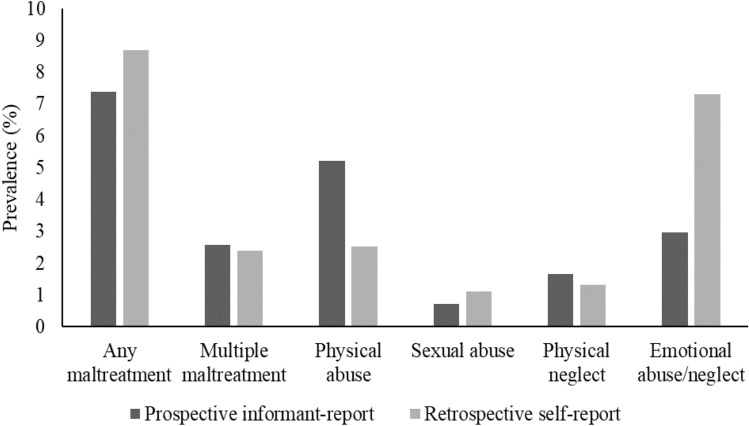
Growing evidence suggests that prospective informant-reports and retrospective self-reports of childhood maltreatment may be differentially associated with adult psychopathology. However, it remains unknown how associations for these two maltreatment reporting types compare when considering functional outcomes. The present study compared associations between childhood maltreatment and functional outcomes at age 18 years using these two methods.
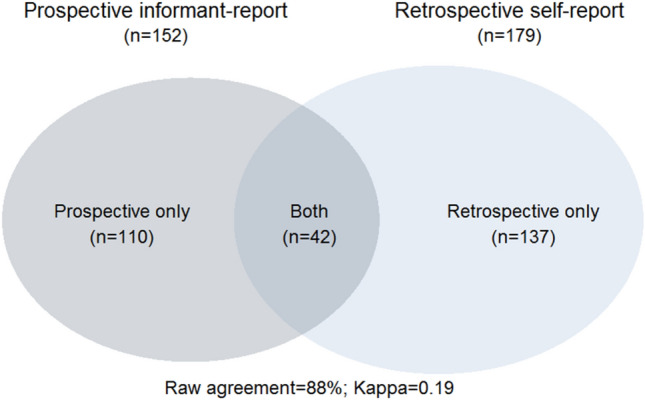
We used data from the Environmental Risk (E-Risk) Longitudinal Twin Study, a nationally representative birth cohort of 2232 children born in England and Wales in 1994-1995. Maltreatment prior to age 12 years was assessed prospectively (during multiple home visits between birth and age of 12 years based on interviews with caregivers, researcher observations, and information from practitioners where child protection referrals were made) and retrospectively (at age 18 via self-report on the Childhood Trauma Questionnaire). Nine functional outcomes were measured at age 18, forming two variables capturing: (i) psychosocial and (ii) vocational disadvantage.
Among the 2054 participants with available data, childhood maltreatment was associated with poorer functional outcomes regardless of whether this was reported only prospectively, only retrospectively, or both. Stronger associations with psychosocial disadvantage arose in the context of retrospective recall by participants (OR = 8.25, 95% CI 4.93-13.82) than prospective reports by informants (OR = 2.03, 95% CI 1.36-3.04) of maltreatment. Conversely, associations with vocational disadvantage were comparable for both prospective informant-reports (OR = 2.19, 95% CI 1.42-3.38) and retrospective self-reports (OR = 1.93, 95% CI 1.33-2.81) of maltreatment.
Results highlight the importance of considering the maltreatment report type used when interpreting the functional consequences of childhood maltreatment.
越来越多的证据表明,前瞻性知情者报告和回顾性自我报告的儿童期虐待可能与成人精神病理学存在差异相关。然而,当考虑到功能结果时,这两种虐待报告类型的关联如何比较尚不清楚。本研究使用这两种方法比较了儿童期虐待与 18 岁时的功能结果之间的关联。
我们使用了来自环境风险(E-Risk)纵向双胞胎研究的数据,该研究是一项全国性代表性的出生队列研究,共纳入了 1994 年至 1995 年在英格兰和威尔士出生的 2232 名儿童。12 岁之前的虐待情况通过前瞻性评估(在出生至 12 岁期间进行多次家访,基于对照顾者的访谈、研究人员观察以及儿童保护转介时的从业者信息)和回顾性评估(在 18 岁时通过儿童期创伤问卷进行自我报告)进行评估。在 18 岁时测量了九项功能结果,形成了两个变量:(i)心理社会和(ii)职业劣势。
在有可用数据的 2054 名参与者中,无论虐待情况仅通过前瞻性报告、仅通过回顾性报告还是两者都报告,儿童期虐待均与较差的功能结果相关。与前瞻性报告相比,参与者的回顾性回忆更强烈地与心理社会劣势相关(OR=8.25,95%CI 4.93-13.82),而知情者的前瞻性报告(OR=2.03,95%CI 1.36-3.04)则与虐待相关。相反,前瞻性知情者报告(OR=2.19,95%CI 1.42-3.38)和回顾性自我报告(OR=1.93,95%CI 1.33-2.81)的儿童期虐待与职业劣势之间的关联相当。
结果强调了在解释儿童期虐待的功能后果时,考虑使用的虐待报告类型的重要性。