Department of Hematology-Oncology, Institut d'Investigacions Biomèdiques August Pi I Sunyer (IDIBAPS), Barcelona, Spain.
Centro de Investigación Biomédica en Red-Oncología, Madrid, Spain.
Blood Adv. 2020 Sep 8;4(17):4217-4231. doi: 10.1182/bloodadvances.2020001584.
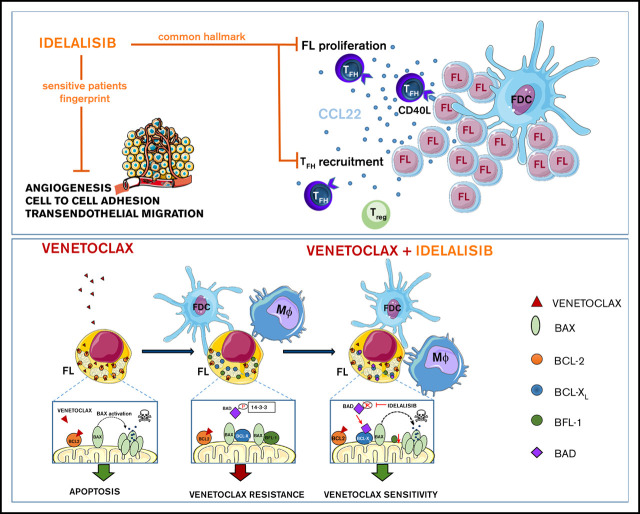
Despite idelalisib approval in relapsed follicular lymphoma (FL), a complete characterization of the immunomodulatory consequences of phosphatidylinositol 3-kinase δ (PI3Kδ) inhibition, biomarkers of response, and potential combinatorial therapies in FL remain to be established. Using ex vivo cocultures of FL patient biopsies and follicular dendritic cells (FDCs) to mimic the germinal center (n = 42), we uncovered that PI3Kδ inhibition interferes with FDC-induced genes related to angiogenesis, extracellular matrix formation, and transendothelial migration in a subset of FL samples, defining an 18-gene signature fingerprint of idelalisib sensitivity. A common hallmark of idelalisib found in all FL cases was its interference with the CD40/CD40L pathway and induced proliferation, together with the downregulation of proteins crucial for B-T-cell synapses, leading to an inefficient cross talk between FL cells and the supportive T-follicular helper cells (TFH). Moreover, idelalisib downmodulates the chemokine CCL22, hampering the recruitment of TFH and immunosupressive T-regulatory cells to the FL niche, leading to a less supportive and tolerogenic immune microenvironment. Finally, using BH3 profiling, we uncovered that FL-FDC and FL-macrophage cocultures augment tumor addiction to BCL-XL and MCL-1 or BFL-1, respectively, limiting the cytotoxic activity of the BCL-2 inhibitor venetoclax. Idelalisib restored FL dependence on BCL-2 and venetoclax activity. In summary, idelalisib exhibits a patient-dependent activity toward angiogenesis and lymphoma dissemination. In all FL cases, idelalisib exerts a general reshaping of the FL immune microenvironment and restores dependence on BCL-2, predisposing FL to cell death, providing a mechanistic rationale for investigating the combination of PI3Kδ inhibitors and venetoclax in clinical trials.
尽管伊德拉利昔布已被批准用于复发性滤泡性淋巴瘤(FL),但在 FL 中,PI3Kδ 抑制的免疫调节后果、反应生物标志物和潜在的联合治疗方案仍有待进一步明确。本研究使用 FL 患者活检和滤泡树突状细胞(FDC)的体外共培养来模拟生发中心(n=42),结果发现,PI3Kδ 抑制在一部分 FL 样本中会干扰 FDC 诱导的与血管生成、细胞外基质形成和跨内皮迁移相关的基因,从而定义了伊德拉利昔布敏感性的 18 基因特征指纹。在所有 FL 病例中,伊德拉利昔布的一个共同特征是干扰 CD40/CD40L 通路并诱导增殖,同时下调对 B-T 细胞突触至关重要的蛋白,导致 FL 细胞与支持性滤泡辅助 T 细胞(TFH)之间的有效交流中断。此外,伊德拉利昔布下调趋化因子 CCL22,阻碍 TFH 和免疫抑制性 T 调节细胞向 FL 龛位的募集,导致支持性和耐受性免疫微环境减少。最后,通过 BH3 分析,我们发现 FL-FDC 和 FL 巨噬细胞共培养分别增加了肿瘤对 BCL-XL 和 MCL-1 或 BFL-1 的依赖性,从而限制了 BCL-2 抑制剂 venetoclax 的细胞毒性作用。伊德拉利昔布恢复了 FL 对 BCL-2 和 venetoclax 活性的依赖性。总之,伊德拉利昔布对血管生成和淋巴瘤播散具有患者依赖性活性。在所有 FL 病例中,伊德拉利昔布对 FL 免疫微环境进行了全面重塑,并恢复了对 BCL-2 的依赖性,使 FL 易于发生细胞死亡,为研究 PI3Kδ 抑制剂与 venetoclax 的联合治疗在临床试验中的应用提供了机制依据。