Department of Forensic and Addiction Psychiatry, Jianan Psychiatric Center, Ministry of Health and Welfare, Tainan City 717, Taiwan.
Department of Mental Health, Johns Hopkins Bloomberg School of Public Health, Baltimore, MD 21205, USA.
Int J Mol Sci. 2020 Sep 3;21(17):6413. doi: 10.3390/ijms21176413.
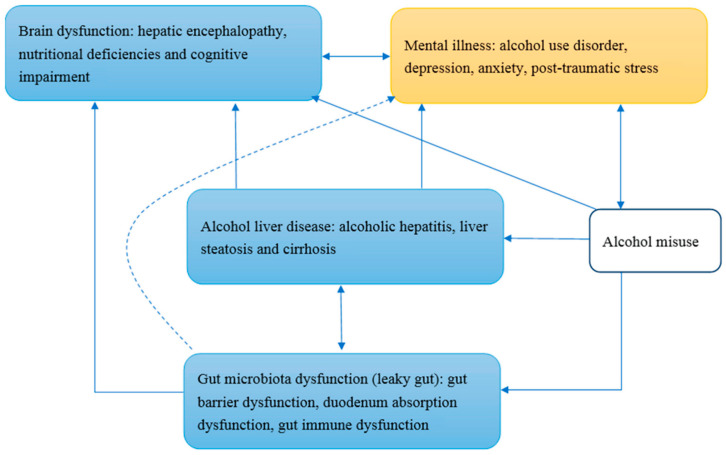
Alcohol addiction is a leading risk factor for personal death and disability. In 2016, alcohol use caused 2.2% of female deaths and 6.8% of male deaths, and disability-adjusted life years (DALYs) were 2.3% in female and 8.9% in male. Individuals with alcohol use disorder are at high risk of anxiety, depression, impaired cognition performance, and illicit drug use and are comorbid with liver disease, such as alcoholic hepatitis and liver cirrhosis, which is a major cause of personal death and disability worldwide. Psychological interventions, such as cognitive behavior therapy and motivational interviewing, as well as medical treatments, such as disulfiram, naltrexone, acamprosate, and nalmefene, are used for the treatment of alcohol addiction in Europe and the United States. However, the effect of current interventions is limited, and the need for additional interventions is substantial. Alcohol use impairs the intestinal barrier and causes changes to the intestinal permeability as well as the gut microbiota composition. Emerging studies have tried to reveal the role of the gut-brain axis among individuals with alcohol use disorder with or without alcohol liver disease. Bacterial products penetrate the impaired intestinal barrier and cause central inflammation; changes to the gut microbiota impair enterohepatic circulation of bile acids; alcohol abuse causes shortage of vital nutrients such as thiamine. Several studies have suggested that probiotics, through either oral administration or fecal microbiota transplantation, increased intestinal levels of potentially beneficial bacteria such as bifidobacteria and lactobacilli, improving the levels of liver-associated enzymes in patients with mild alcoholic hepatitis, and demonstrating beneficial psychotropic effects on anxiety and depression. In addition to medications for alcohol addiction, gene editing therapy such as clustered regularly interspaced short palindromic repeats (CRISPRs) may be another potential research target. Alcohol dehydrogenase (ADH) and aldehyde dehydrogenase (ALDH), which are associated with ADH and ALDH genes, are major enzymes involved in alcohol metabolism, and gene editing approaches may have the potential to directly modify specific genes to treat alcoholism caused by genetic defects. Further research is needed to study the effect of the combined treatment for alcohol addiction.
酒精成瘾是导致个人死亡和残疾的主要风险因素之一。2016 年,酒精使用导致 2.2%的女性死亡和 6.8%的男性死亡,女性的伤残调整生命年(DALYs)为 2.3%,男性为 8.9%。患有酒精使用障碍的个体患焦虑、抑郁、认知功能受损和滥用非法药物的风险较高,并且常合并肝脏疾病,如酒精性肝炎和肝硬化,这是全球个人死亡和残疾的主要原因。在欧洲和美国,用于治疗酒精成瘾的方法包括心理干预,如认知行为疗法和动机访谈,以及医学治疗,如双硫仑、纳曲酮、阿坎酸和纳美芬。然而,目前干预措施的效果有限,需要更多的干预措施。酒精使用会损害肠道屏障,导致肠道通透性改变和肠道微生物群落组成改变。新出现的研究试图揭示酒精使用障碍个体(无论是否患有酒精性肝病)中肠道-大脑轴的作用。细菌产物穿透受损的肠道屏障并引起中枢炎症;肠道微生物群落的改变会损害胆汁酸的肠肝循环;酒精滥用会导致硫胺素等重要营养物质的缺乏。几项研究表明,益生菌通过口服或粪便微生物移植,可以增加双歧杆菌和乳杆菌等潜在有益细菌的肠道水平,改善轻度酒精性肝炎患者的肝相关酶水平,并对焦虑和抑郁表现出有益的精神治疗作用。除了治疗酒精成瘾的药物外,基因编辑疗法,如成簇规律间隔短回文重复(CRISPRs),可能是另一个潜在的研究靶点。与 ADH 和 ALDH 基因相关的酒精脱氢酶(ADH)和醛脱氢酶(ALDH)是参与酒精代谢的主要酶,基因编辑方法可能有潜力直接修饰特定基因,以治疗由遗传缺陷引起的酒精中毒。需要进一步研究联合治疗酒精成瘾的效果。