Department of Chemistry, College of the Atlantic, Bar Harbor, ME 04609;
Department of Chemistry, Colby College, Waterville, ME 04901.
Proc Natl Acad Sci U S A. 2020 Sep 15;117(37):22873-22879. doi: 10.1073/pnas.2002659117. Epub 2020 Sep 8.
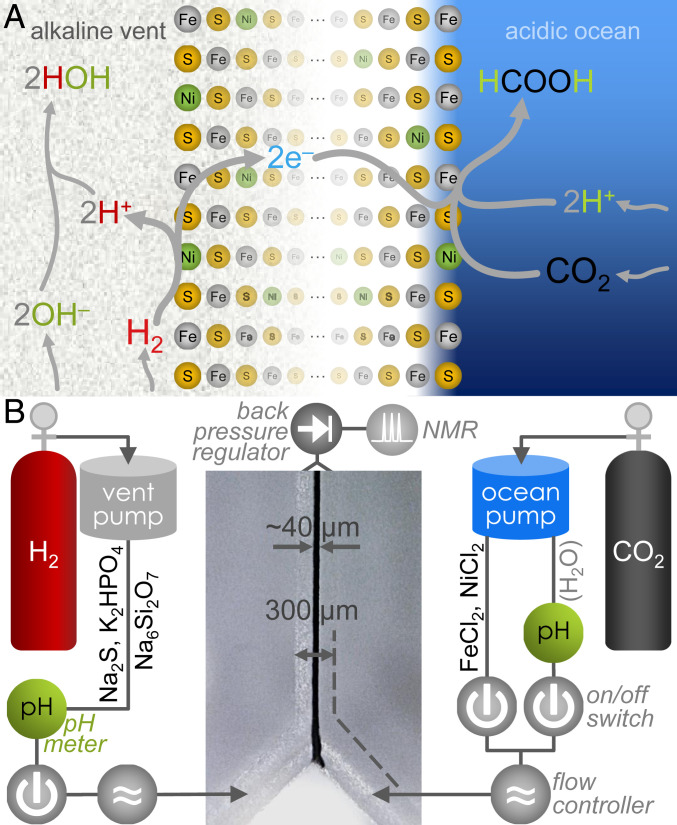
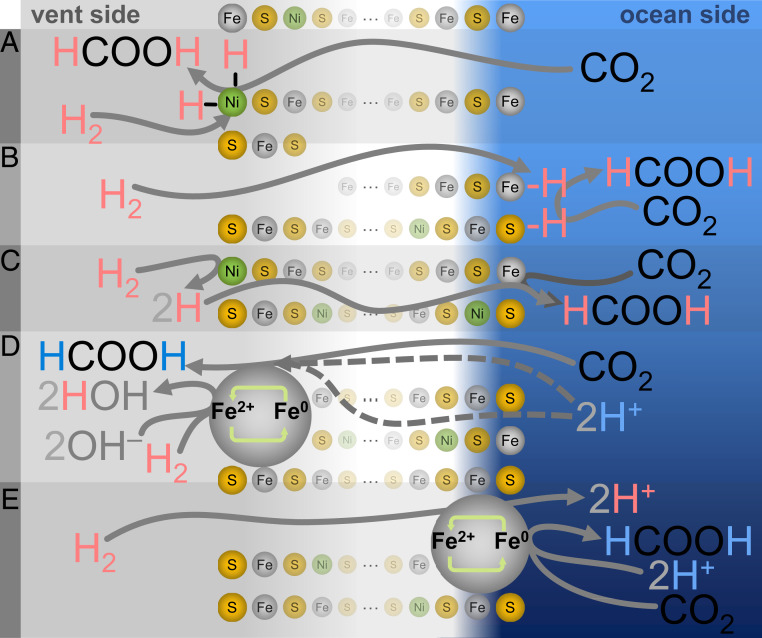
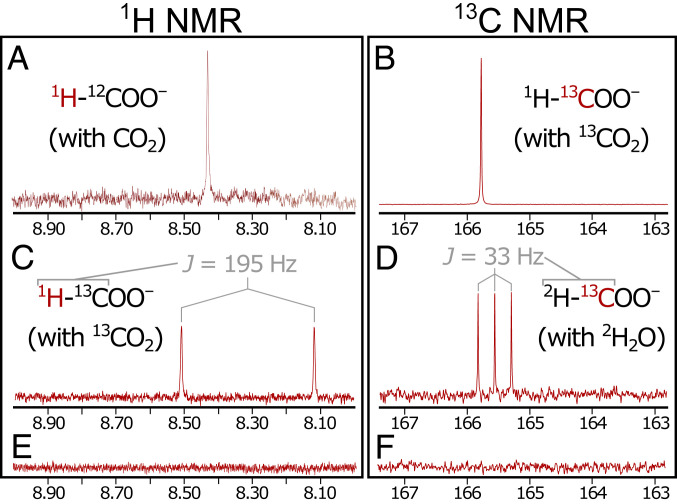
All life on Earth is built of organic molecules, so the primordial sources of reduced carbon remain a major open question in studies of the origin of life. A variant of the alkaline-hydrothermal-vent theory for life's emergence suggests that organics could have been produced by the reduction of CO via H oxidation, facilitated by geologically sustained pH gradients. The process would be an abiotic analog-and proposed evolutionary predecessor-of the Wood-Ljungdahl acetyl-CoA pathway of modern archaea and bacteria. The first energetic bottleneck of the pathway involves the endergonic reduction of CO with H to formate (HCOO), which has proven elusive in mild abiotic settings. Here we show the reduction of CO with H at room temperature under moderate pressures (1.5 bar), driven by microfluidic pH gradients across inorganic Fe(Ni)S precipitates. Isotopic labeling with C confirmed formate production. Separately, deuterium (H) labeling indicated that electron transfer to CO does not occur via direct hydrogenation with H but instead, freshly deposited Fe(Ni)S precipitates appear to facilitate electron transfer in an electrochemical-cell mechanism with two distinct half-reactions. Decreasing the pH gradient significantly, removing H, or eliminating the precipitate yielded no detectable product. Our work demonstrates the feasibility of spatially separated yet electrically coupled geochemical reactions as drivers of otherwise endergonic processes. Beyond corroborating the ability of early-Earth alkaline hydrothermal systems to couple carbon reduction to hydrogen oxidation through biologically relevant mechanisms, these results may also be of significance for industrial and environmental applications, where other redox reactions could be facilitated using similarly mild approaches.
地球上所有的生命都是由有机分子构成的,因此,还原碳的原始来源仍然是生命起源研究中的一个主要未解决的问题。一种碱性热液喷口理论的变体表明,有机物质可能是通过 H 对 CO 的氧化还原作用产生的,这种作用是由地质上持续的 pH 梯度促进的。这个过程将是现代古菌和细菌的 Wood-Ljungdahl 乙酰辅酶 A 途径的非生物模拟物——也是其进化前体。该途径的第一个能量瓶颈涉及 CO 与 H 反应生成甲酸(HCOO)的内吸还原,这在温和的非生物环境中一直难以实现。在这里,我们在温和压力(1.5 巴)下通过无机 Fe(Ni)S 沉淀的微流控 pH 梯度显示了 CO 与 H 在室温下的还原反应。用 C 进行的同位素标记证实了甲酸的生成。另外,氘(H)标记表明,电子向 CO 的转移不是通过与 H 的直接氢化发生的,而是新沉积的 Fe(Ni)S 沉淀似乎在具有两个不同半反应的电化学电池机制中促进了电子转移。显著降低 pH 梯度、去除 H 或消除沉淀都没有产生可检测到的产物。我们的工作证明了空间分离但电耦合的地球化学反应作为非自发过程驱动力的可行性。除了证实早期地球碱性热液系统通过生物相关机制将碳还原与氢氧化偶联的能力外,这些结果对于工业和环境应用也可能具有重要意义,在这些应用中,其他氧化还原反应也可以通过类似的温和方法来促进。