Department of Cardiology, University Medical Center Groningen, University of Groningen, Hanzeplein 1, 9700 RB, Groningen, The Netherlands.
Department of Cardiology, Division Heart and Lungs, University Medical Center Utrecht, University of Utrecht, Utrecht, The Netherlands.
Sci Rep. 2020 Sep 8;10(1):14771. doi: 10.1038/s41598-020-70724-5.
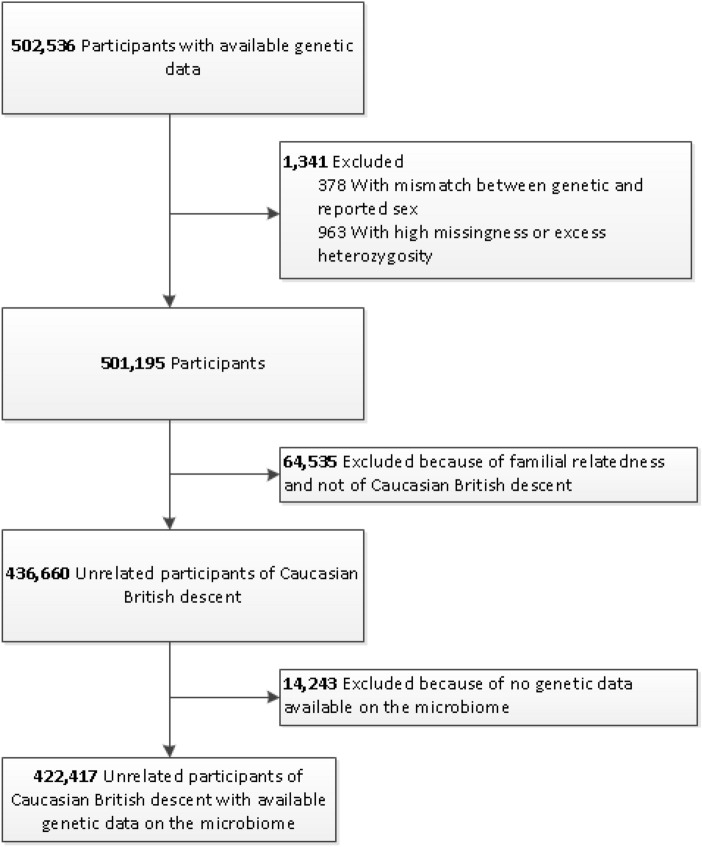
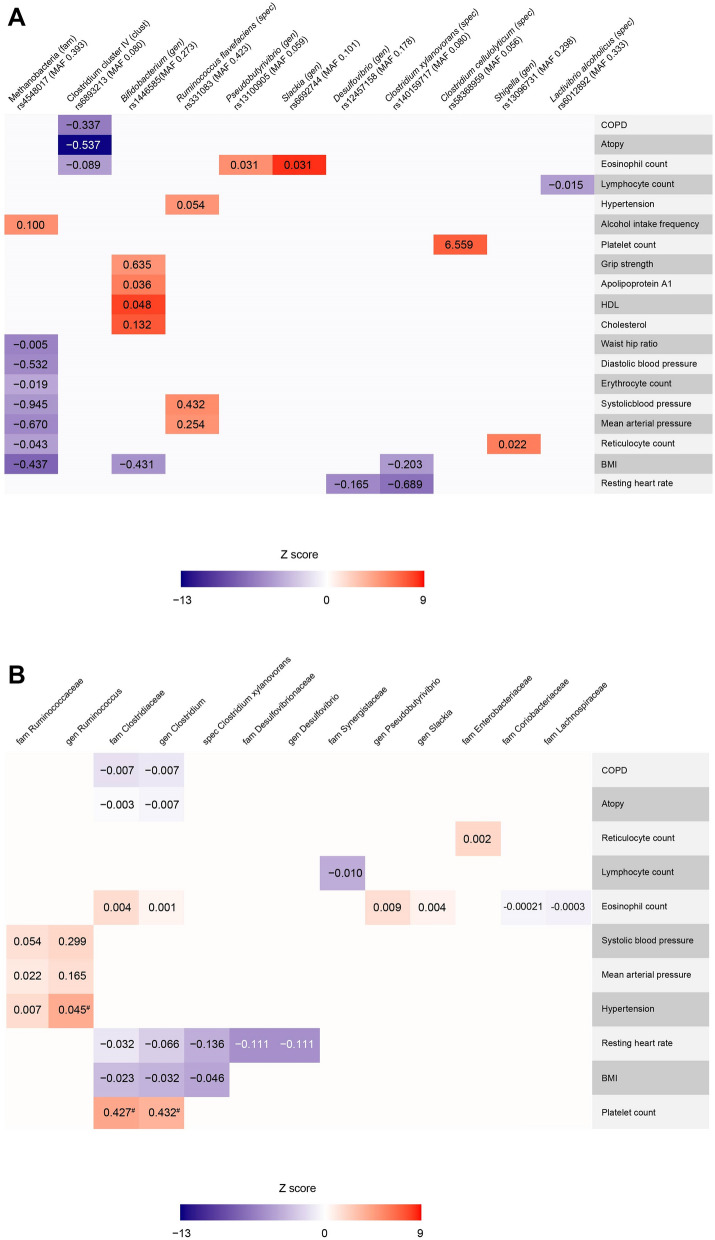
Small-scale studies have suggested a link between the human gut microbiome and highly prevalent diseases. However, the extent to which the human gut microbiome can be considered a determinant of disease and healthy aging remains unknown. We aimed to determine the spectrum of diseases that are linked to the human gut microbiome through the utilization of its genetic determinants as a proxy for its composition. 180 single nucleotide polymorphisms (SNPs) known to influence the human gut microbiome were used to assess the association with health and disease outcomes in 422,417 UK Biobank participants. Potential causal estimates were obtained using a Mendelian randomization (MR) approach. From the total sample analysed (mean age was 57 ± 8 years), 194,567 (46%) subjects were male. Median exposure was 66-person years (interquartile range 59-72). Eleven SNPs were significantly associated with 28 outcomes (Bonferroni corrected P value < 4.63·10) including food intake, hypertension, atopy, COPD, BMI, and lipids. Multiple SNP MR pointed to a possible causal link between Ruminococcus flavefaciens and hypertension, and Clostridium and platelet count. Microbiota and their metabolites might be of importance in the interplay between overlapping pathophysiological processes, although challenges remain in establishing causal relationships.
一些小规模的研究表明,人类肠道微生物组与高发疾病之间存在关联。然而,人类肠道微生物组在多大程度上可以被认为是疾病和健康衰老的决定因素尚不清楚。我们旨在通过利用其遗传决定因素作为其组成的替代物,确定与人类肠道微生物组相关的疾病谱。使用 180 个已知影响人类肠道微生物组的单核苷酸多态性(SNP)来评估 422417 名英国生物库参与者的健康和疾病结果的关联。使用孟德尔随机化(MR)方法获得潜在的因果估计。在分析的总样本中(平均年龄为 57±8 岁),194567(46%)名受试者为男性。中位暴露为 66 人年(四分位间距为 59-72)。有 11 个 SNP 与 28 个结果显著相关(Bonferroni 校正 P 值<4.63·10),包括饮食摄入、高血压、过敏、COPD、BMI 和脂质。多重 SNP-MR 表明,瘤胃球菌(Ruminococcus flavefaciens)和高血压之间可能存在因果关系,拟杆菌属(Clostridium)和血小板计数之间也可能存在因果关系。尽管在确定因果关系方面仍然存在挑战,但微生物组及其代谢物可能在重叠的病理生理过程相互作用中具有重要意义。