Universidade do Estado do Rio de Janeiro. Instituto de Nutrição. Programa de Pós-Graduação em Alimentação, Nutrição e Saúde. Rio de Janeiro, RJ, Brasil.
Universidade do Estado do Rio de Janeiro. Instituto de Nutrição. Departamento de Nutrição Social. Rio de Janeiro, RJ, Brasil.
Rev Saude Publica. 2020 Sep 4;54:89. doi: 10.11606/s1518-8787.2020054001752.
To analyze the nutritional composition of ultra-processed foods consumed by children that attend basic health units.
This is a cross-sectional study with a representative probabilistic sample of 536 children aged between 6 and 59 months treated at a health unit in the city of Rio de Janeiro. Nutritional information was extracted from labels of the ultra-processed foods referred to in a 24-hour recall. The 351 foods mentioned were divided into 22 groups and 38 subgroups according to the type of product, and they were characterized according to the averages of the values for energy, total fats, saturated fats, trans fats and sodium in 100 grams of the product, in addition to presence, number, and type of "other sweeteners". The nutritional Profile Model of the Pan American Health Organization was applied for each food and for the average of nutrient content obtained for each group to examine the occurrence of critical nutrients excess.
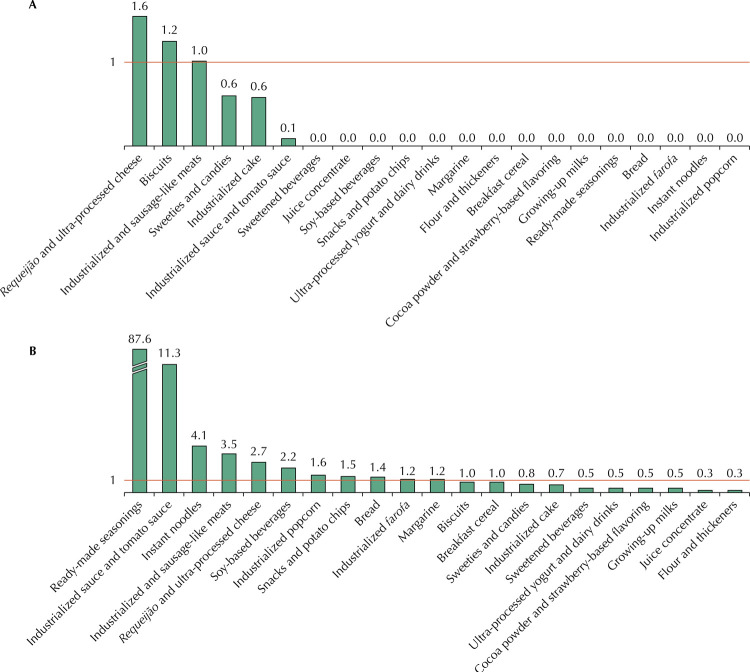
Ultra-processed foods contained high energy value and high levels of total fats, saturated fats, trans fats, and sodium. Out of the total of ultra-processed foods, 66% presented excess of at least one critical nutrient, with emphasis on requeijões and ultra-processed cheeses, instant noodles, and industrialized and sausage-like meats, which presented 100% of foods with excess of total fats, saturated fats and sodium. Out of the 21 groups, the following exceeded the limit established by the Pan American Health Organization: for total fats, 10 groups; for saturated fats, 11; for trans fats, 3; and sodium, 13. Requeijões and ultra-processed cheeses; industrialized and sausage-like meats; and biscuits exceeded this limit in all parameters. Out of the set of ultra-processed foods analyzed, 13.4% contained "other sweeteners" (eight different types).
The ultra-processed foods analyzed presented unbalanced nutritional profile, and two thirds presented excess of at least one critical nutrient. Educational actions and regulatory measures are necessary to better inform the population and to discourage its consumption.
分析儿童在基本保健单位消费的超加工食品的营养成分。
这是一项具有代表性的概率抽样横断面研究,共纳入 536 名年龄在 6 至 59 个月之间在里约热内卢市某卫生单位接受治疗的儿童。从 24 小时回忆中提到的超加工食品标签中提取营养信息。351 种食品根据产品类型分为 22 组和 38 个亚组,并根据产品每 100 克的能量、总脂肪、饱和脂肪、反式脂肪和钠的平均值以及“其他甜味剂”的存在、数量和类型进行特征描述。应用泛美卫生组织营养成分模型对每种食品以及每个组获得的营养素含量平均值进行分析,以检查是否存在关键营养素过量的情况。
超加工食品含有高热量值和高含量的总脂肪、饱和脂肪、反式脂肪和钠。在所有的超加工食品中,66%的食品至少有一种关键营养素过量,其中强调的是再制干酪和超加工奶酪、方便面、以及工业化和香肠状肉类,这些食品的总脂肪、饱和脂肪和钠含量都有 100%的食品过量。在 21 个组中,有以下 10 个组超过了泛美卫生组织规定的限制:总脂肪 10 个组;饱和脂肪 11 个组;反式脂肪 3 个组;钠 13 个组。再制干酪和超加工奶酪;工业化和香肠状肉类;以及饼干在所有参数上都超过了这个限制。在分析的超加工食品中,有 13.4%含有“其他甜味剂”(八种不同类型)。
分析的超加工食品营养不均衡,三分之二的食品至少有一种关键营养素过量。有必要采取教育行动和监管措施,以更好地向公众提供信息,并劝阻其消费。