Vinmec Research Institute of Stem Cell and Gene Technology (VRISG), Hanoi, Vietnam.
Vinmec Times City International Hospital, Hanoi, Vietnam.
Stem Cells Transl Med. 2021 Jan;10(1):14-26. doi: 10.1002/sctm.20-0102. Epub 2020 Sep 9.
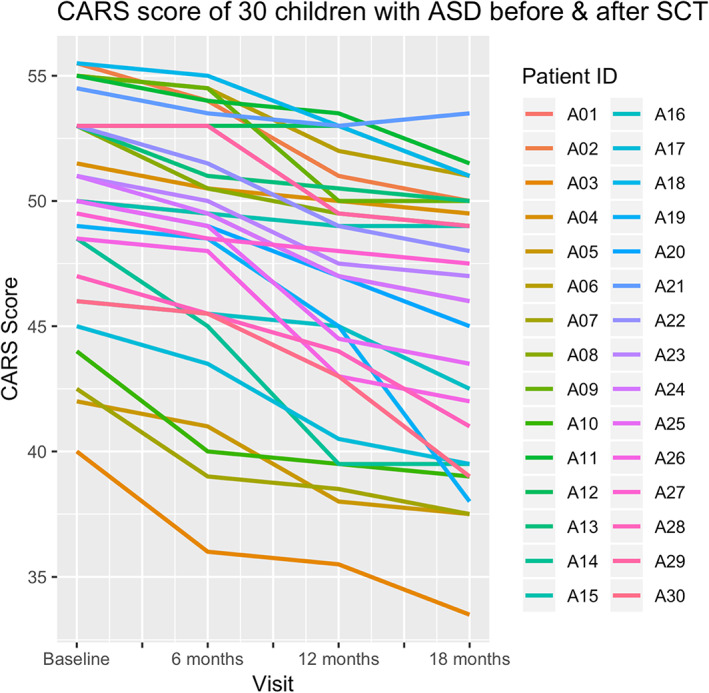
The aim of this study was to evaluate the safety and efficacy of autologous bone marrow mononuclear cell transplantation combined with educational intervention for children with autism spectrum disorder. An open-label clinical trial was performed from July 2017 to August 2019 at Vinmec International Hospital, Hanoi, Vietnam. Thirty children who fulfilled the autism criteria of the Diagnostic and Statistical Manual of Mental Disorders, Fifth Edition, and had Childhood Autism Rating Scale (CARS) scores >37 were selected. Bone marrow was harvested by anterior iliac crest puncture under general anesthesia. The volume collected was as follows: 8 mL/kg for patients under 10 kg (80 mL + [body weight in kg - 10] × 7 mL) for patients above 10 kg. Mononuclear cells were isolated with a Ficoll gradient and then infused intrathecally. The same procedure was repeated 6 months later. After the first transplantation, all patients underwent 8 weeks of educational intervention based on the Early Start Denver Model. There were no severe adverse events associated with transplantation. The severity of autism spectrum disorder (ASD) was significantly reduced, with the median CARS score decreasing from 50 (range 40-55.5) to 46.5 (range 33.5-53.5) (P < .05). Adaptive capacity increased, with the median Vineland Adaptive Behavior Scales score rising from 53.5 to 60.5. Social communication, language, and daily skills improved markedly within 18 months after transplantation. Conversely, repetitive behaviors and hyperactivity decreased remarkably. Autologous bone marrow mononuclear cell transplantation in combination with behavioral intervention was safe and well tolerated in children with ASD (Trial registration: ClinicalTrials.gov identifier: NCT03225651).
本研究旨在评估自体骨髓单个核细胞移植联合教育干预治疗儿童孤独症谱系障碍的安全性和有效性。一项开放性临床试验于 2017 年 7 月至 2019 年 8 月在越南河内的 Vinmec 国际医院进行。入选标准为符合《精神障碍诊断与统计手册》第五版孤独症诊断标准,且儿童孤独症评定量表(CARS)评分>37 的 30 例孤独症患儿。患儿均在全身麻醉下经髂前上棘穿刺抽取骨髓,采集量如下:体重<10kg 者 8mL/kg(80mL+[体重-10]kg×7mL);体重>10kg 者。使用淋巴细胞分离液分离单个核细胞,然后鞘内注射。6 个月后重复该操作。首次移植后,所有患儿均接受基于早期丹佛模式的 8 周教育干预。与移植相关的严重不良事件发生率为 0。孤独症谱系障碍(ASD)的严重程度显著降低,CARS 评分中位数从 50(40-55.5)降至 46.5(33.5-53.5)(P<.05)。适应能力增加,适应行为量表评分中位数从 53.5 升至 60.5。移植后 18 个月内,社会沟通、语言和日常技能显著改善,而重复行为和多动明显减少。自体骨髓单个核细胞移植联合行为干预治疗儿童孤独症谱系障碍是安全且耐受良好的(临床试验注册编号:NCT03225651)。