Department of Medical Oncology, Chongqing University Cancer Hospital, Chongqing, China.
Clinical Medicine Research Center, Xinqiao Hospital, Army Medical University, Chongqing, China.
Front Immunol. 2020 Aug 13;11:1554. doi: 10.3389/fimmu.2020.01554. eCollection 2020.
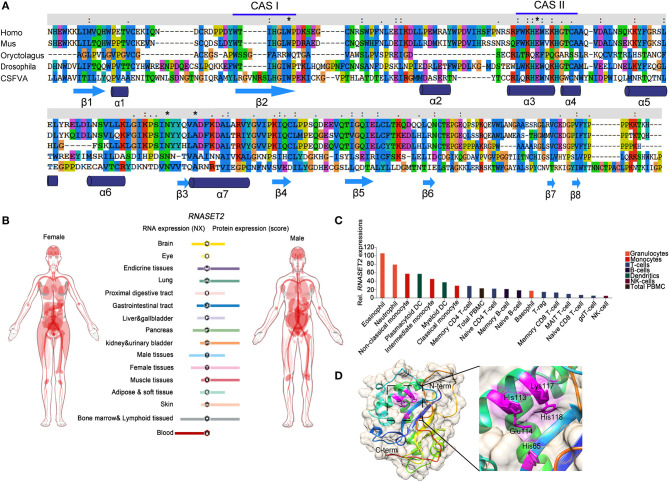
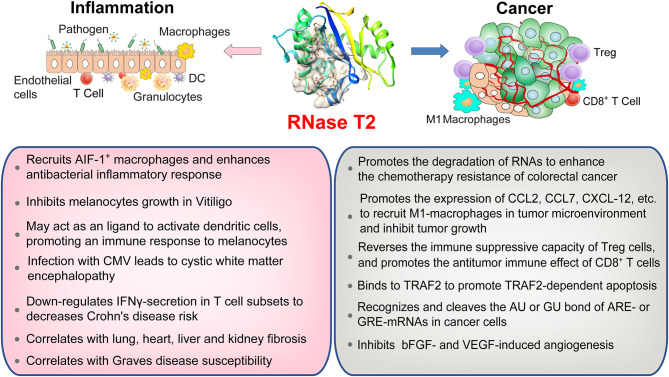
The RNase T2 family consists of evolutionarily conserved endonucleases that express in many different species, including animals, plants, protozoans, bacteria, and viruses. The main biological roles of these ribonucleases are cleaving or degrading RNA substrates. They preferentially cleave single-stranded RNA molecules between purine and uridine residues to generate two nucleotide fragments with 2'3'-cyclic phosphate adenosine/guanosine terminus and uridine residue, respectively. Accumulating studies have revealed that RNase T2 is critical for the pathophysiology of inflammation and cancer. In this review, we introduce the distribution, structure, and functions of RNase T2, its differential roles in inflammation and cancer, and the perspective for its research and related applications in medicine.
RNase T2 家族由进化上保守的核酸内切酶组成,在许多不同的物种中表达,包括动物、植物、原生动物、细菌和病毒。这些核糖核酸酶的主要生物学作用是切割或降解 RNA 底物。它们优先切割嘧啶和尿嘧啶残基之间的单链 RNA 分子,分别生成具有 2'3'-环磷酸腺苷/鸟苷末端和尿嘧啶残基的两个核苷酸片段。越来越多的研究表明,RNase T2 在炎症和癌症的病理生理学中起着关键作用。在这篇综述中,我们介绍了 RNase T2 的分布、结构和功能,及其在炎症和癌症中的差异作用,以及其在医学研究和相关应用中的前景。