Sun Zeyu, Ren Keyi, Zhang Xing, Chen Jinghua, Jiang Zhengyi, Jiang Jing, Ji Feiyang, Ouyang Xiaoxi, Li Lanjuan
State Key Laboratory for Diagnosis and Treatment of Infectious Diseases, National Clinical Research Center for Infectious Diseases, Collaborative Innovation Center for Diagnosis and Treatment of Infectious Disease, The First Affiliated Hospital, School of Medicine, Zhejiang University, Hangzhou 310011, China.
Department of Biophysics & Center of Cryo-Electron Microscopy, School of Medicine, Zhejiang University, Hangzhou 310011, China.
Engineering (Beijing). 2021 Oct;7(10):1441-1451. doi: 10.1016/j.eng.2020.07.014. Epub 2020 Aug 30.
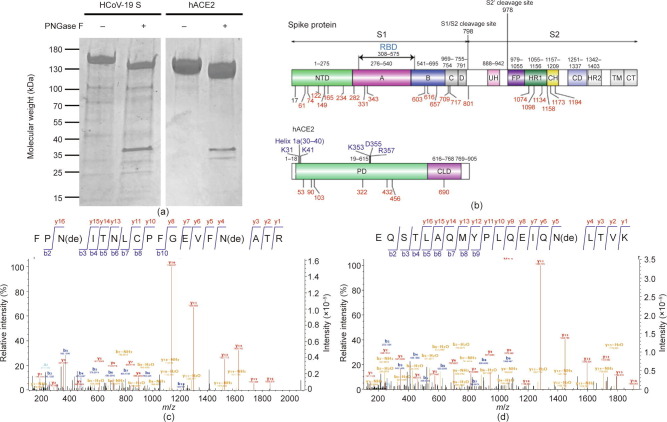
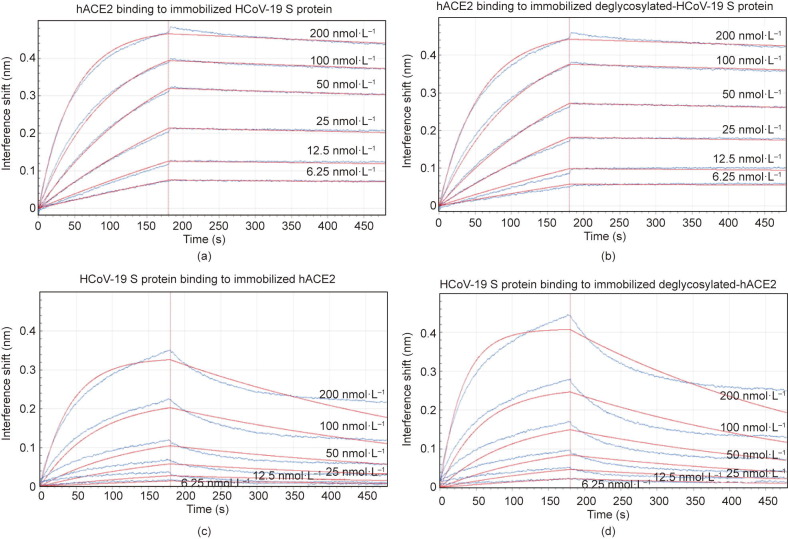
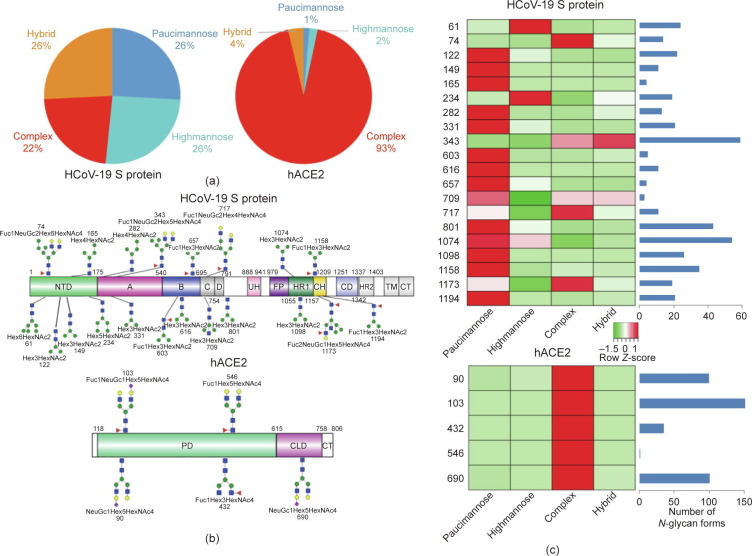
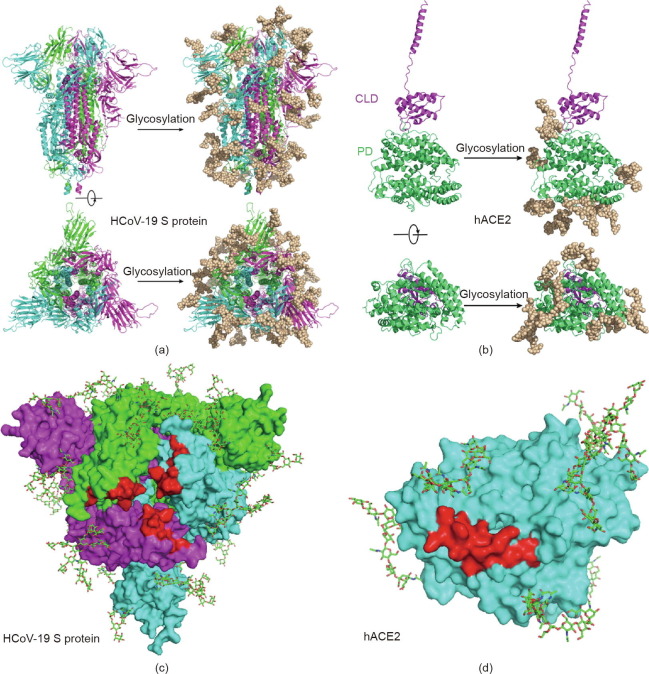
The coronavirus disease 2019 (COVID-19) pandemic has led to worldwide efforts to understand the biological traits of the newly identified human coronavirus (HCoV-19) virus. In this mass spectrometry (MS)-based study, we reveal that out of 21 possible glycosites in the HCoV-19 spike protein (S protein), 20 are completely occupied by -glycans, predominantly of the oligomannose type. All seven glycosylation sites in human angiotensin I converting enzyme 2 (hACE2) were found to be completely occupied, mainly by complex -glycans. However, glycosylation did not directly contribute to the binding affinity between HCoV-19 S protein and hACE2. Additional post-translational modification (PTM) was identified, including multiple methylated sites in both proteins and multiple sites with hydroxylproline in hACE2. Refined structural models of HCoV-19 S protein and hACE2 were built by adding -glycan and PTMs to recently published cryogenic electron microscopy structures. The PTM and glycan maps of HCoV-19 S protein and hACE2 provide additional structural details for studying the mechanisms underlying host attachment and the immune response of HCoV-19, as well as knowledge for developing desperately needed remedies and vaccines.
2019年冠状病毒病(COVID-19)大流行促使全球致力于了解新发现的人类冠状病毒(HCoV-19)的生物学特性。在这项基于质谱(MS)的研究中,我们发现,在HCoV-19刺突蛋白(S蛋白)的21个可能的糖基化位点中,有20个被聚糖完全占据,主要是寡甘露糖型。人类血管紧张素I转换酶2(hACE2)中的所有7个糖基化位点都被发现完全被占据,主要是复杂型聚糖。然而,糖基化并未直接影响HCoV-19 S蛋白与hACE2之间的结合亲和力。还鉴定出了其他翻译后修饰(PTM),包括两种蛋白质中的多个甲基化位点以及hACE2中的多个羟脯氨酸位点。通过在最近发表的低温电子显微镜结构中添加聚糖和PTM,构建了HCoV-19 S蛋白和hACE2的精细结构模型。HCoV-19 S蛋白和hACE2的PTM和聚糖图谱为研究HCoV-19宿主附着和免疫反应的潜在机制提供了额外的结构细节,也为开发急需的治疗方法和疫苗提供了知识。