Chen Ling, Lin Jing, Chen Li-Zhu, Chen Yu, Wang Xiao-Jie, Guo Zeng-Qing, Yu Jia-Mi
Department of Abdominal Oncology, Fujian Cancer Hospital & Fujian Medical University Cancer Hospital, Fuzhou 350014, People's Republic of China.
Cancer Manag Res. 2020 Aug 21;12:7601-7610. doi: 10.2147/CMAR.S264582. eCollection 2020.
To investigate the clinicopathological and prognostic factors related to early gastric cancer recurrence after curative resection.
Between October 2006 and August 2018, a total of 149 patients with recurrence of gastric cancer/adenocarcinoma of the esophagogastric junction after curative resection were enrolled from our treatment group. A retrospective clinical analysis was performed on these patients with gastric cancer recurrence after curative resection.
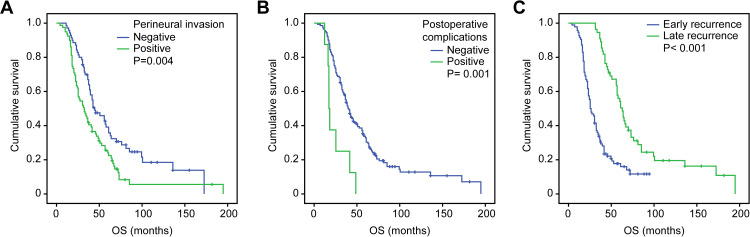
Among the 149 patients, 99 (66.4%) had only one recurrence pattern, and 50 (33.6%) had multiple recurrence patterns. The median recurrence-free survival (RFS) was 18.2 months (95% CI 15.0-21.4). Ninety-four patients (63.1%) experienced early recurrence (recurrence within 24 months after curative resection), and 55 patients (36.9%) experienced late recurrence (recurrence beyond 24 months after curative resection). The univariate analysis showed that perineural invasion (P=0.002), depth of invasion (P=0.026), postoperative chemotherapy (P=0.036) and postoperative complications (P=0.004) were significant factors associated with early recurrence after curative resection for gastric cancer. Perineural invasion (P=0.003), postoperative chemotherapy (P=0.036) and postoperative complications (P=0.042) were independent factors associated with early recurrence after curative resection in the multivariate analysis. The survival analysis showed that perineural invasion (P=0.011) and postoperative complications (P=0.007) were independent prognostic factors. The median survival time of early recurrence patients was significantly shorter than that of late recurrence patients (25.4 vs 62.9 months, P<0.001).
Perineural invasion, postoperative chemotherapy and postoperative complications were independent factors associated with early recurrence after curative resection. Patients with early recurrence after curative resection had poorer survival.
探讨与胃癌根治性切除术后早期复发相关的临床病理及预后因素。
2006年10月至2018年8月期间,从我们的治疗组中纳入了149例胃癌/食管胃交界腺癌根治性切除术后复发的患者。对这些胃癌根治性切除术后复发的患者进行回顾性临床分析。
149例患者中,99例(66.4%)仅有1种复发模式,50例(33.6%)有多种复发模式。无复发生存期(RFS)的中位数为18.2个月(95%CI 15.0 - 21.4)。94例患者(63.1%)出现早期复发(根治性切除术后24个月内复发),55例患者(36.9%)出现晚期复发(根治性切除术后24个月后复发)。单因素分析显示,神经周围侵犯(P = 0.002)、浸润深度(P = 0.026)、术后化疗(P = 0.036)和术后并发症(P = 0.004)是与胃癌根治性切除术后早期复发相关的显著因素。多因素分析中,神经周围侵犯(P = 0.003)、术后化疗(P = 0.036)和术后并发症(P = 0.042)是与根治性切除术后早期复发相关的独立因素。生存分析显示,神经周围侵犯(P = 0.011)和术后并发症(P = 0.007)是独立的预后因素。早期复发患者的中位生存时间显著短于晚期复发患者(25.4对62.9个月,P < 0.001)。
神经周围侵犯、术后化疗和术后并发症是与根治性切除术后早期复发相关的独立因素。根治性切除术后早期复发的患者生存较差。