Siemionow Krzyzstof, Luciano Cristian, Forsthoefel Craig, Aydogmus Suavi
HoloSurgical, Inc., University of Illinois Hospital, Chicago, IL, USA.
Department of Orthopedic Surgery, University of Illinois Hospital, Chicago, IL, USA.
J Craniovertebr Junction Spine. 2020 Apr-Jun;11(2):99-103. doi: 10.4103/jcvjs.JCVJS_37_20. Epub 2020 Jun 5.
Machine-learning algorithms are a subset of artificial intelligence that have proven to enhance analytics in medicine across various platforms. Spine surgery has the potential to benefit from improved hardware placement utilizing algorithms that autonomously and accurately measure pedicle and vertebral body anatomy. The purpose of this study was to assess the accuracy of an autonomous convolutional neural network (CNN) in measuring vertebral body anatomy utilizing clinical lumbar computed tomography (CT) scans and automatically segment vertebral body anatomy.
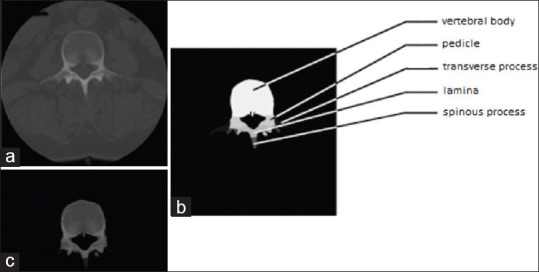
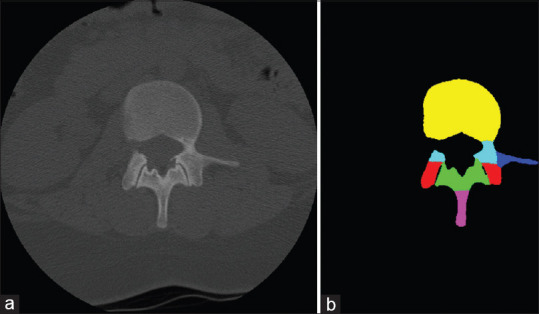
The CNN was trained utilizing 8000 manually segmented CT slices from 15 cadaveric specimens and 30 adult diagnostic scans. Validation was performed with twenty randomly selected patient datasets. Anatomic landmarks that were segmented included the pedicle, vertebral body, spinous process, transverse process, facet joint, and lamina. Morphometric measurement of the vertebral body was compared between manual measurements and automatic measurements.
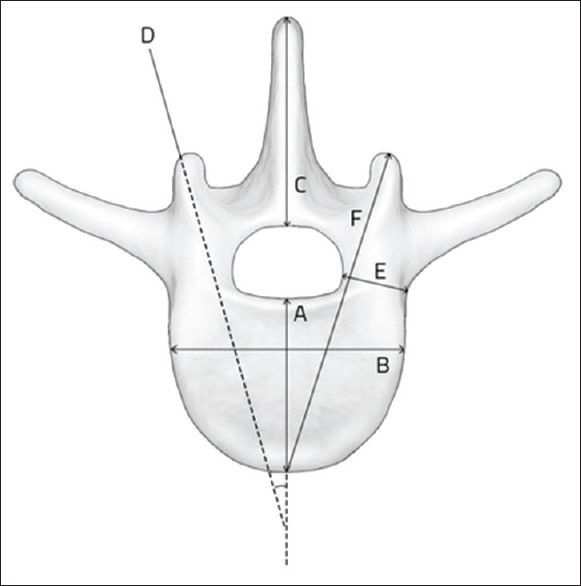
Automatic segmentation was found to have a mean accuracy ranging from 96.38% to 98.96%. Coaxial distance from the lamina to the anterior cortex was 99.10% with pedicle angulation error of 3.47%.
The CNN algorithm tested in this study provides an accurate means to automatically identify the vertebral body anatomy and provide measurements for implants and placement trajectories.
机器学习算法是人工智能的一个子集,已被证明可在各种平台上增强医学分析。脊柱手术有可能受益于利用算法自主且准确地测量椎弓根和椎体解剖结构来改善硬件放置。本研究的目的是评估一种自主卷积神经网络(CNN)在利用临床腰椎计算机断层扫描(CT)扫描测量椎体解剖结构并自动分割椎体解剖结构方面的准确性。
利用来自15个尸体标本的8000个手动分割的CT切片和30个成人诊断扫描对CNN进行训练。使用20个随机选择的患者数据集进行验证。分割的解剖标志包括椎弓根、椎体、棘突、横突、小关节和椎板。比较了手动测量和自动测量之间椎体的形态学测量结果。
发现自动分割的平均准确率在96.38%至98.96%之间。从椎板到前皮质的同轴距离为99.10%,椎弓根成角误差为3.47%。
本研究中测试的CNN算法提供了一种准确的方法来自动识别椎体解剖结构,并为植入物和放置轨迹提供测量。