Public Health Policy Evaluation Unit, Imperial College London, 3rd Floor, Reynold's Building, St Dunstan's Road, Hammersmith, London, W6 8RP, UK.
Primary Care and Population Sciences, University of Southampton, Southampton, SO16 6YD, UK.
BMC Med. 2020 Sep 10;18(1):266. doi: 10.1186/s12916-020-01708-5.
Armed conflict can indirectly affect population health through detrimental impacts on political and social institutions and destruction of infrastructure. This study aimed to quantify indirect mortality impacts of armed conflict in civilian populations globally and explore differential effects by armed conflict characteristics and population groups.
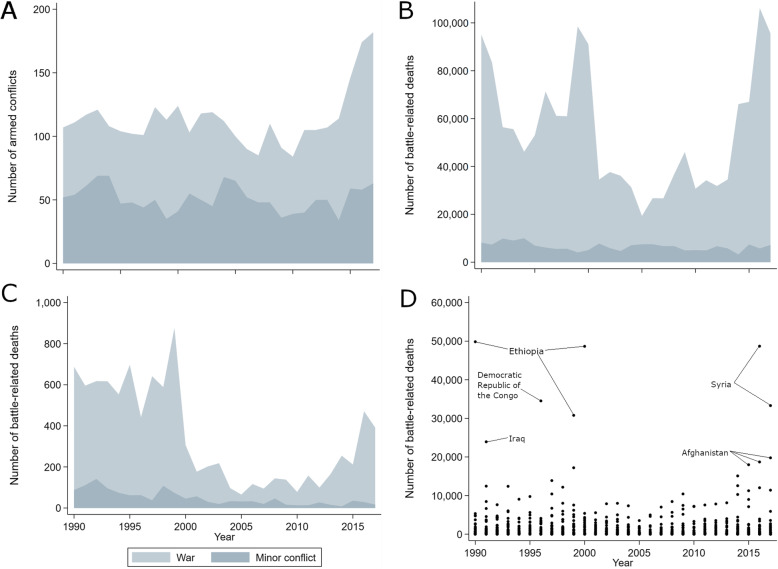
We included 193 countries between 1990 and 2017 and constructed fixed effects panel regression models using data from the Uppsala Conflict Data Program and Global Burden of Disease study. Mortality rates were corrected to exclude battle-related deaths. We assessed separately four different armed conflict variables (capturing binary, continuous, categorical, and quintile exposures) and ran models by cause-specific mortality stratified by age groups and sex. Post-estimation analyses calculated the number of civilian deaths.
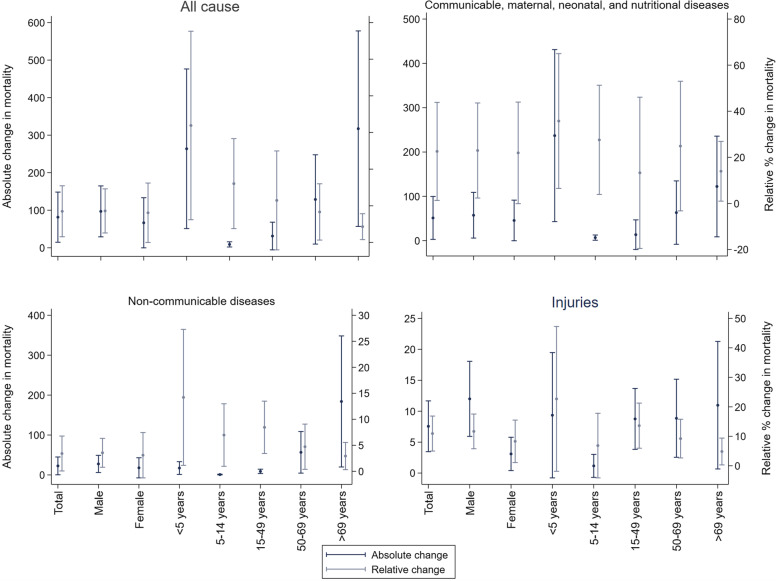
We identified 1118 unique armed conflicts. Armed conflict was associated with increases in civilian mortality-driven by conflicts categorised as wars. Wars were associated with an increase in age-standardised all-cause mortality of 81.5 per 100,000 population (β 81.5, 95% CI 14.3-148.8) in adjusted models contributing 29.4 million civilian deaths (95% CI 22.1-36.6) globally over the study period. Mortality rates from communicable, maternal, neonatal, and nutritional diseases (β 51.3, 95% CI 2.6-99.9); non-communicable diseases (β 22.7, 95% CI 0.2-45.2); and injuries (β 7.6, 95% CI 3.4-11.7) associated with war increased, contributing 21.0 million (95% CI 16.3-25.6), 6.0 million (95% CI 4.1-8.0), and 2.4 million deaths (95% CI 1.7-3.1) respectively. War-associated increases in all-cause and cause-specific mortality were found across all age groups and both genders, but children aged 0-5 years had the largest relative increases in mortality.
Armed conflict, particularly war, is associated with a substantial indirect mortality impact among civilians globally with children most severely burdened.
武装冲突可通过对政治和社会机构造成有害影响以及破坏基础设施,间接地对人口健康造成影响。本研究旨在量化全球平民人群中武装冲突的间接死亡影响,并探讨武装冲突特征和人群群体的差异效应。
我们纳入了 1990 年至 2017 年间的 193 个国家,并使用来自乌普萨拉冲突数据项目和全球疾病负担研究的数据构建了固定效应面板回归模型。死亡率经过校正排除了与战斗相关的死亡。我们分别评估了四个不同的武装冲突变量(捕捉二进制、连续、分类和五分位数暴露),并按年龄组和性别分层的特定原因死亡率运行模型。事后估计分析计算了平民死亡人数。
我们确定了 1118 次独特的武装冲突。武装冲突与平民死亡率的增加有关,这是由被归类为战争的冲突驱动的。战争与调整后的模型中每 10 万人标准化全因死亡率增加 81.5 例(β81.5,95%置信区间 14.3-148.8)有关,在研究期间全球共导致 2940 万平民死亡(95%置信区间 2210 万至 3660 万)。与战争相关的传染病、孕产妇、新生儿和营养疾病(β51.3,95%置信区间 2.6-99.9)、非传染性疾病(β22.7,95%置信区间 0.2-45.2)和伤害(β7.6,95%置信区间 3.4-11.7)的死亡率增加,分别导致 2100 万(95%置信区间 1630 万至 2560 万)、600 万(95%置信区间 410 万至 800 万)和 240 万死亡(95%置信区间 170 万至 310 万)。在所有年龄组和性别中,都发现了与战争相关的全因和特定原因死亡率的增加,但 0-5 岁儿童的死亡率相对增加最大。
武装冲突,特别是战争,与全球平民的大量间接死亡影响有关,儿童受影响最为严重。