Department of Liver and Gastrointestinal Diseases, Biodonostia Health Research Institute, Donostia University Hospital, San Sebastian, Spain.
Institute for Vascular Biology, Center for Physiology and Pharmacology, Medical University Vienna, Vienna, Austria.
Gut. 2021 Jul;70(7):1345-1361. doi: 10.1136/gutjnl-2019-319227. Epub 2020 Sep 9.
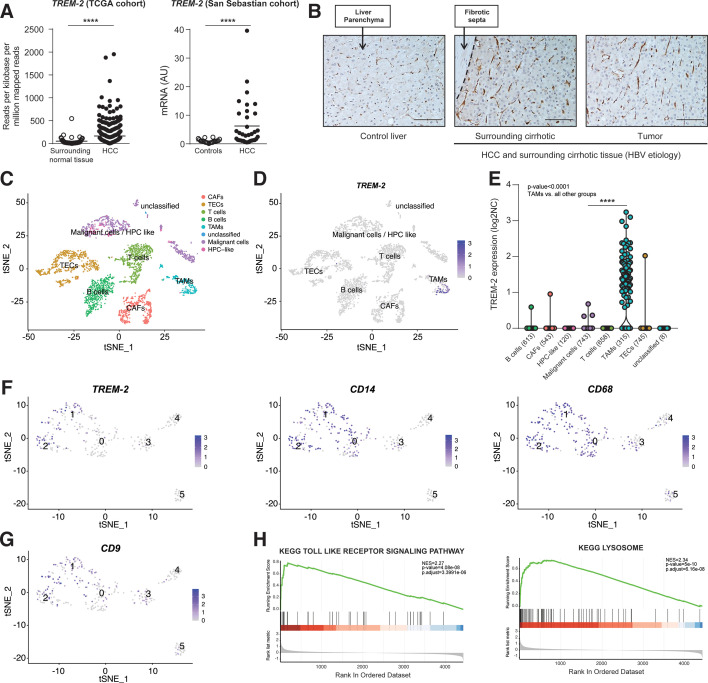
Hepatocellular carcinoma (HCC) is a prevalent and aggressive cancer usually arising on a background of chronic liver injury involving inflammatory and hepatic regenerative processes. The triggering receptor expressed on myeloid cells 2 (TREM-2) is predominantly expressed in hepatic non-parenchymal cells and inhibits Toll-like receptor signalling, protecting the liver from various hepatotoxic injuries, yet its role in liver cancer is poorly defined. Here, we investigated the impact of TREM-2 on liver regeneration and hepatocarcinogenesis.
TREM-2 expression was analysed in liver tissues of two independent cohorts of patients with HCC and compared with control liver samples. Experimental HCC and liver regeneration models in wild type and mice, and studies with hepatic stellate cells (HSCs) and HCC spheroids were conducted.
expression was upregulated in human HCC tissue, in mouse models of liver regeneration and HCC. mice developed more liver tumours irrespective of size after diethylnitrosamine (DEN) administration, displayed exacerbated liver damage, inflammation, oxidative stress and hepatocyte proliferation. Administering an antioxidant diet blocked DEN-induced hepatocarcinogenesis in both genotypes. Similarly, animals developed more and larger tumours in fibrosis-associated HCC models. livers showed increased hepatocyte proliferation and inflammation after partial hepatectomy. Conditioned media from human HSCs overexpressing TREM-2 inhibited human HCC spheroid growth through attenuated Wnt ligand secretion.
TREM-2 plays a protective role in hepatocarcinogenesis via different pleiotropic effects, suggesting that TREM-2 agonism should be investigated as it might beneficially impact HCC pathogenesis in a multifactorial manner.
肝细胞癌(HCC)是一种常见且侵袭性强的癌症,通常发生在慢性肝损伤的背景下,涉及炎症和肝再生过程。髓系细胞表达的触发受体 2(TREM-2)主要在肝非实质细胞中表达,抑制 Toll 样受体信号,保护肝脏免受各种肝毒性损伤,但它在肝癌中的作用尚未明确。在这里,我们研究了 TREM-2 对肝再生和肝癌发生的影响。
分析了来自两个独立 HCC 患者队列的肝组织中 TREM-2 的表达,并与对照肝样本进行了比较。在野生型和 小鼠中进行了实验性 HCC 和肝再生模型以及肝星状细胞(HSCs)和 HCC 球体的 研究。
TREM-2 在人 HCC 组织、小鼠肝再生和 HCC 模型中均上调。在二乙基亚硝胺(DEN)给药后, 小鼠无论肿瘤大小均形成更多的肝肿瘤,表现出更严重的肝损伤、炎症、氧化应激和肝细胞增殖。给予抗氧化饮食可阻断两种基因型的 DEN 诱导的肝癌发生。同样,在纤维化相关 HCC 模型中, 动物形成更多和更大的肿瘤。部分肝切除后, 肝脏的肝细胞增殖和炎症增加。过表达 TREM-2 的人 HSCs 的条件培养基通过减弱 Wnt 配体分泌来抑制人 HCC 球体的生长。
TREM-2 通过不同的多效性作用在肝癌发生中发挥保护作用,这表明 TREM-2 激动剂应作为一种有益的方式进行研究,因为它可能以多因素的方式影响 HCC 的发病机制。